We had a free morning today, so decided to head to the Yanaka area, a few stops north from our hotel. According to Audley, it has “an artsy ambience, with lots of craft stores, coffee shops and the odd friendly cat”.
We negotiated the railways successfully and struck out for Yanaka Ginza, a “shopping street” with a very different feel to the main areas of Tokyo. Some of the shops were no bigger than the average living room, and you could get all sorts of weird and wonderful things. There was a delicious smelling organic bakery, which would have been a great place to stop if we hadn’t just had breakfast.
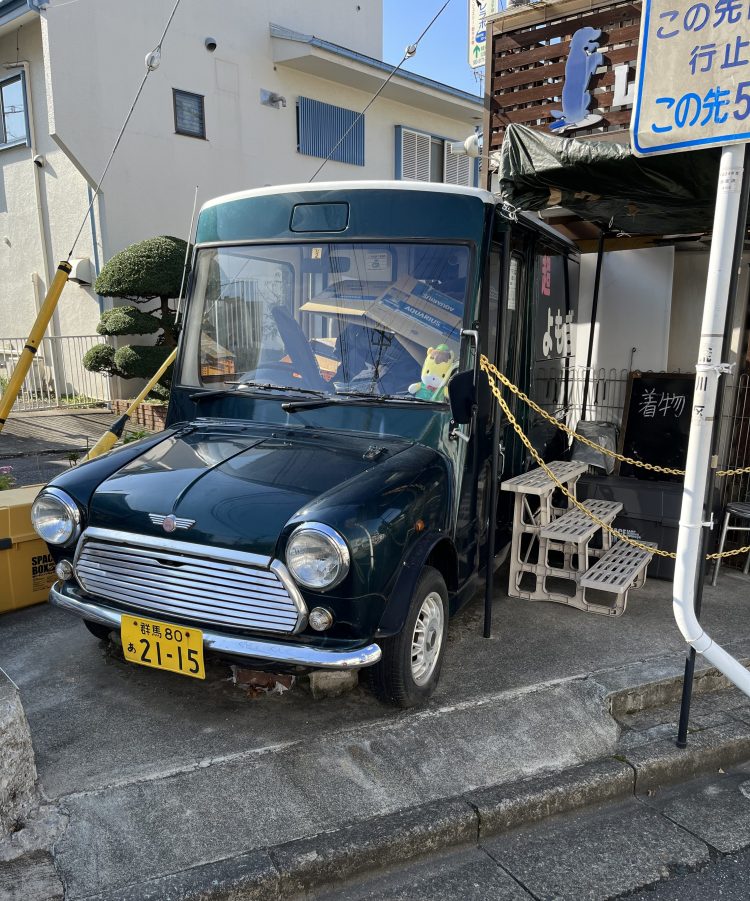
As we walked down the street, I felt it looked a bit like an oriental Petticoat Lane. At the end, we turned the corner and there was a shop called Petticoat Lane! No idea what it sold, it was closed.
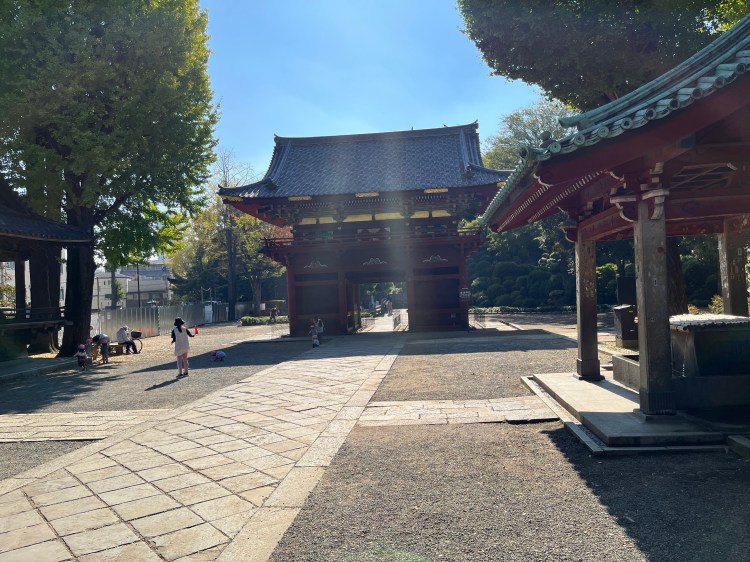
From there we walked on to the Neju Jinja shrine, one of the oldest in Japan. It was a bit like a commuter’s place of worship really; people would turn up, say a quick prayer and then continue their journey. It was a lovely day, the sun was shining brightly and there was a bunch of tiny children playing wherever you tried to get a photo!
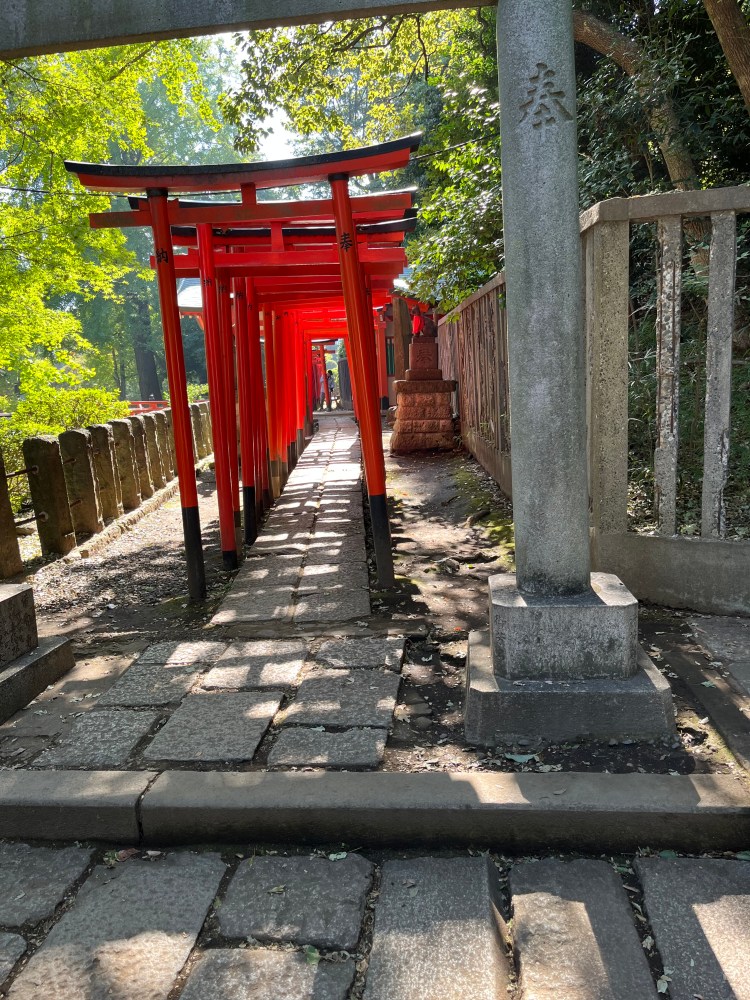
As well as the main shrine, there was also a series of tiny Torii gates meandering around the area.
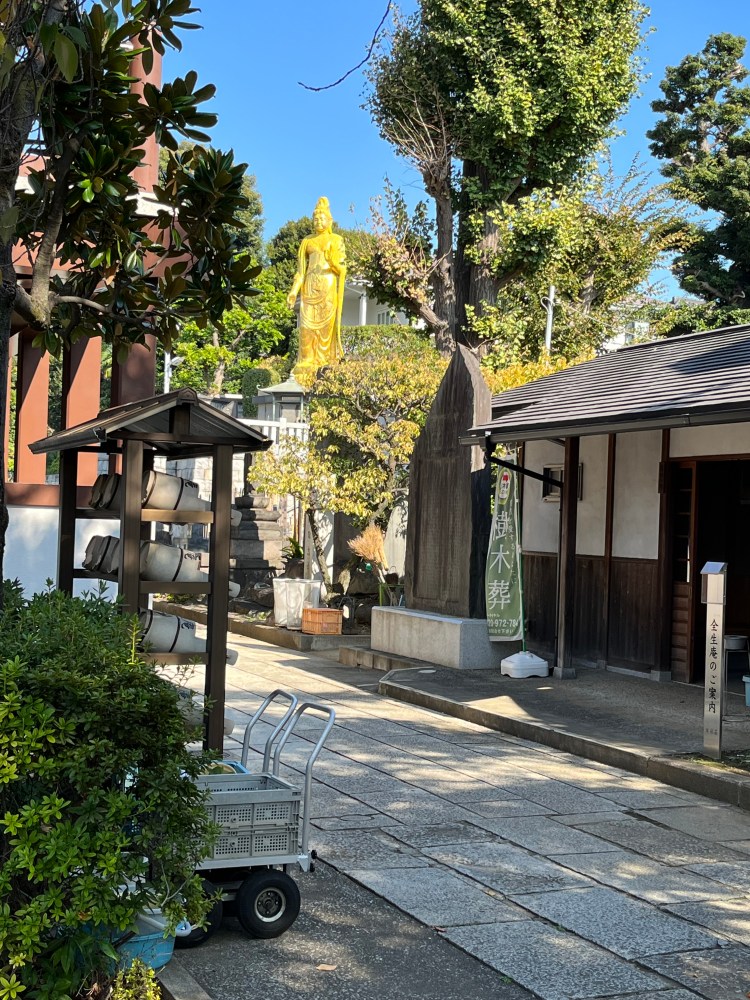
From there we headed off to Yanaka cemetery. On the way we just happened to stumble upon the Zensho-an temple. I can’t find out anything about it, but it does have a huge golden Buddha guarding its cemetery.
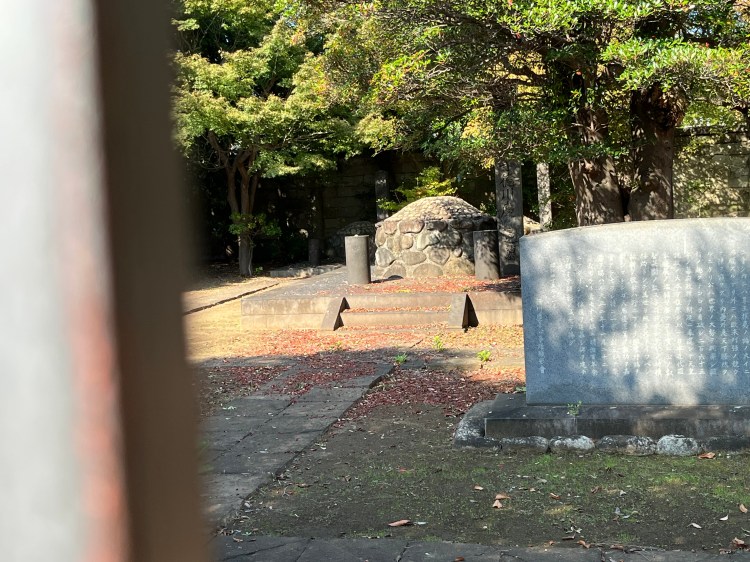
After a coffee stop, we finally arrived at Yanaka cemetery. It seems a bit like Highgate cemetery, full of celebrities, most of whom you’d have to be Japanese to know about. We did manage to locate the tomb of Tokugawa Yoshinobu, the last Shogun before Imperial rule was restored.
We then headed back to the station and were fortunate to get there just as a train arrived. It turned out to be an express train and we couldn’t work out where it was going, so we got off at the next station to change onto the orange metro line. Which worked out quite well, because between the barriers we found a nice little restaurant and had a rice bowl instead of noodles for a change.
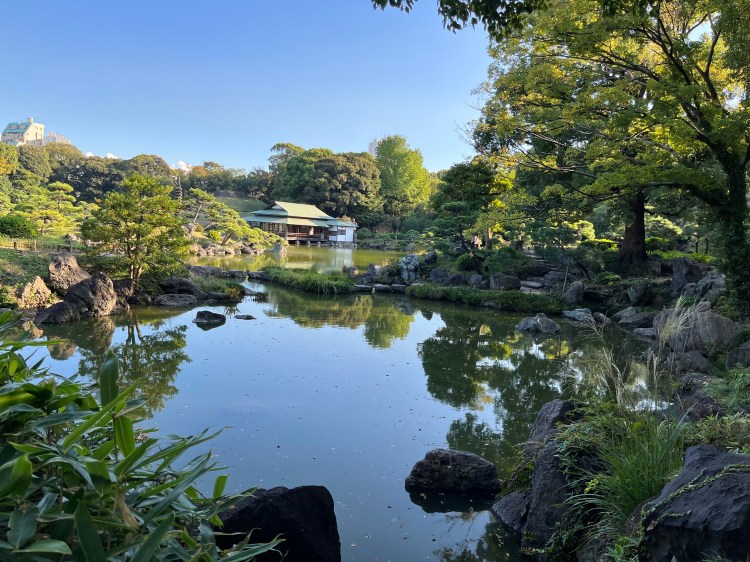
Back at the hotel, we met up with Tomie, our guide for the afternoon’s tour. We started off at Kiyosumi Gardens, originally created by Iwasaki Yatara, founder of Mitsubishi. He had a penchant for rocks, and brought them in from all over Japan. Apart from that, there’s a man-made lake with an island in the middle and walkways all around the garden. As ever, there are koi carp living in the lake, but this one also has turtles, heron and egrets.
Back on the metro, we then went off to visit the Tomioka Hachiman shrine, birthplace of Sumo wrestling. The shrine itself looks much like any other shrine, but on one side there’s a series of stone blocks inscribed with the name of every top-ranking sumo until the 73rd.
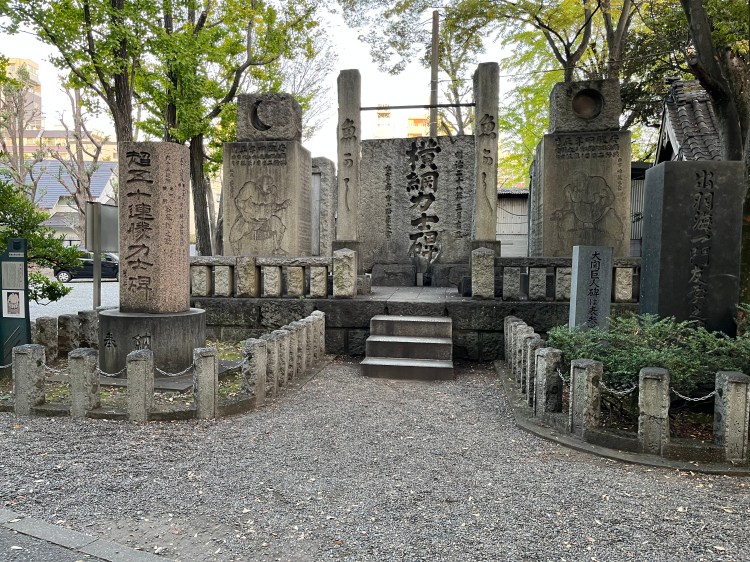
There’s also a statue of Ino Tadataka, who completed the first map of Japan using scientific methods. He walked the coastline counting the number of steps he took.

We were very lucky to be in the area on one of the days that the Goma fire ritual takes place in the Fukagawa Fudo-do temple next door to the shrine. The main deity of the temple is Fudo Myo, who drives away evil spirits. His statues are always very fierce, with fangs and weapons for doing his job.
Attached to the traditional prayer hall is a new hall in an incredibly modern design.
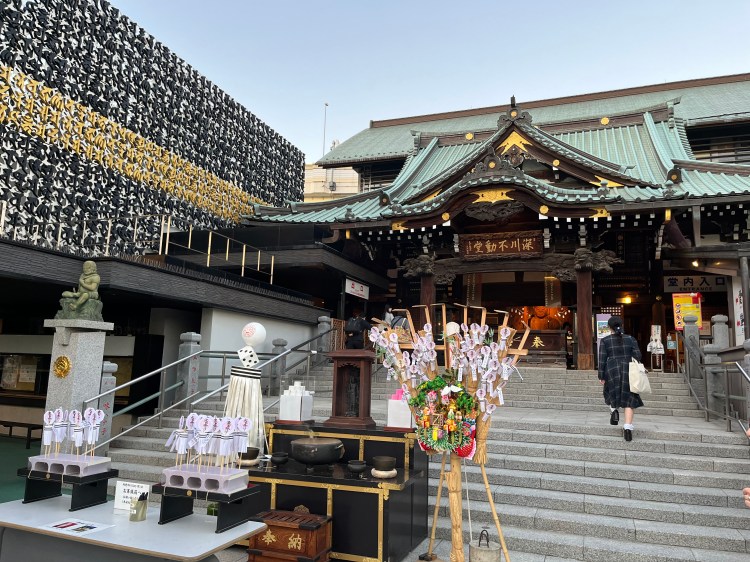
Unfortunately, cameras aren’t allowed inside. You enter through the old building and move into the new one, with rows of seating, a low stage with an altar and statues of Fudo Myo at the back. The statues and other decorations around him are all black, and his eyes are lit from behind. Gold lanterns hang in front of the statues.
On the stage there are two huge drums and two bigger drums, all hung horizontally. At the start of the ritual, ten monks in very rich coloured robes enter, some of them playing conch shells, and they sit down with their backs to the worshippers. The head monk sits at the altar, the others in a line behind.
Somehow, a fire is lit in the altar and the monks start chanting. The fire is fed with firewood on which people’s wishes or prayers are written, until the flames are literally shooting out of the altar. At various points, two pairs of monks take turns at drumming, and someone I couldn’t see is beating out a tune. At the end of the chanting, worshippers move to the front and each one hands off a personal item to the monks, a child’s toy, a handbag, and so on. The monk takes the item, puts it close to the flame and then gives it back. Our guide wasn’t very clear on the reason for this, but it seems to be some kind of purification or blessing.
It’s difficult to describe this in words, but it is a spectacular ritual and very moving; we felt privileged to be part of it.
 Steve and Diane on Tour