I’ve eaten street food all around the world with no problems but one of the world’s most luxurious brands puts me out of action for three days!
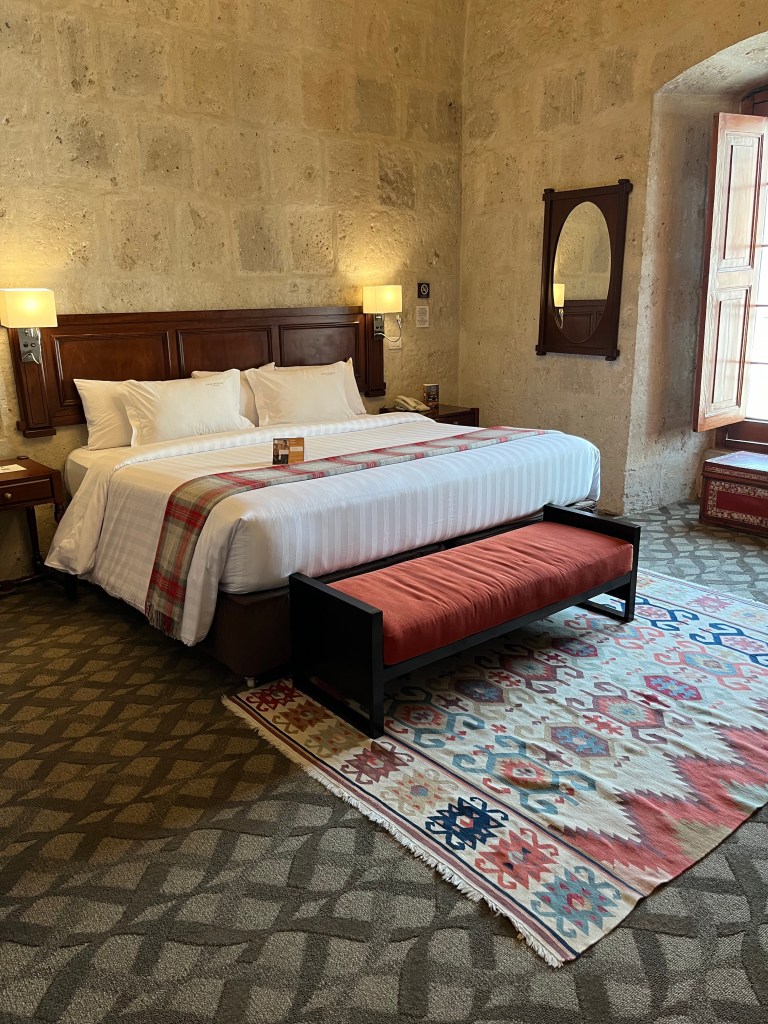
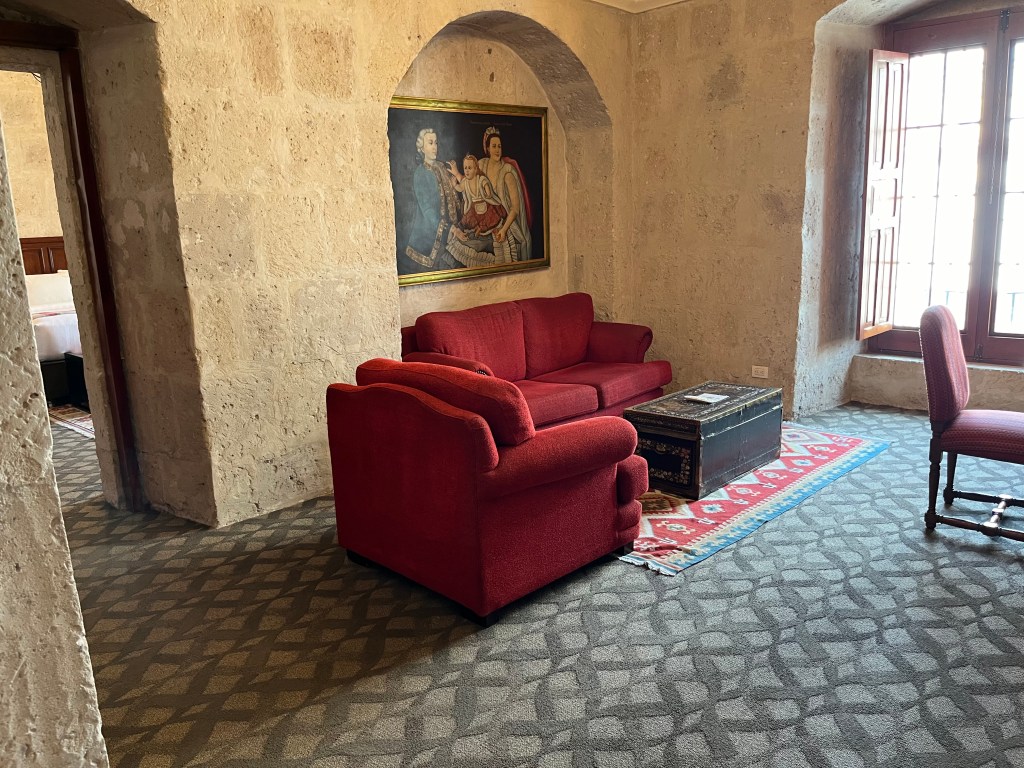
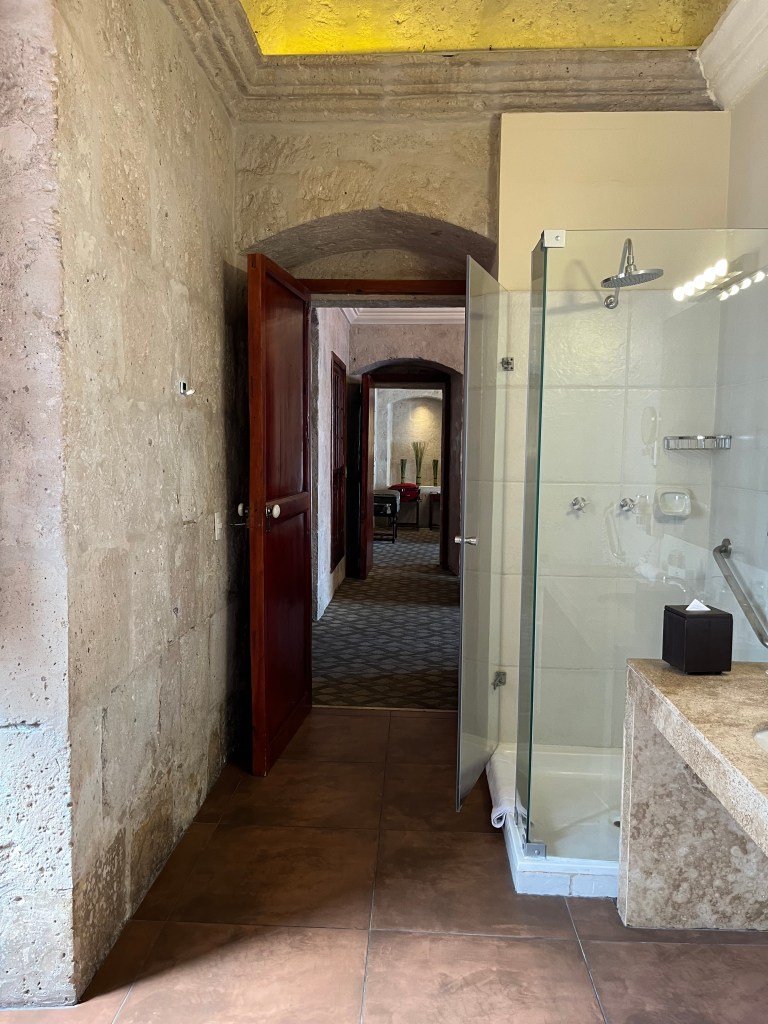
But if we had to stay put, this isn’t a bad place to do it. When the hotel moved us to our proper room, it turned out to be a huge suite with vaulted ceilings and stone walls hung with paintings. We’ve almost resorted to communicating via WhatsApp if we’re at opposite ends of the room!
BedroomLiving roomThe full length
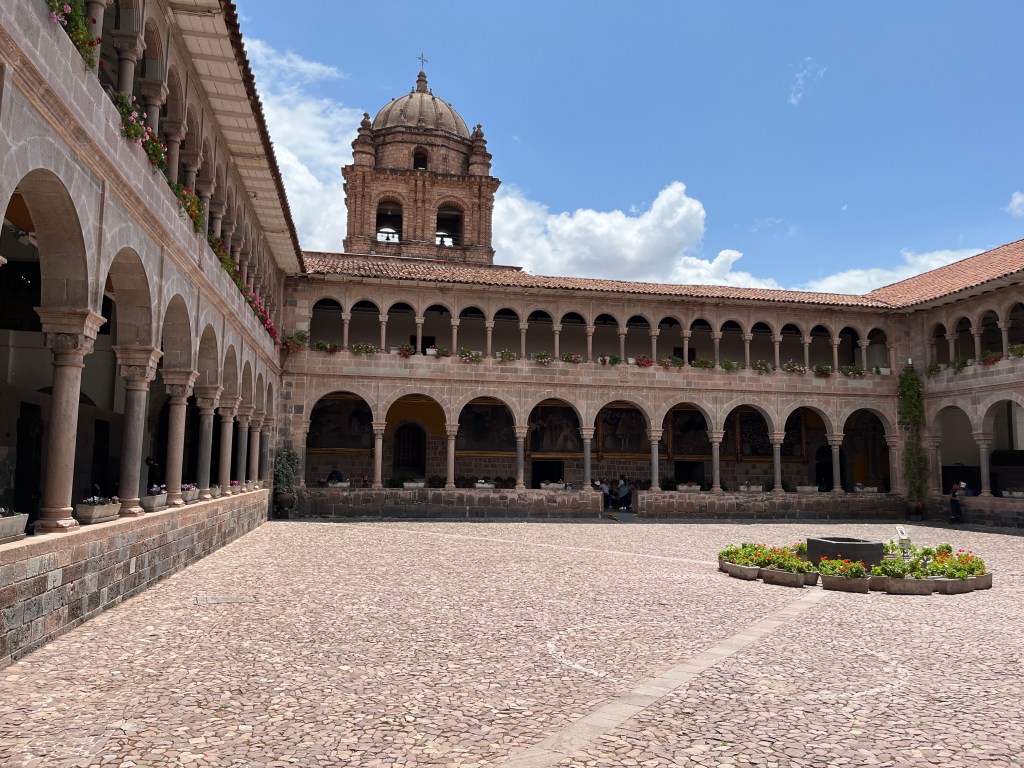
The hotel is an old colonial building, once a mint, that lay neglected for 100 years. After removing five or six layers of paint, they discovered colourful frescoes underneath.
Fresco in the restaurant
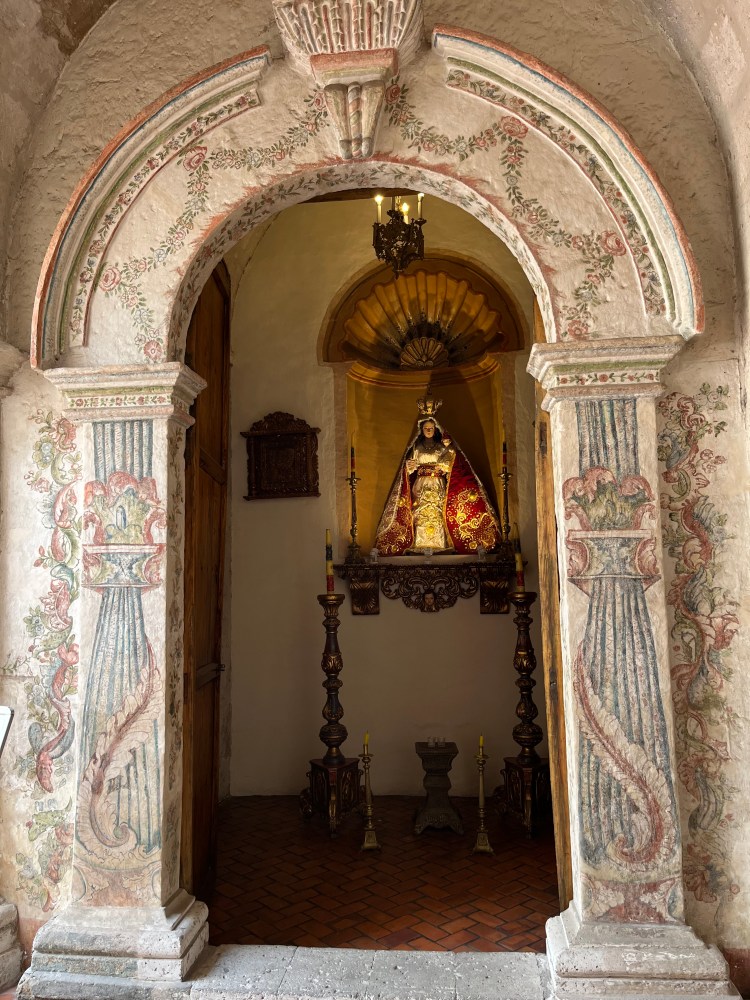
It even has its own chapel.
The restored chapel
As well as missing out on Lake Titicaca, we also had to cut out Colca Canyon and Condors Cross from our itinerary. This means an extra night here, but we’ve got to go back to our first room again!
We woke up on day 10 to find that it was pouring with rain!
It was a late start today, Joan and Juan Carlos were due at 10am. And there they were, right on time. Except they loaded someone else’s luggage into the car instead of ours! After a quick change, they whisked us off to the Belmond Monasterio Hotel, about 10 minutes away by car or 5 minutes on foot! It was the start of our Peruvian Highlands adventure on the Belmond Andean Explorer.
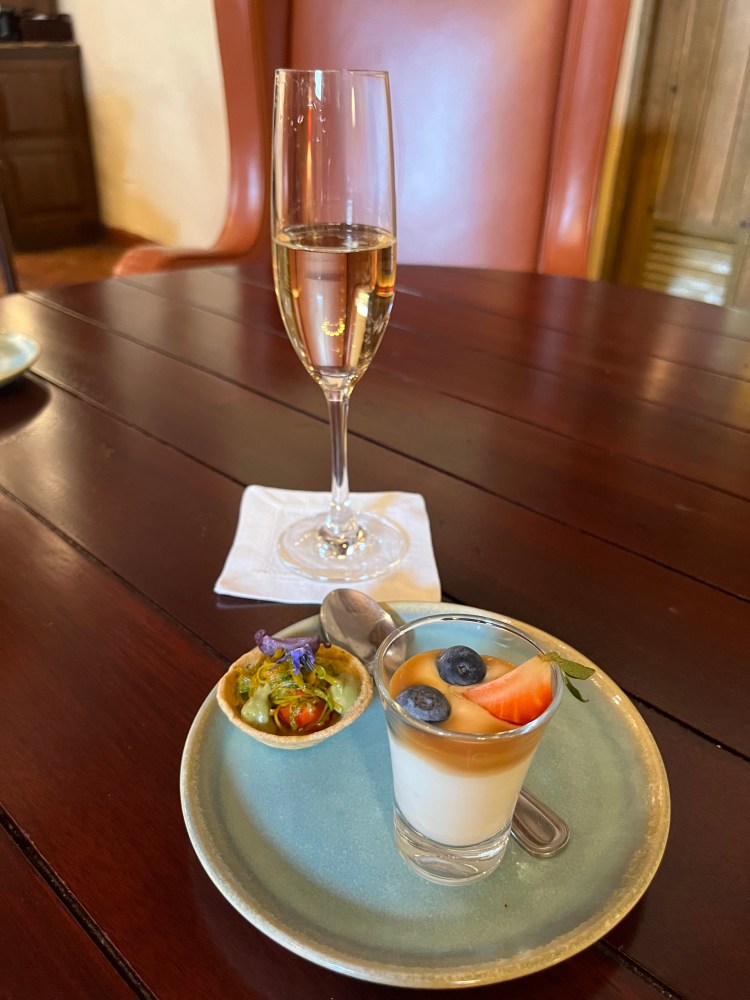
Just like an airline, they checked us onto the train and then checked our bags. Not like an airline, we were then seated in a majestic lounge with a violinist with a repertoire of Beatles, Leonard Cohen and other standards. The champagne was French and the snacks delicious.
Snacks while waiting
After fifteen minutes, we were joined by the couple whose baggage we almost stole! Then it was time to board our cars for another 10 minute ride to Wanchaq station where our train was waiting.
We were shown to the piano bar and introduced to the three most important people on the train, the nurse, the barman and the spa manager! We learned that the train is pulled by two locomotives, has 19 carriages and is carrying 38 passengers. We also ran through the schedule for the trip.
Next, Willington showed us to our cabin, which is small but perfectly formed. It’s a bit like being in a motorhome except that the bathroom is bigger and there’s no steering wheel.
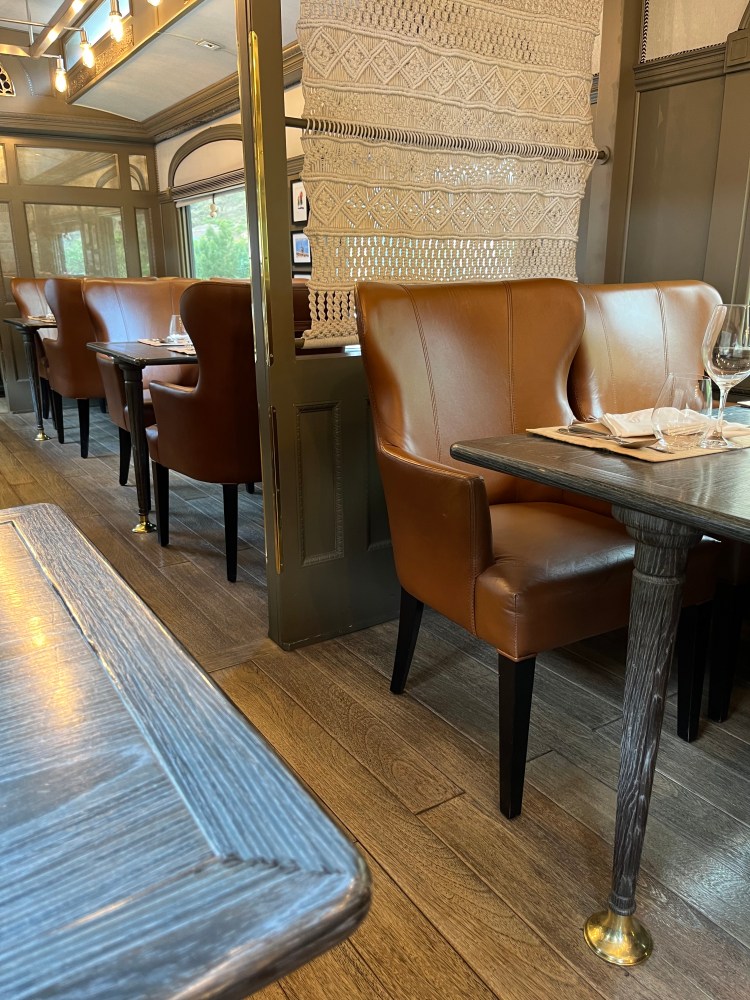
By this time it was time for lunch. We could have opted for the observation car at the back or the piano bar in the middle, but we chose to enjoy our four course lunch in the restaurant car. It was perfectly timed to finish as we arrived at our first stop. Except that we were held up for 30 minutes by another train!
Restaurant car
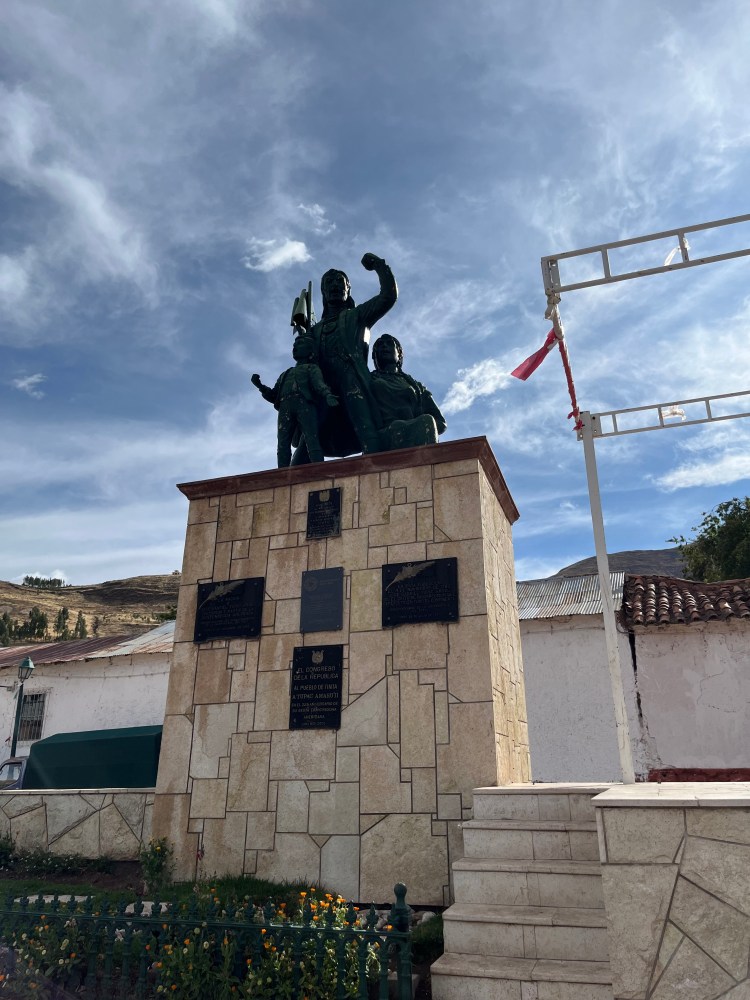
We stopped at a town called Tinta. Diane duly boarded the bus to go and visit the Inca ruins at Raqchi, but I decided to take a walk in the town instead. A few minutes walk took me to the town square, where a sign informed me that Tinta was the cradle of the Latin American revolution. It was surrounded by statues and monuments to prove this.
(I later found out from one of the train managers that Túpac Amaru started the revolution, and he was born in Tinta. He was also step brother to the last two Inca rulers.)
Something to do with the revolution
There was a market going on in the square and a couple of the streets off, plus an indoor market further on. It was mostly local farmers selling their wares, but there were also textiles, juices, toys and hot food that I couldn’t recognise. No souvenirs. Clearly, they don’t get non-conformist tourists here!
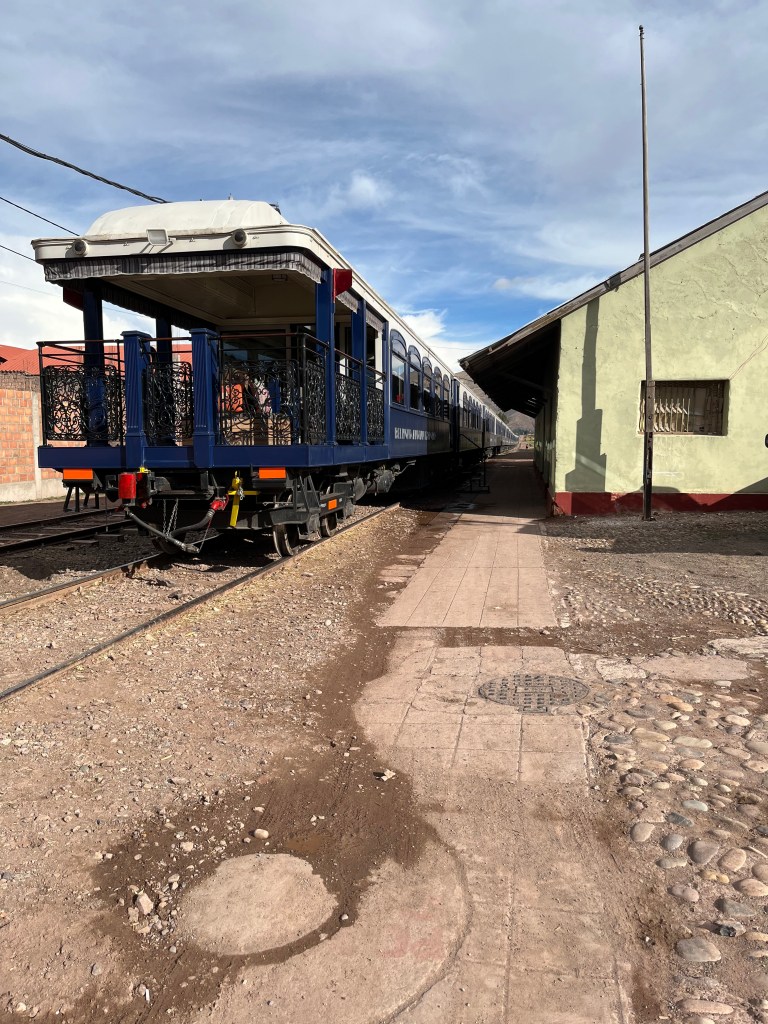
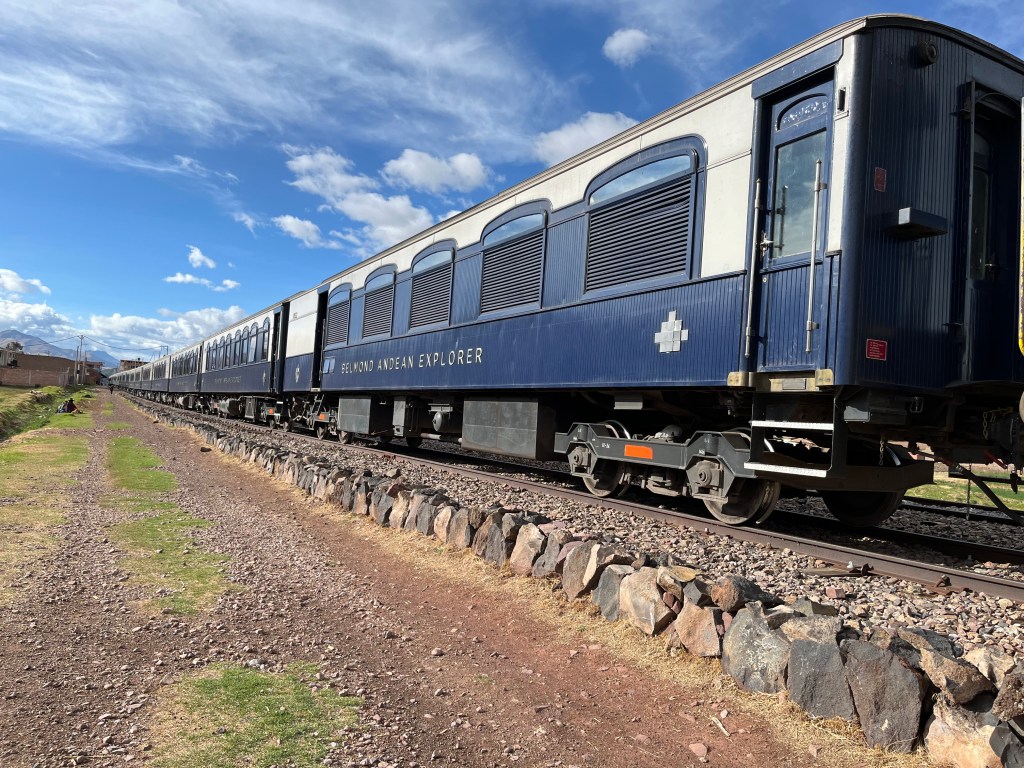
I came back down to the train, so walked the length of it to get a photo before getting back on board.
The observation carOur train
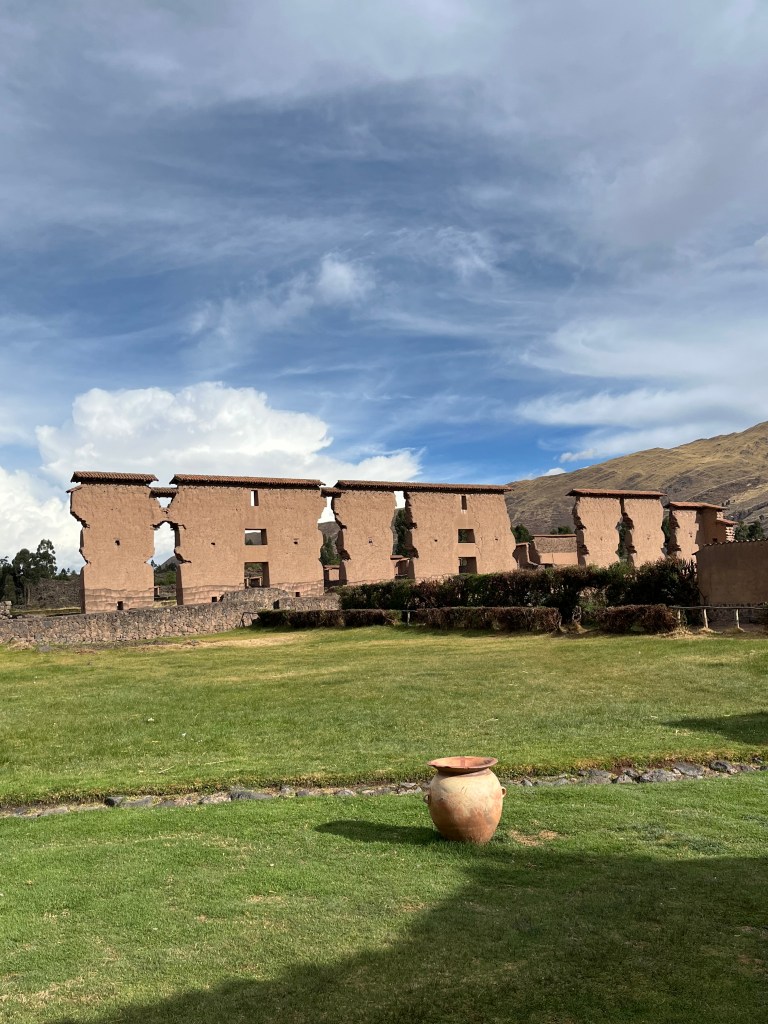
In the meantime, Diane had visited Raqchi, a pre-Inca ruin. Rather than granite, they used lava stone from the local volcano to build the town. There are three sections; an agricultural area where the Incas built an artificial lagoon to conserve water, a living area and the temple area. Like Machu Picchu, it had an avenue that aligned with the sun at the solstice.
Back on the train it was time for afternoon tea. In this case, the tea was a Peruvian berry tea, which was delicious. We were also given nuts, a cucumber flavoured savoury drink and some kind of sorbet with more nuts. When the waiter came round with the cocktail menu we declined and went back to our cabin.
We were supposed to stop at La Raya, the highest point of our journey, to see the sunset. Due to the delay, it was dark when we got there!
And that’s not all that didn’t go according to plan. We went back to have dinner and I started feeling unwell. Not to put too fine a point to it, I didn’t know which end the dinner was going to come out of first. In the end, I called the nurse and she gave me an injection for the nausea. Which made my left hand numb. I was no better this morning, so we decided to cut and run to our next destination, Arequipa.
It’s a shame because we’re not going to see Titicaca, one of the highlights of our tour. But I couldn’t face a day on the lake feeling like I was.
The local travel company were brilliant, they had a car outside at 7:30am and organised an extra day at our next hotel. We’re going to have to switch rooms tomorrow because they only had a lower grade room for today, but that’s not a problem.
They also arranged for a doctor (with glamorous assistant) to come and check me out. He doesn’t think it’s altitude sickness, more likely an infection from the lettuce they served at dinner as I’ve also got a fever. He’s given me so many pills that I’m going to rattle tomorrow!
So, no pics tomorrow because tomorrow is for chilling.
Elias had told us that Peruvians will use any excuse for a party. Eating breakfast in the hotel restaurant while watching the activity on the platform, we could believe that.
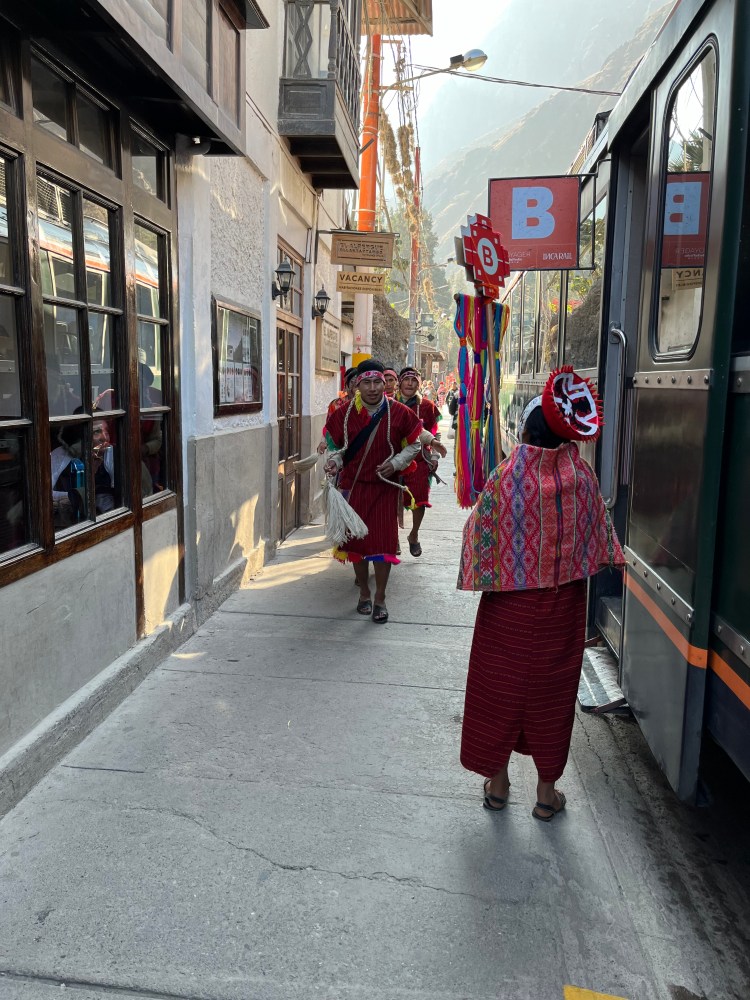
Whenever a train towards Machu Picchu was due, women in local dress would lead the passengers skipping and dancing onto the platform holding a banner with the carriage number. Once there was a bit of space on the platform a group of Peruvian morris dancers would then dance up and down the platform to the sounds of drums and pan pipes. They became a little less enthusiastic if the train was delayed! On one train, there was even a guy hanging out of the observation car playing pan pipes as the train left.
Peruvian Morris Dancers
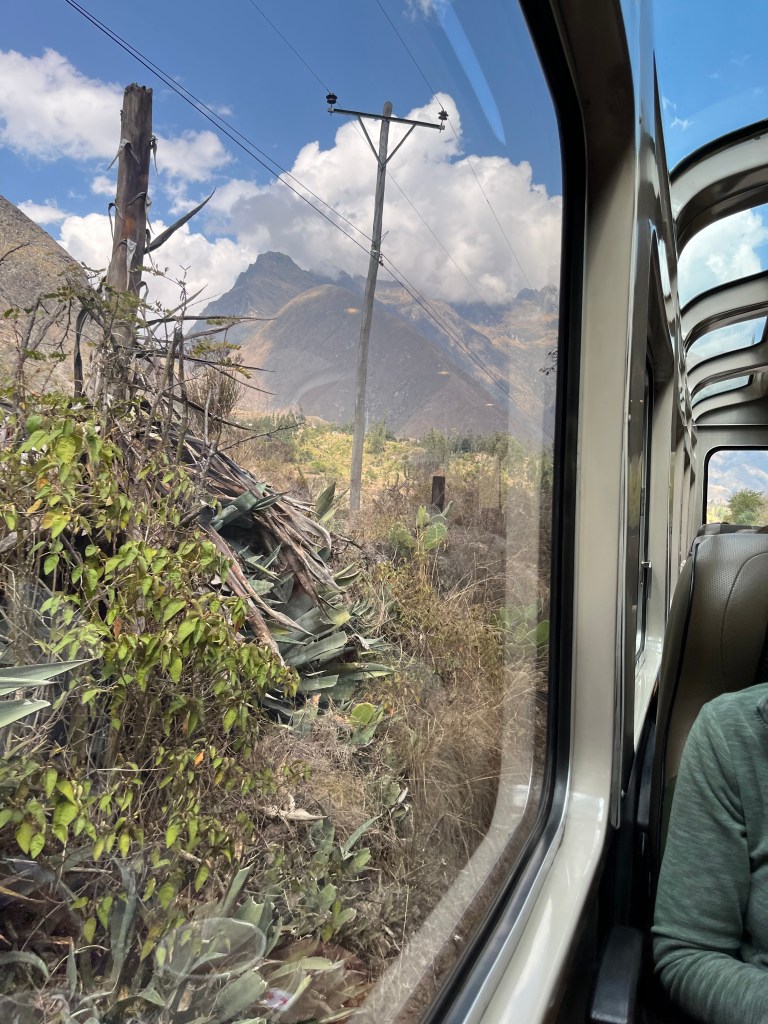
We were booked on the Vistadome train, which has glass panels in the roof so you can see how small you are compared to the mountains around you. It was half an hour late, but that didn’t matter because there was lots of music and two masked dancers cavorting behind us.
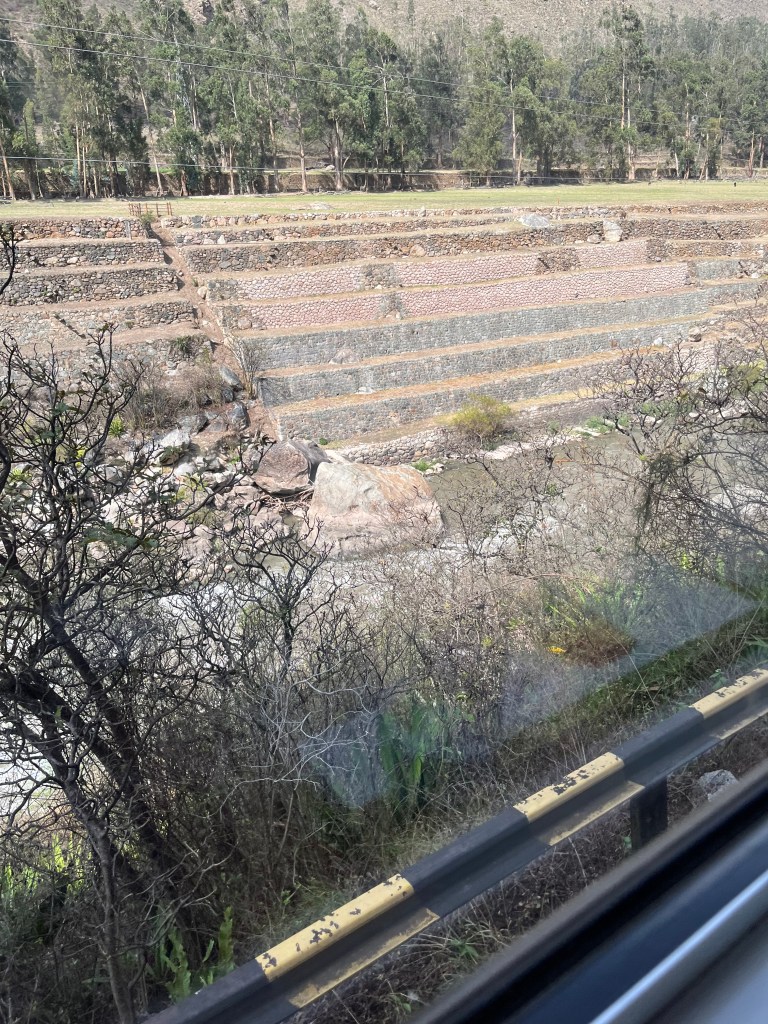
That’s where we’re goingTerraces on our route
As we continued down the line, the mountains closed in until there were granite cliffs to our right and a fast flowing river to our left. Which is when I realised that we were going down; I’d thought that we’d be going up towards Machu Picchu, but that wasn’t the case. At least, not in the train.
Eventually, we arrived at Aguas Calientes, or hot waters, which wasn’t the sleepy little village, we’d been expecting. Leaving the station we had to run the gamut of a huge, indoor, souvenir market!
We then had to scramble for the shuttle bus that takes you up to Machu Picchu itself. The journey takes 25 minutes along a narrow dirt road that zigzags up the side of the mountain. Every now and then we’d see people hiking it. I almost felt like joining them!
Eventually we got to the top and the bus turned round before letting us off. By doing a five-point turn between the cliff face and the queues of people going in. Which we duly joined. We already had our entry tickets; there are two circuits and we were assigned to circuit 2.
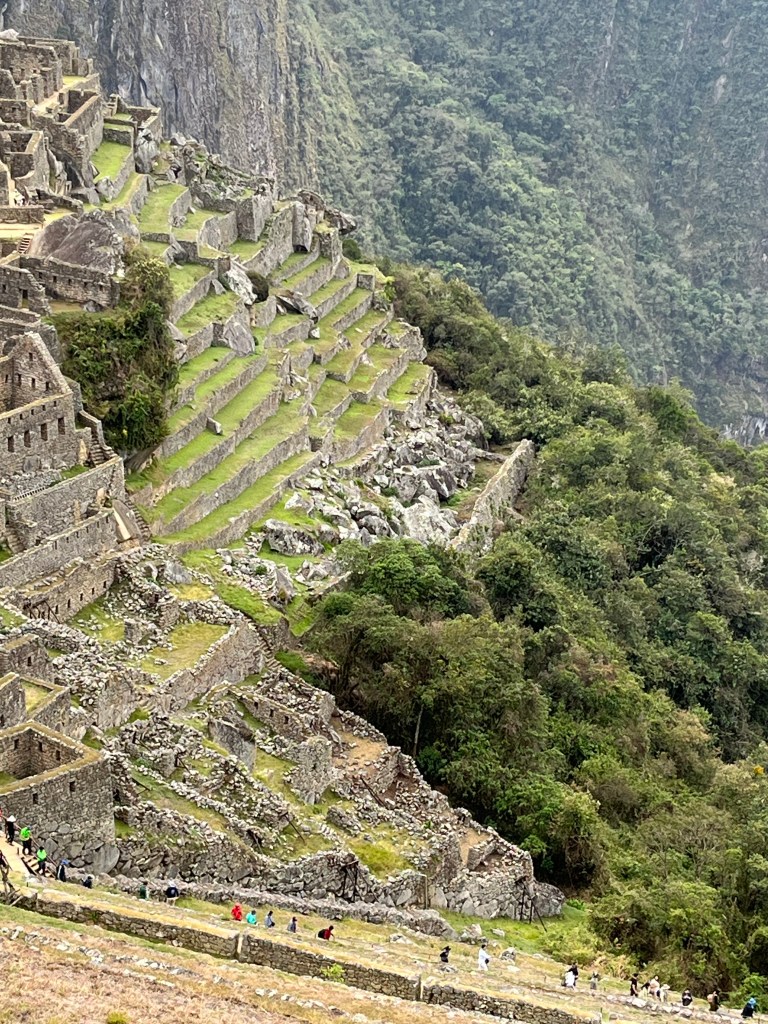
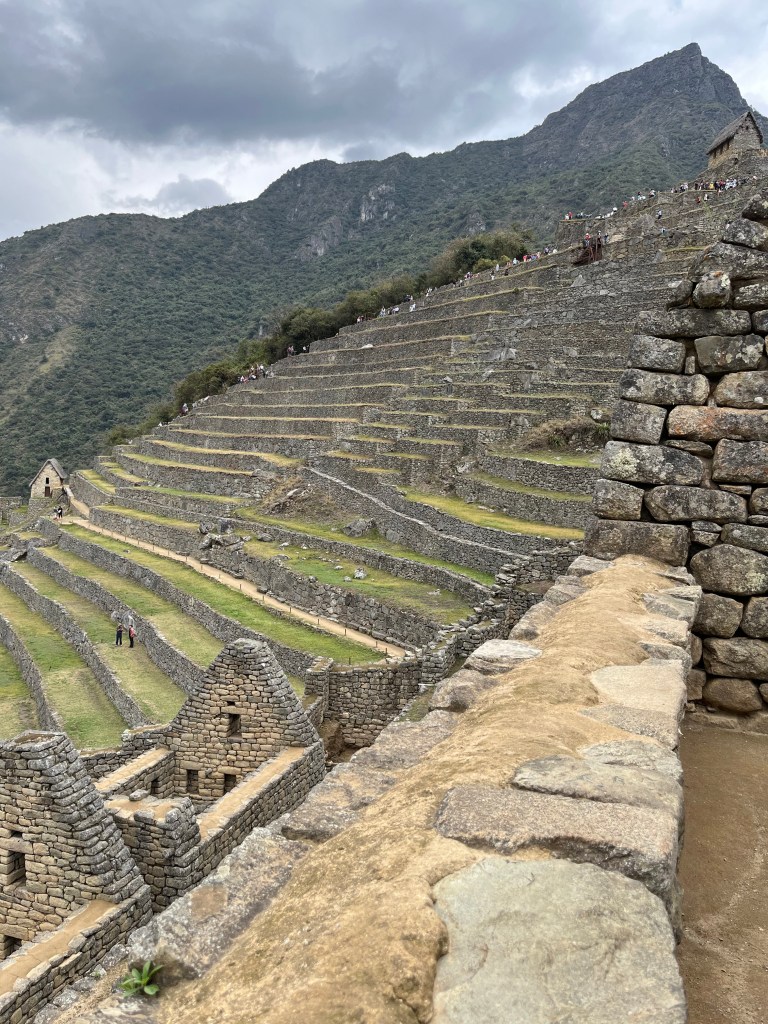
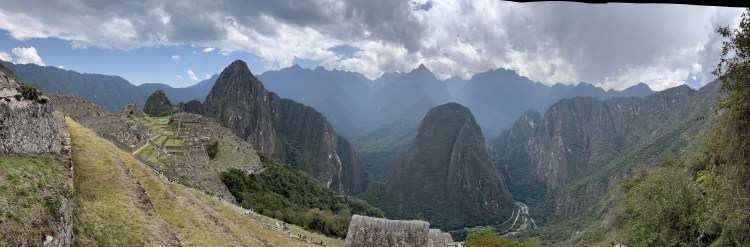
In we went and we finally got to see Machu Picchu in all its glory. Elias told us all sorts of things about it, but the gist of it is that:
· It predates the Incas
· The Spanish never found the place, possibly because the locals destroyed the trails
· It was “rediscovered” by Hiram Bingham around 1911
· There’s a lot more underground than above, but they are unlikely to uncover it
· Only one gold artefact has ever been found
· They uncovered a lot of ceramic and seashell artefacts
· Most of the names ascribed to the site have proved to be wrong
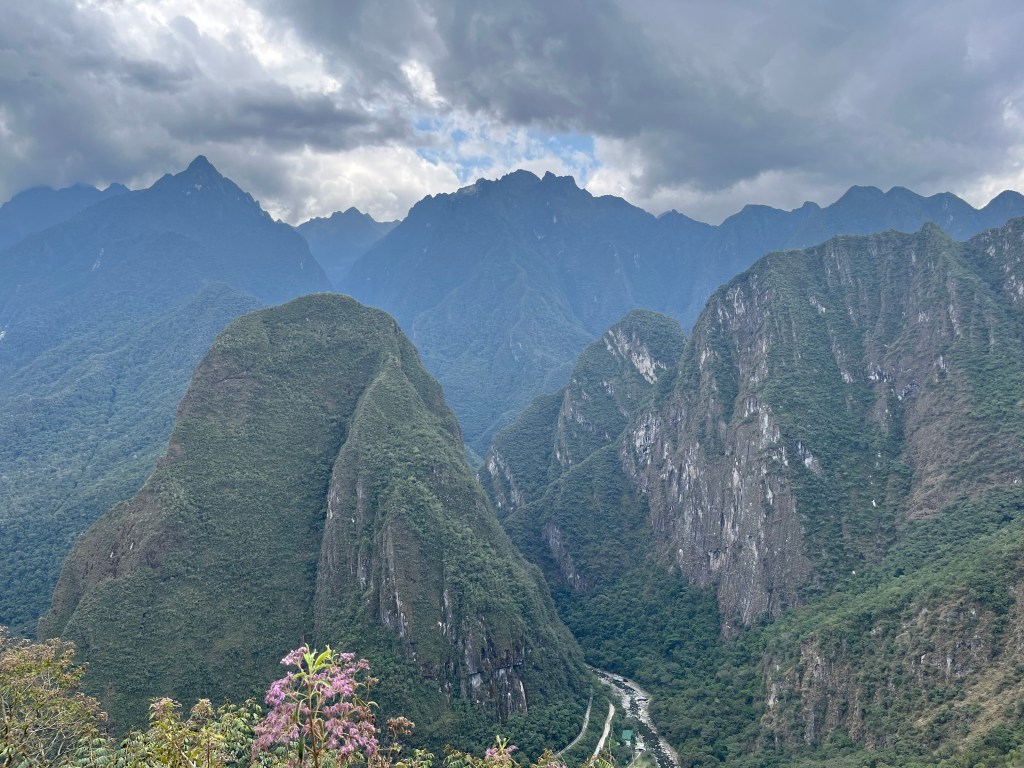
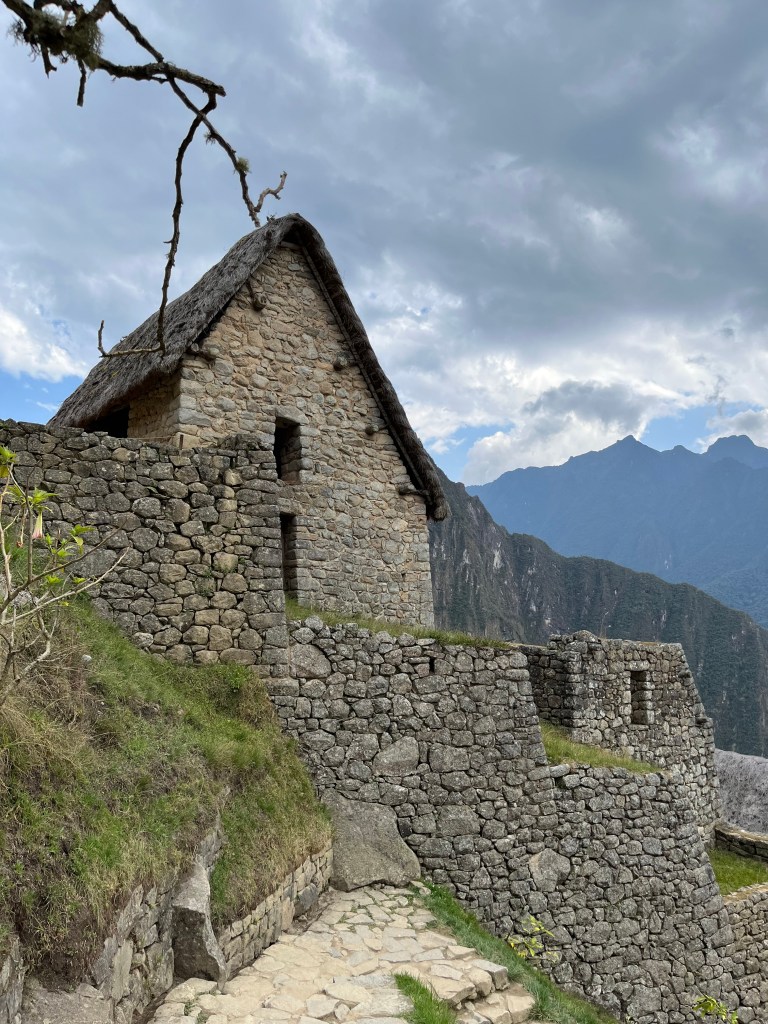
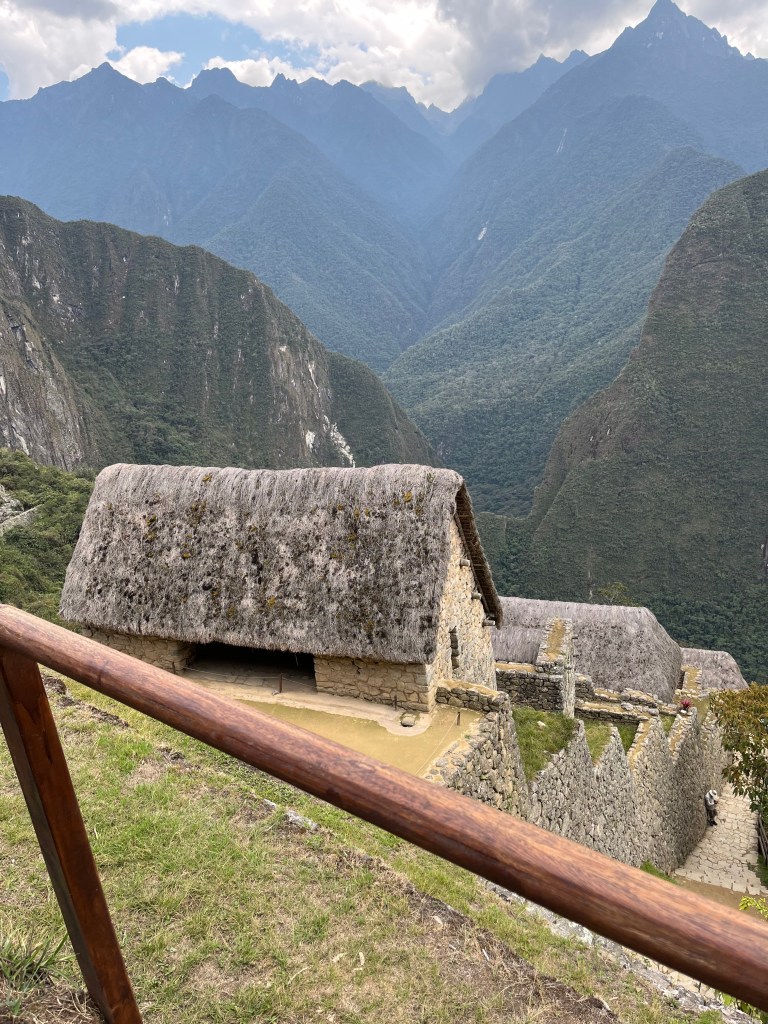
Anyway, here’s a bunch of photos, not that any of them can do justice to the place.
The other directionA restored buildingTowards the Temple of the SunMore terracesPanorama A Viscacha ignoring us
Shortly after we arrived it rained; we’d been warned to bring appropriate clothing, and it didn’t last long, so no problem. However, as we were nearing the end of our tour (or our ability to take any more in) it started raining again and this time it didn’t stop. We decided to return to Aguas Calientes, which meant joining a huge queue of people with the same idea. And if you think that heading up was scary, heading down on a wet dirt road is even scarier!
We had reservations for the train, so there was plenty of time to grab a bite to eat before boarding. There were only 2 coaches in the morning and we were in coach A at the front. The train going back was 7 coaches and we were in A again. We thought it would be at the back this time, but no, we had to walk all the way to the front.
This was a livelier ride, with “traditional” Peruvian entertainment in the buffet car at the front, first for carriage B, then for us. After that the staff put on a Peruvian “fashion show”, accompanied by rapturous applause from the Americans on board; surprisingly, they also bought some items. We checked out a couple of items and they were three times the price you’d pay in the market.
We eventually got back to Ollantaytambo after a very tiring day, had a bite to eat and went to bed, hence this post being a day late.
The following morning, we checked out, found Alan, our new driver, and headed up to the ruins of Ollantaytambo. While not as extensive as Machu Picchu, they are equally spectacular, Again, they predated the Incas who just took them over and improved them.
And now we’re back in Cusco for the night. Tomorrow we’re setting off on a very special trip.
We went down to check out this morning and found Joan and Elias both waiting for us. Quite impressive at 7:30 on a Monday morning! Juan Carlos turned up shortly afterwards, we piled in, said goodbye to Joan and hit the Monday morning rush hour.
It always feels like you’re going round in circles when you drive in Cuzco, and today was no exception. We eventually circled up above the town and kept climbing. The views were magnificent, with the occasional glacier and mountain lake.
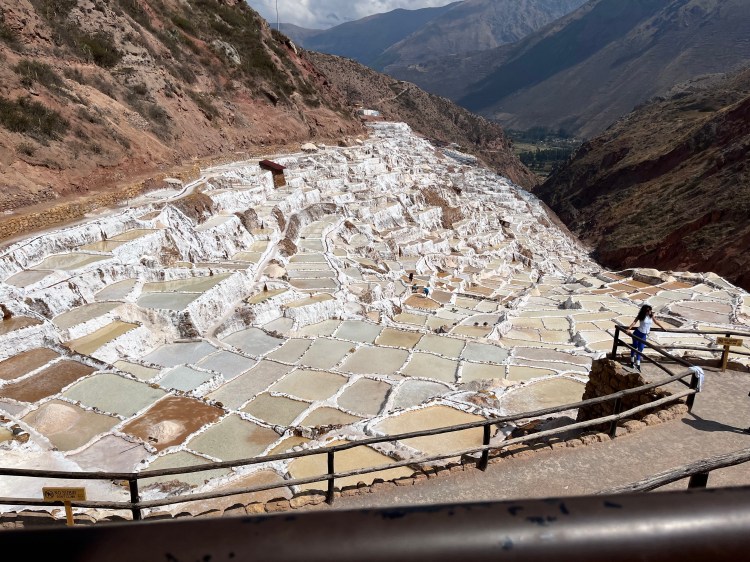
Eventually, we turned onto a gravel road and, after a lot of bouncing around, arrived at the entrance to Salineras de Maras, or the Maras salt pans. You’d think that having paid to go in the road would be better, but it became worse. We wound our way downwards through a series of hairpin bends on a narrow dirt road. With the odd bus coming the other way!
As you descend, the salt pans suddenly appear down below, stark white against the countryside. When you get close up, you can see that they are a patchwork of squarish pans, separated by stone retaining walls, ranging in colour from pure white to reddish brown.
Maras salt pans
These pans are fed by a stream of salt-rich water. The workers let water into a pan until it is 5cm deep, then block it off again. The sun evaporates the water, leaving behind the salt, which is white, pink or black, depending on the quality. The salt is raked around until it is dried and then bagged and taken away. There are three “harvests” a year, which alternate with the workers’ agricultural activities.
Overall ownership of the area is with the local council, but local families have owned their sections for generations. The salt is sold to a cooperative, which also happens to be owned by the same local families!
By this time, the place was getting busy, so we retraced our path up to the main road and moved on to Moray, notable for its circular terraces. It was via a fairly short and winding gravel road, but in this case upwards.
The Spanish named Moray Temple of Mother Earth because it looks like it might have been a temple at one time. However, according to Elias, it was more likely to have been another example of Incan agricultural experiments. The temperature from the bottom to the top varies by 1 degree, and there are also storage huts that were likely used to adapt varieties of crops to different climates.
Circular terraces at Moray
We didn’t take the winding road away from Moray. We took one going in the opposite direction, right down to the valley floor. It took 30 minutes!
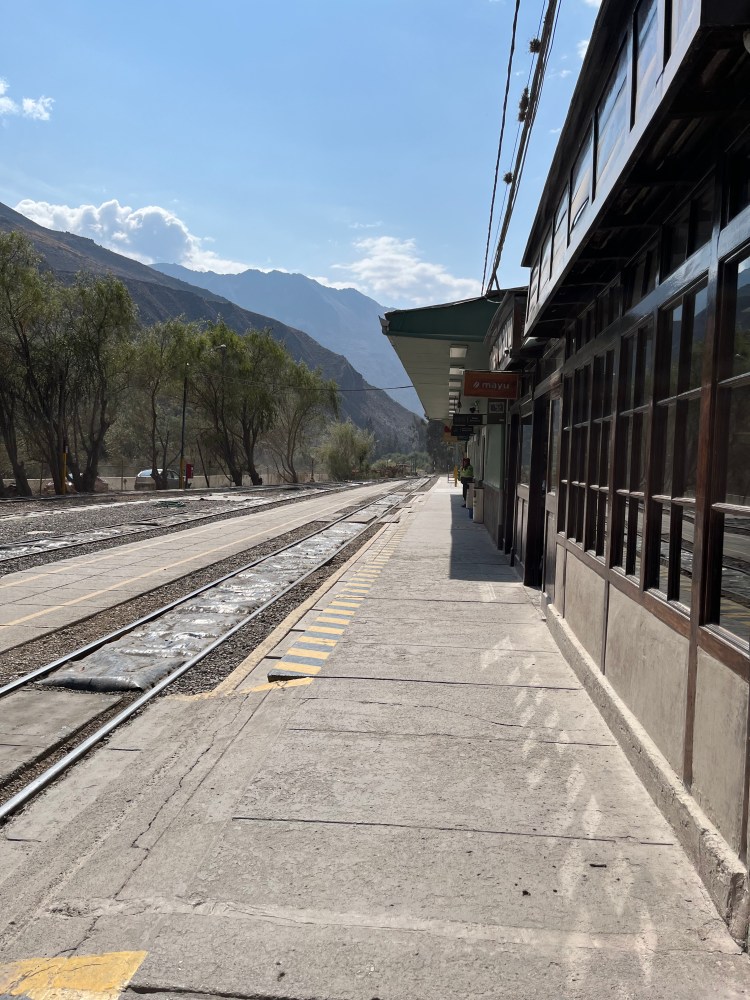
We eventually came out onto a main road and continued on until we reached Ollantaytambo, from where the train to Machu Picchu starts. It was a very slow meander through the packed village streets until we came to the station, which also happens to be our hotel for the next two nights. Step out of reception and you’re literally on the platform.
Outside reception
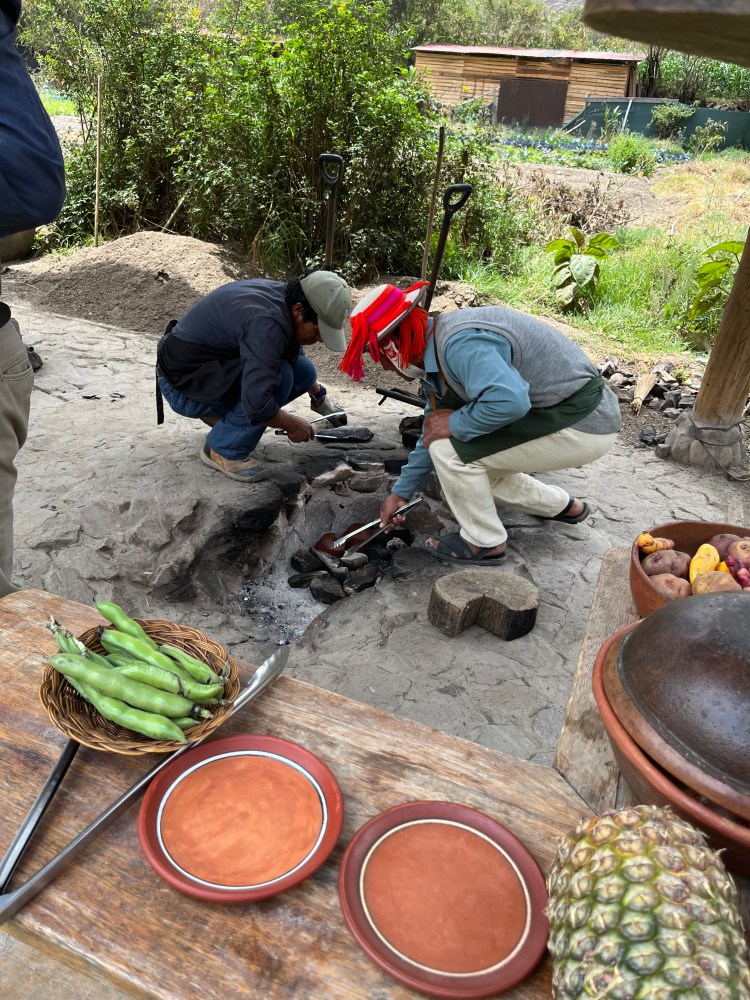
We said goodbye to Juan Carlos, as he’s heading back to Cusco, and Elias handed us into the tender care of Raoul for our Pachamanca lunch experience. This is a traditional method of cooking a whole meal in the Andes, or so they tell tourists!
We were taken out to the hotel’s farm, which is completely organic, where “we” were going to cook and eat this gastronomic feast. But first, we had to have a welcome cocktail, using ingredients from the farm and their distillery. Before drinking, we had to offer a drop to Pachamama, or Mother Earth.
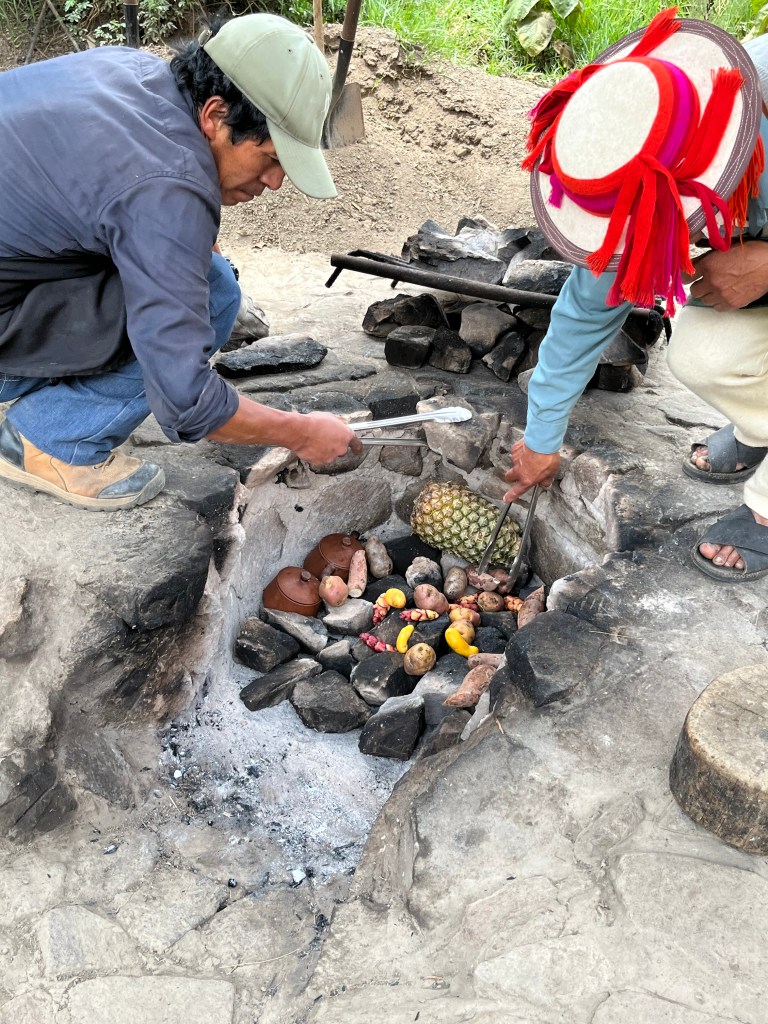
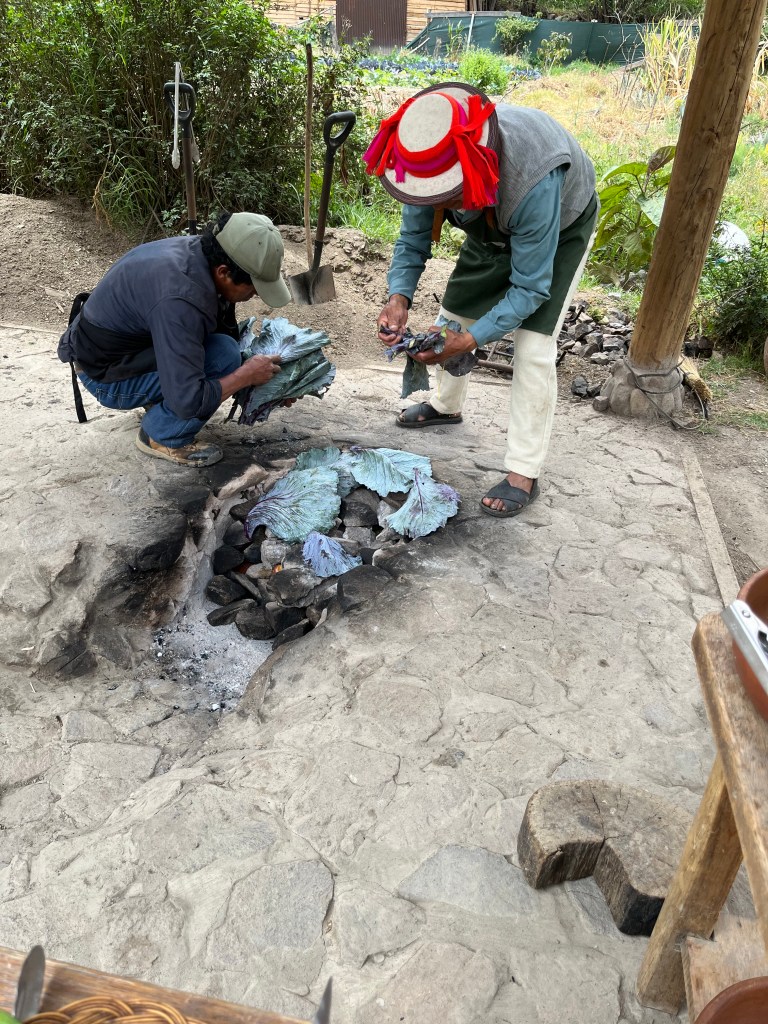
They start by lighting a wood fire in a pit and resting granite rocks over it to heat them up to 200C. They then rake out the embers and put a layer the hot stones into the bottom of the pit. Fortunately, we arrived at this point, so didn’t have to wait two hours!
Bottom layer – hot stones
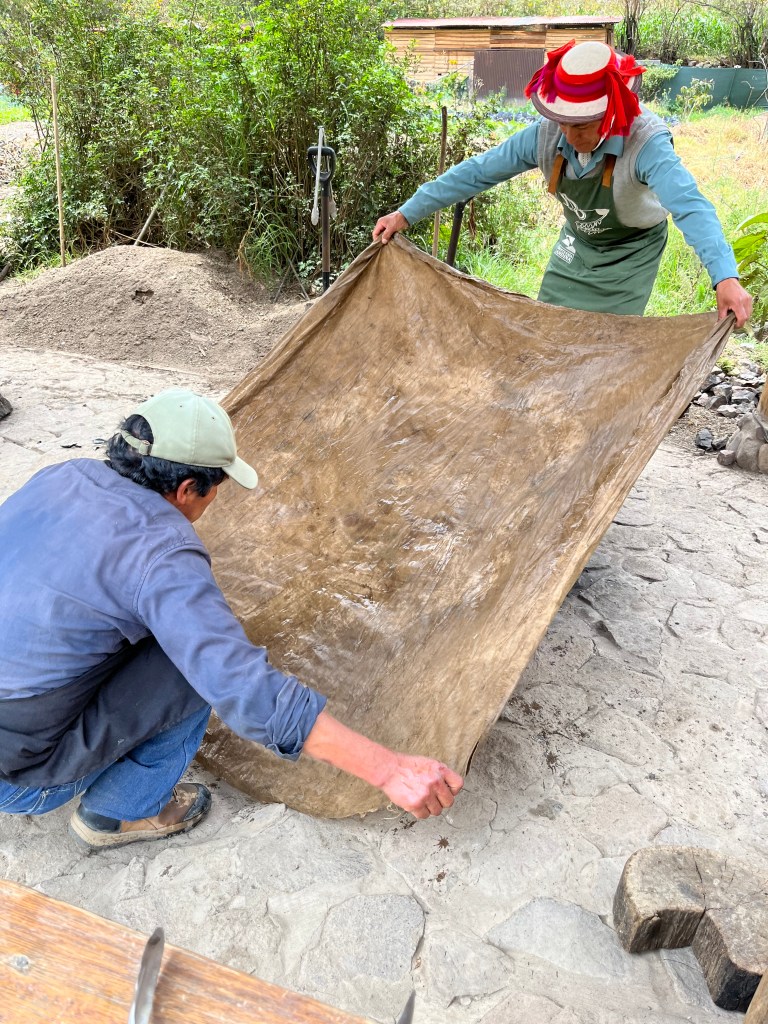
They then added: a couple of little pots of quinoa, a pineapple, several varieties of potatoes and tubers, beans and marinated chicken, pork and lamb. The remaining hot rocks went on top, followed by a layer of what looked like giant kale leaves. Next, came a couple of layers of wet fabric to retain the moisture, followed by a layer of soil to seal it all off.
Adding the vegetablesMarinaded meatsA layer of leavesSealing it up
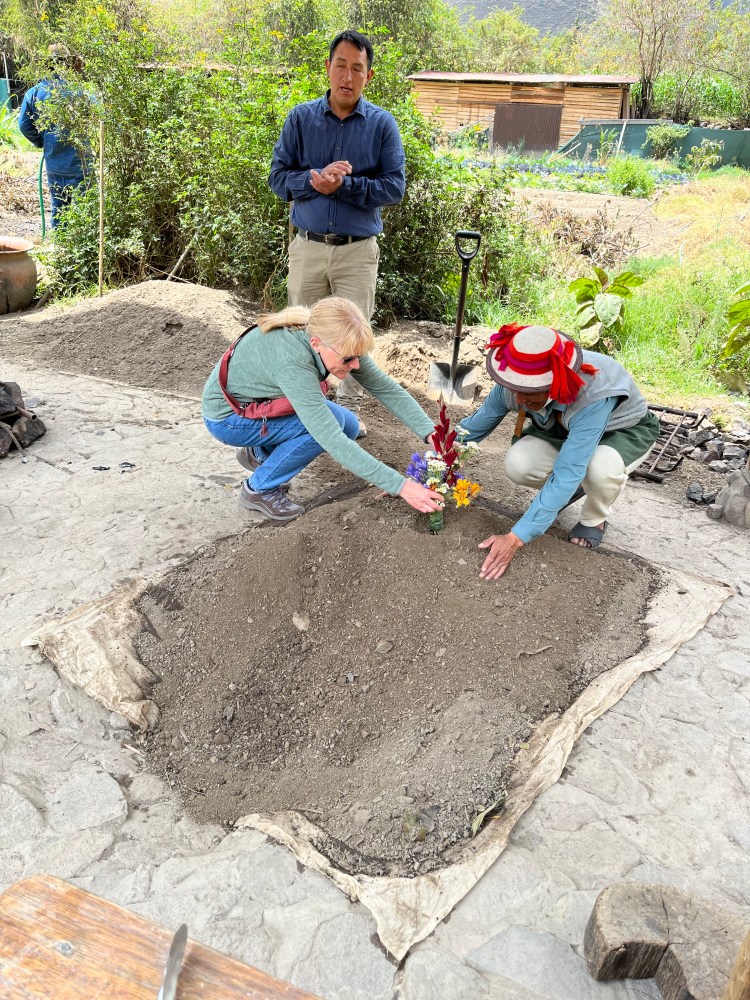
Finally, Diane planted a bouquet of flowers as an offering to Pachamama.
The finishing touch
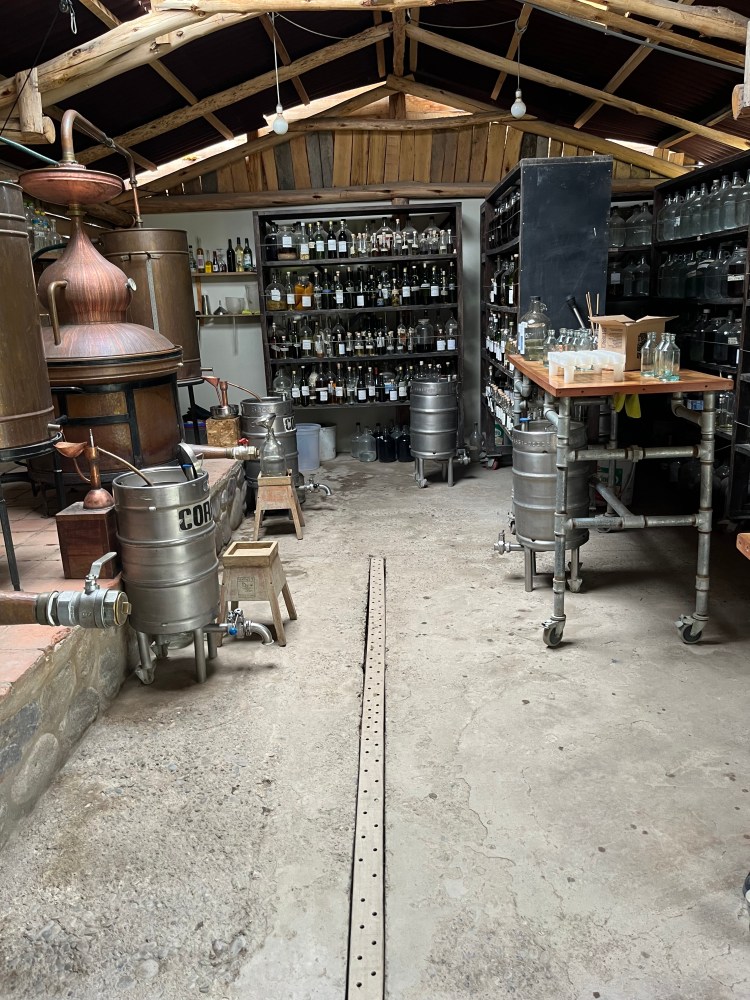
Since it was going to take 14 minutes for the meal to cook, we then went over to have a tasting from the distillery. Made from sugar cane and local ingredients, there were several different flavours, starting at 42% alcohol and rising. My favourite was called Matacuy, or kill guinea pig – it’s a digestif, a bit like chartreuse.
The distillery
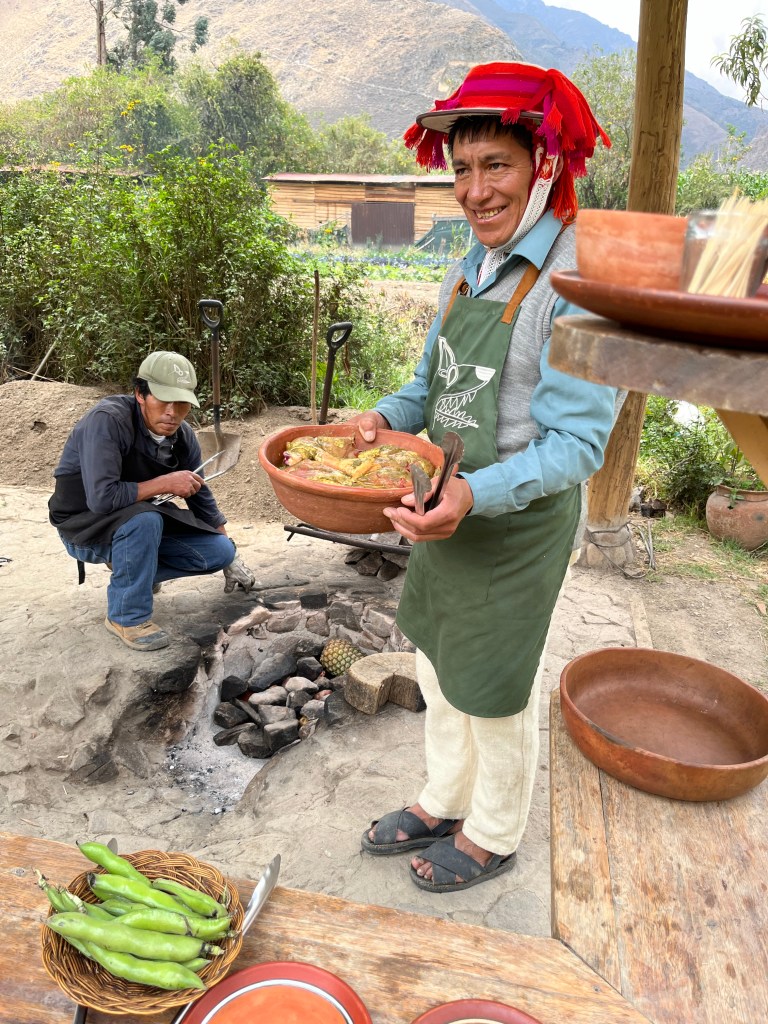
By coincidence, 14 minutes had elapsed, so we rushed back to the fire pit to see the layers coming out in reverse. When we got to our table, they’d put out salads, salsas and drinks, followed shortly by the hot meats and vegetables. We then enjoyed our leisurely lunch in the sunshine with some coffee from their own roastery to finish it off.
This morning Elias and Juan Carlos picked us up from the hotel and we drove to Pisac National Park.
The route is very winding as it climbs up to passes and then down again. We stopped a couple of times along the way at sightseeing places. The hills are all terraced and the local people grow mainly strawberries and potatoes, depending on the altitude. At one point, Elias pointed out a river down below us which finishes up in the Atlantic, despite our proximity to the Pacific.
The road to Pisac and the river
As we neared the park we came upon a long line of tourist buses completely blocking the road. We jumped out and followed Elias to the entrance, leaving Juan Carlos to figure out where to park.
Pisac was built by the Wadi people, who pre-date the Incas. As was their way, when the Incas took over, they didn’t destroy everything, they used and improved it. Very little of the village has been restored, but it gives you an idea of how it used to look.
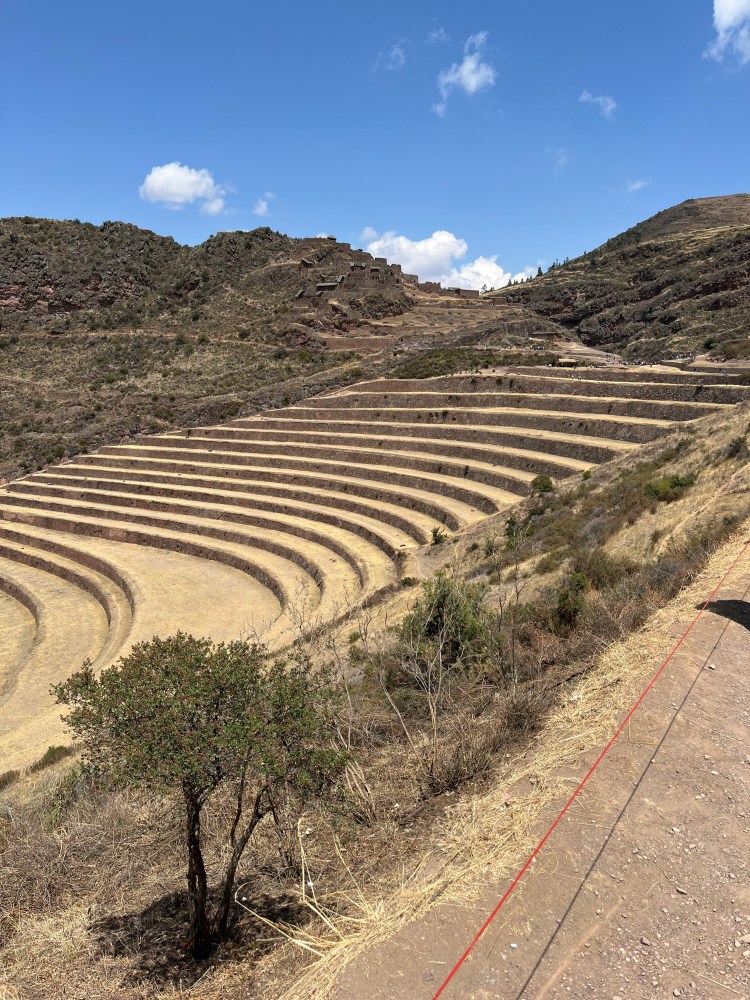
The main feature is the terracing, which the Incas built. They didn’t just build walls and pile earth behind them. Each terrace comprises several layers; rocks, rocks and gravel, gravel and sand, sand, soil and a nitrogen-rich nutrient layer. The latter often contained guano from the coastal regions, as well as manure from local animals.
Inca terracing
The Incas also ploughed deeper furrows, trapping moisture in the soil and creating a series of microclimates, allowing them to grow a large variety of crops.
One hill face wasn’t terraced. This was the local cemetery, where bodies were placed in holes. When the Spanish arrived, they discovered evidence of cranial trepanation in a large number of the skulls, with the holes being closed by gold or silver. They promptly destroyed the tombs and added the precious metals to their booty.
The cemetery
To me, it seems incredible the Incas had brain surgery and agricultural science back in the 13th Century.
From there, we headed back down to the modern town of Pisac for a very pleasant lunch.
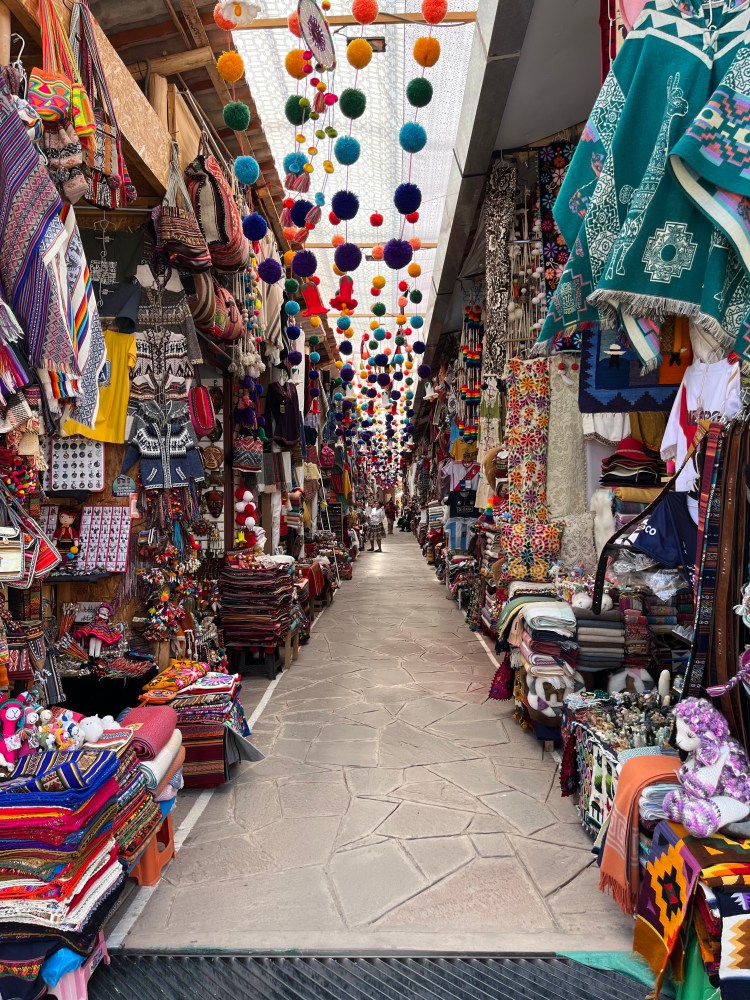
Inevitably, Pisac has a market, which we had to stroll through. It is mainly textiles and tourist items, but we got the impression that local people shop here too. We came away with a couple of purchases. I rather suspect that Elias is in line for some commission too!
Colourful Pisac market
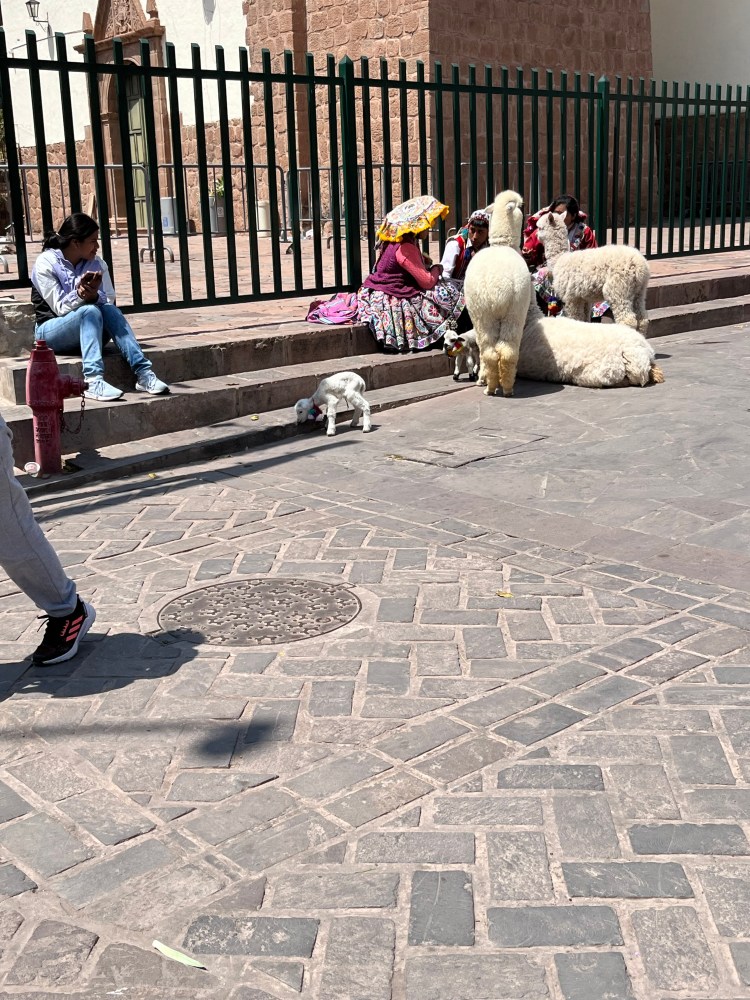
A fairly common occupation for women here is to dress up in their local gear and pose for photos with a baby alpaca – for which you have to pay them. In this photo, they are passing off a couple of lambs as alpacas.
Passing off a lamb as an alpaca
And that’s the end of our visit to Cusco. Tomorrow we’re off to the Sacred Valley of the Incas. Sounds a bit like something from Indiana Jones!
We started our day with a nightmare journey to Cusco. It took a little over an hour to get to Lima airport through the rush-hour traffic.
Our driver told us which door to use to get into the terminal. Once inside, we were met with a wall of people! We discovered that we had to print our own baggage tags. We managed one by ourselves but then needed help for the second one.
We then had to go to the bag drop and work that ourselves. Despite not being able to display the instructions in English, we got one done but again couldn’t do the second. The agent trying to help also failed, but then she asked why we didn’t go over to the premium check in desk. It turned out that we should have used a different door, but even then we had to ask where the check in was. They clearly don’t want people using it.
Anyway, we found the Latam premium desk where a real person checks you in. Except that she couldn’t do the second bag either! Finally, she started again and did them both. With a tear in our eye, we said goodbye to our bags, wondering where they were going to end up!
After all that, the flight was fine, although coming into land between all those Andes was a bit hairy. We managed to recover our bags and find Joan, our “PA” for the next few days, and drove to Cusco. Our hotel is a charming renovated villa on a cobbled street in San Blas, one of Cusco’s oldest neighbourhoods. There’s plenty of wooden colonial furniture and lots of local art and artefacts scattered around.
Antigua Casona San Blas
Joan talked us through our programme for Cusco and the Sacred Valley of the Incas, the rest of this day being doing nothing while we acclimatised to being at 3,400 metres above sea level. We duly did nothing but eat, drink and sleep.
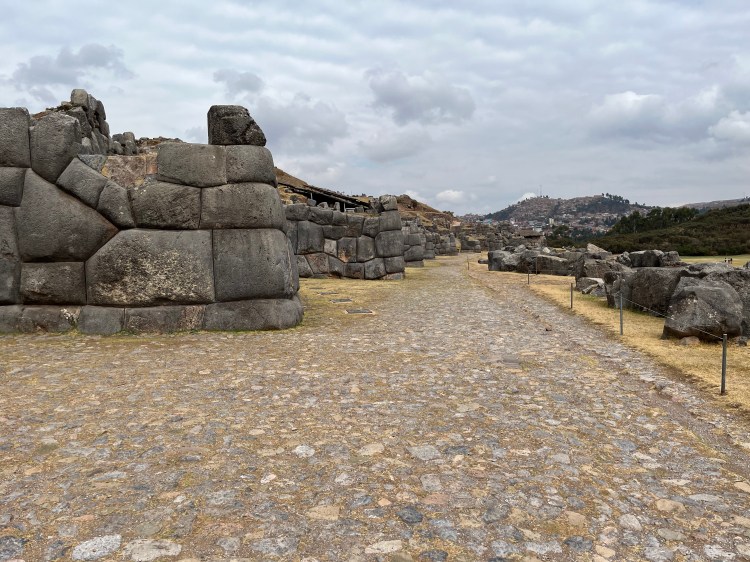
Next morning after breakfast, we met up with Joan and he introduced us to Elias, our guide. We walked up the street a short way and found Juan Carlos, our driver, and were whisked off to our first stop, the Inca ruins of Sacsayhuaman. In fact, these pre-date the Incas, who just moved in and extended them. The only thing left is the walls, which are made of huge blocks of granite, fitted closely together without mortar. It’s like a cousin of Stonehenge; it appears to be connected to the sun’s cycle and nobody knows how a civilisation that didn’t have the wheel or metal could shift the blocks from their original quarry.
Terraces of Sacsayhuaman
When the Spanish arrived, they started taking the stone and using it to construct their own buildings in Cusco, a practice that continued into the 60s when the area became protected.
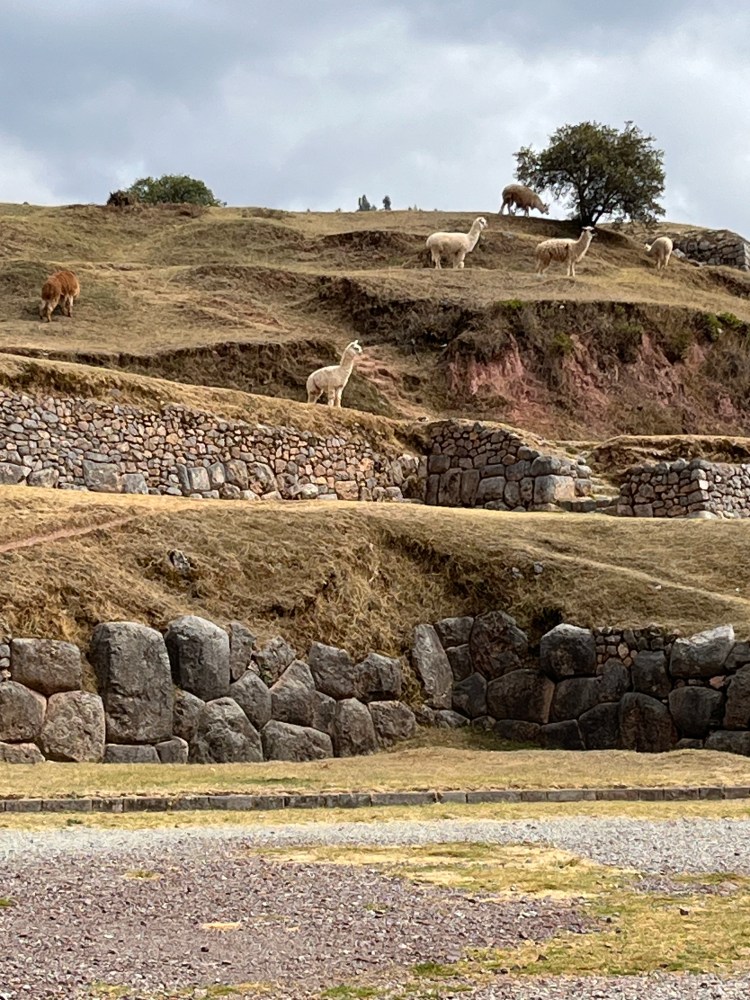
On the way back down, we came across some wild alpacas and llamas and learned how to tell the difference between them.
Alpacas and llamas
From there we drove to Q’enco, a funeral site where the dead were mummified and placed in niches in the walls. Lacking some of the oils the Egyptians used, Inca used water that quinoa had been soaked in, as well as mint oil.
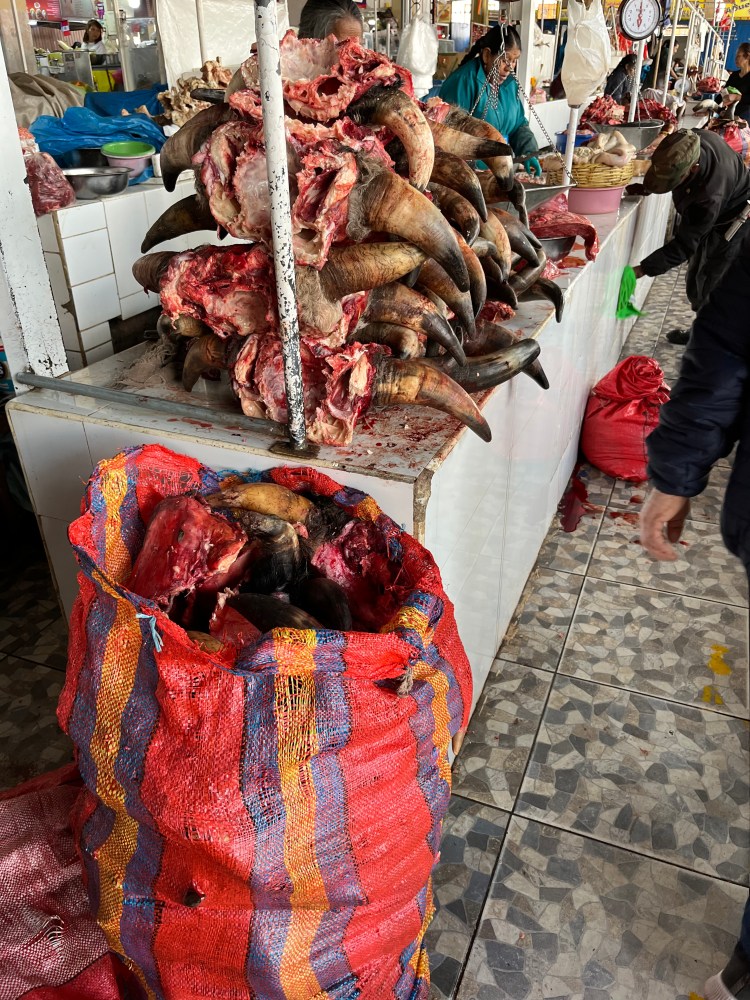
Juan Carlos then drove us back to the city and we took a walk through San Pedro market, a huge indoor market open every day of the week. You can buy anything there and it is divided into sections for meat, vegetables, medicinals, toys, household items, fruit juices, etc. There were some very strange items on sale!
Take the bull by the horns
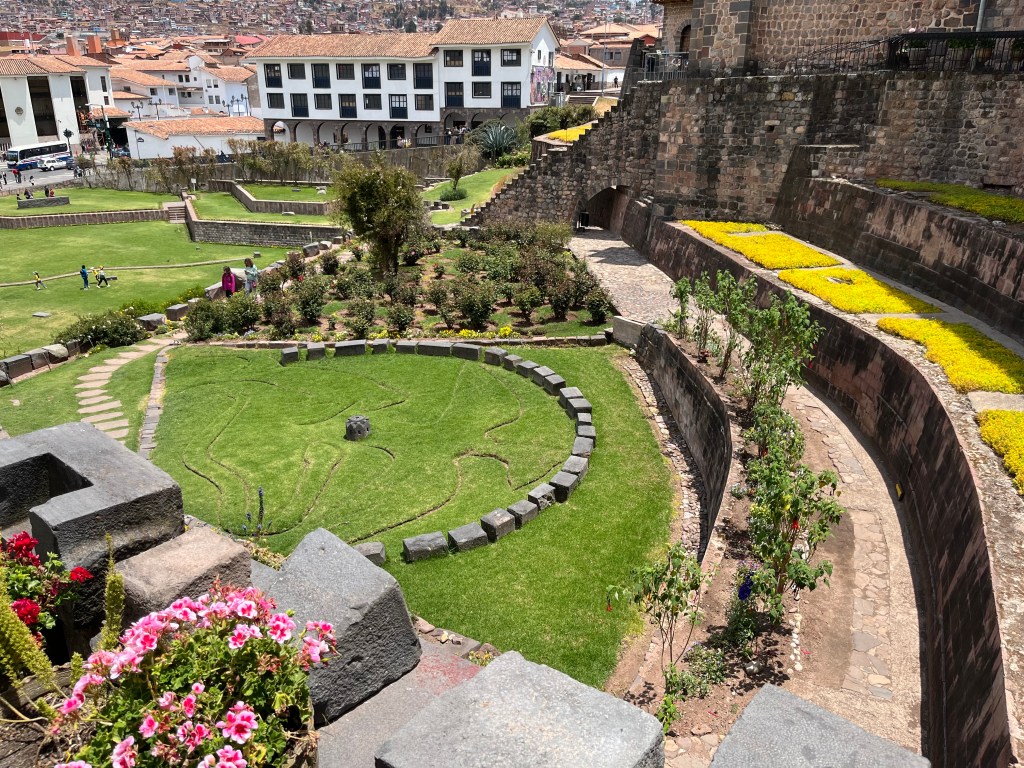
From there, we moved on to the Temple of the Sun. When the Spanish arrived they described it as having a thick gold layer coating the top of all the outside walls, with caches of golden and silver religious objects inside. They promptly melted all the gold down and shipped it back to Spain! The buildings were also built of the same granite as Sacsayhuaman and the Spaniards turned the temple into Santo Domingo church. The ancient stones remain, but much of the Spanish part was destroyed by earthquakes.
Temple of the sunTemple of the sun
Our final destination, after some lunch, was Cusco Cathedral, or Cathedral Basilica of the Virgin of the Assumption. Built from stone removed from Sacsayhuaman, the cathedral has three sections. The Triunfo is the oldest and was built to celebrate the Spanish victory over the Incan empire. It was built on top of the Inca temple Kiswarkancha. The central one was built to accommodate the growing congregation, as locals were converted to Catholicism and is in a very sumptuous Baroque style. The final part was built by the indigenous population and includes a fusion of catholic and local beliefs, including a black figure of Jesus.
By this time we were glad to get back to the hotel for a long rest.
After chilling for a couple of hours, we met Kimberly of Lima Gourmet, our guide for a Culinary Tour of Lima. Our transport was waiting outside, and we met Juan, the driver, and Derren and Sylvana, a couple from Calgary. We were pleased to learn that there were just the four of us.
Our first port of call, was Cala, a restaurant on the beach with views onto the Pacific. We could probably have walked from the hotel in less time than it took to drive!
We started with a Maracuyá sour, a cocktail made with Pisco, the national spirit of Peru. This was served with tulpi, salted sweetcorn kernels.
Maracuyá sour
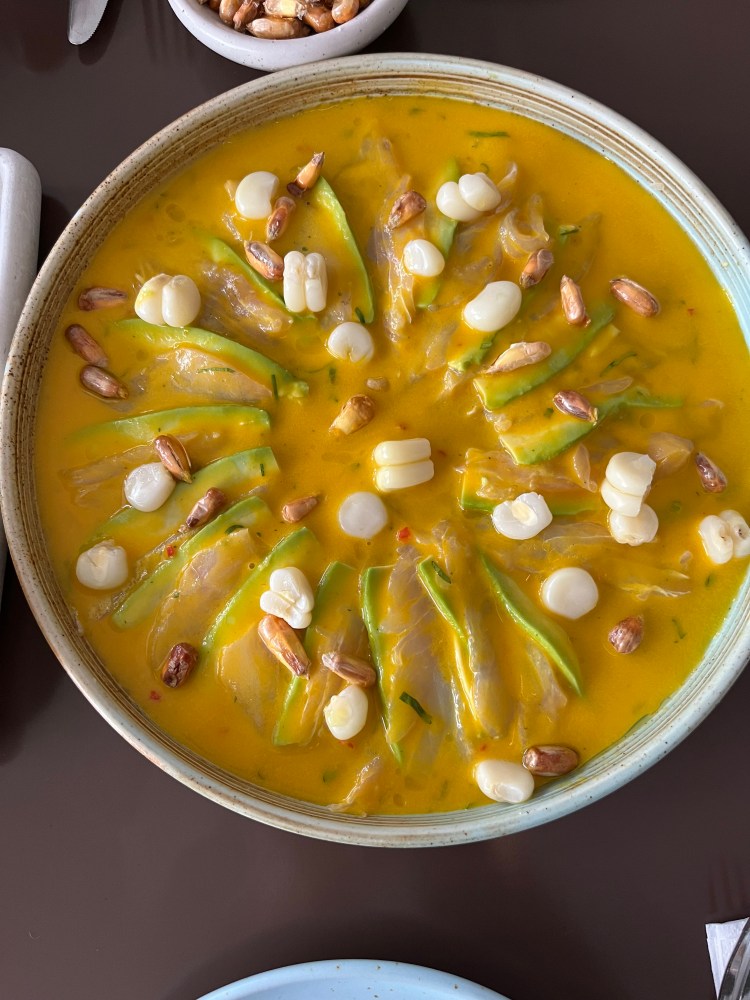
Their signature dish was Tiralito, thin slices of fish and avocado in an orange chilli sauce. Delicious!
Tiralito
From there we drove to Isidora, the financial district, to stop at Limanâ, whose slogan is Placer sin Culpa, or pleasure without guilt. We sat at the bar while Alex gave us a potted history of Pisco and then showed us how to make a classic Pisco sour.
Alex and some of his Pisco
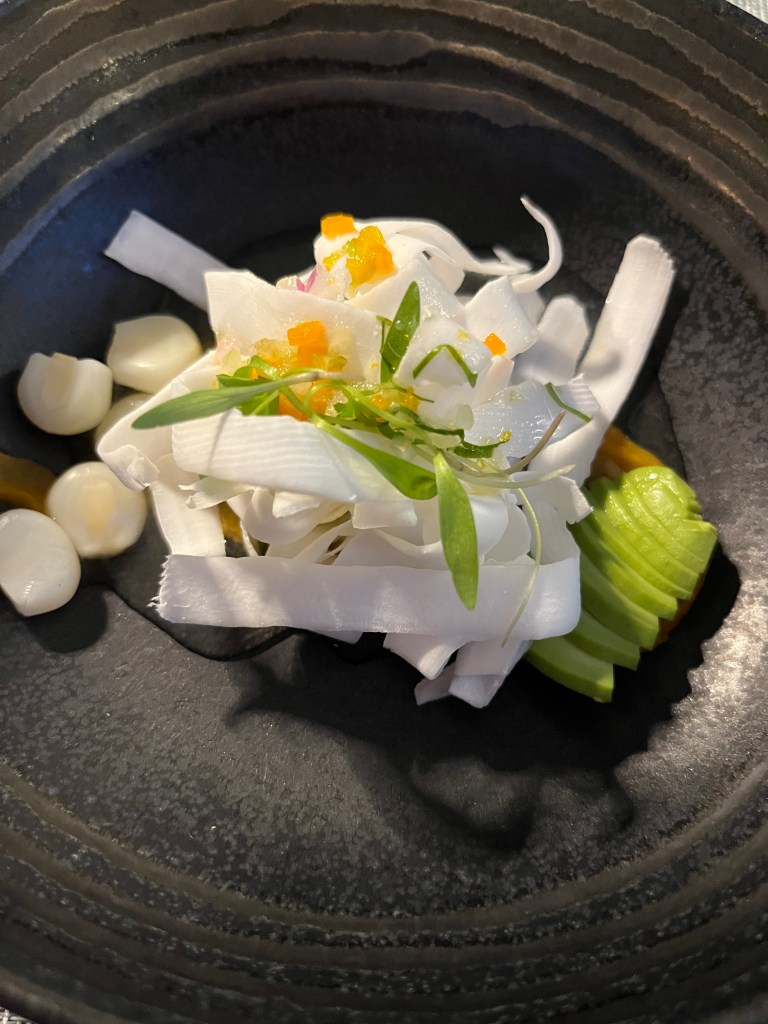
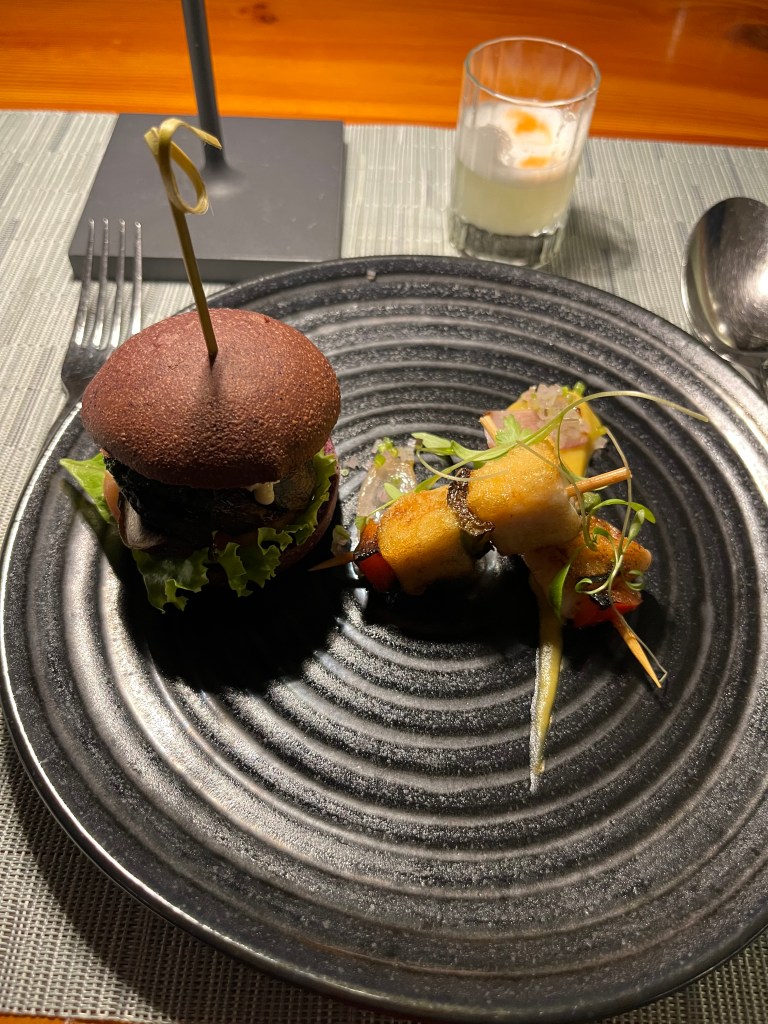
Back at our table, we enjoyed coconut ceviche, a fish from the Amazon called baiche, along with a mushroom slider.
Coconut cevicheBaiche and mushroom slider
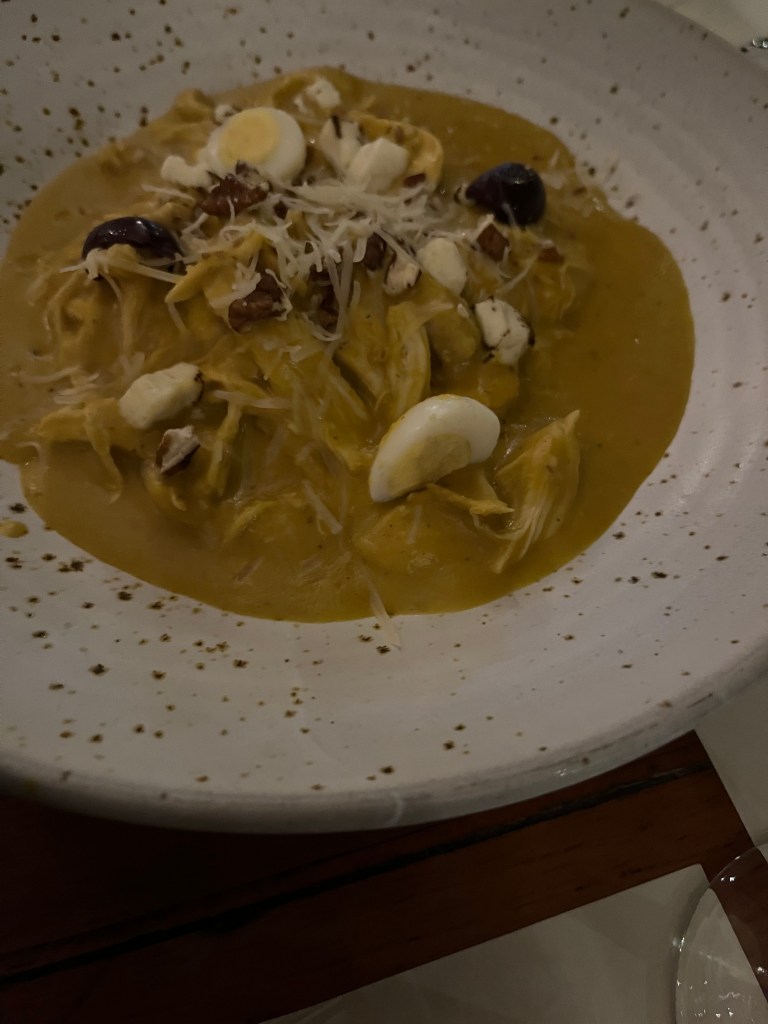
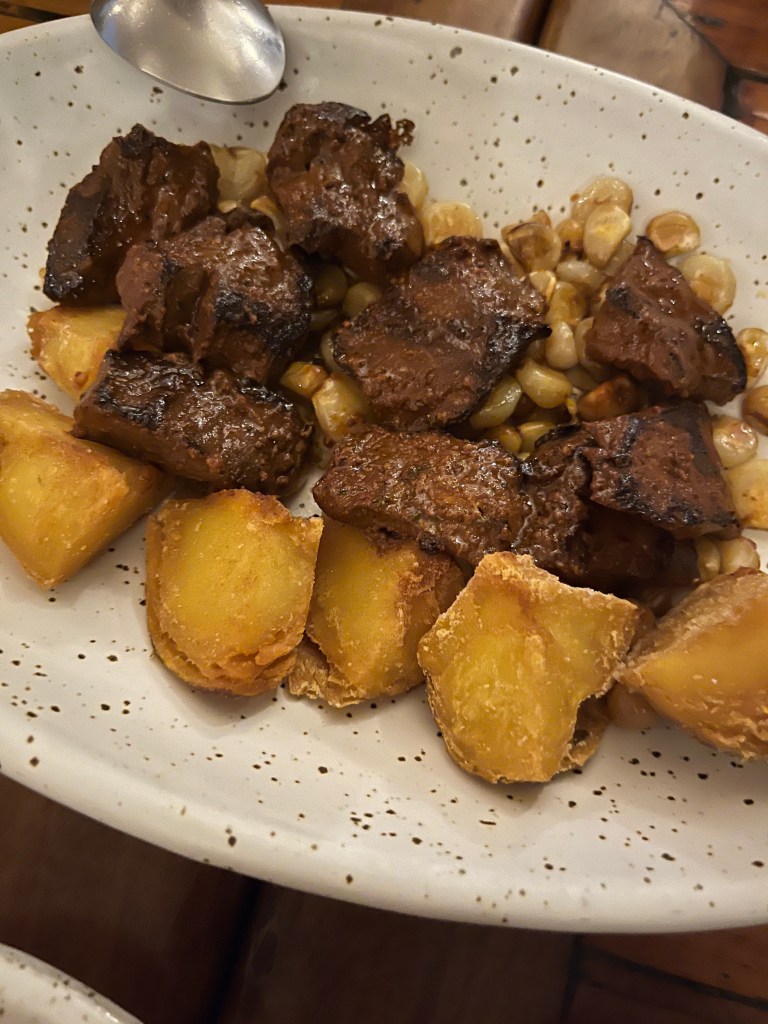
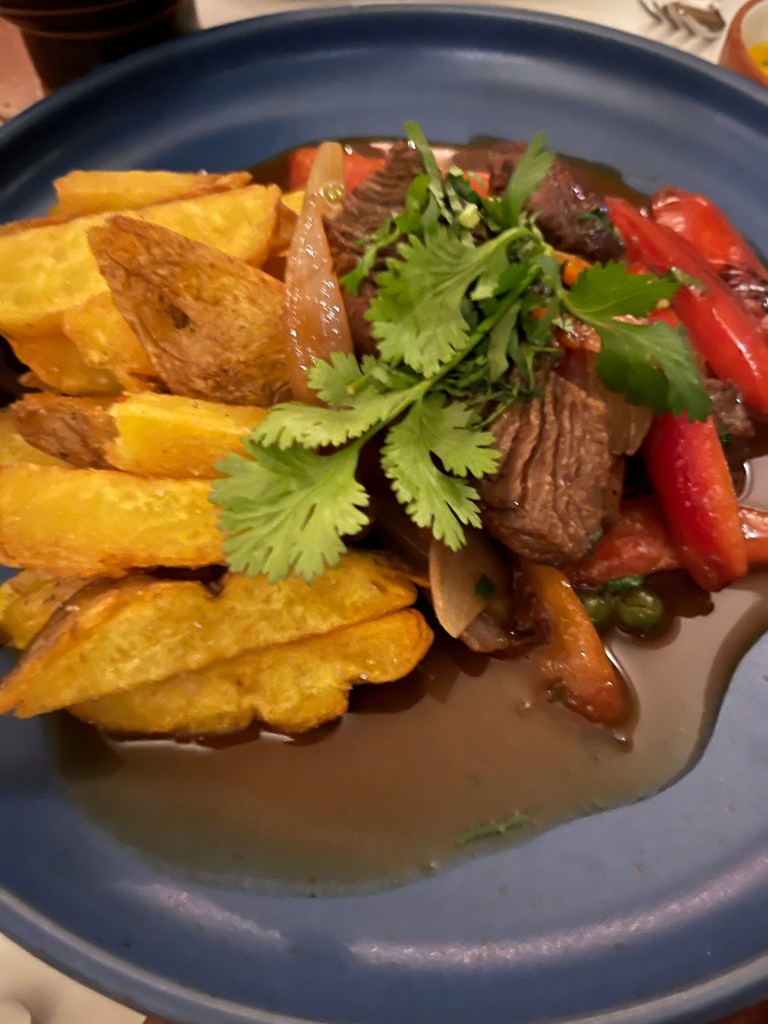
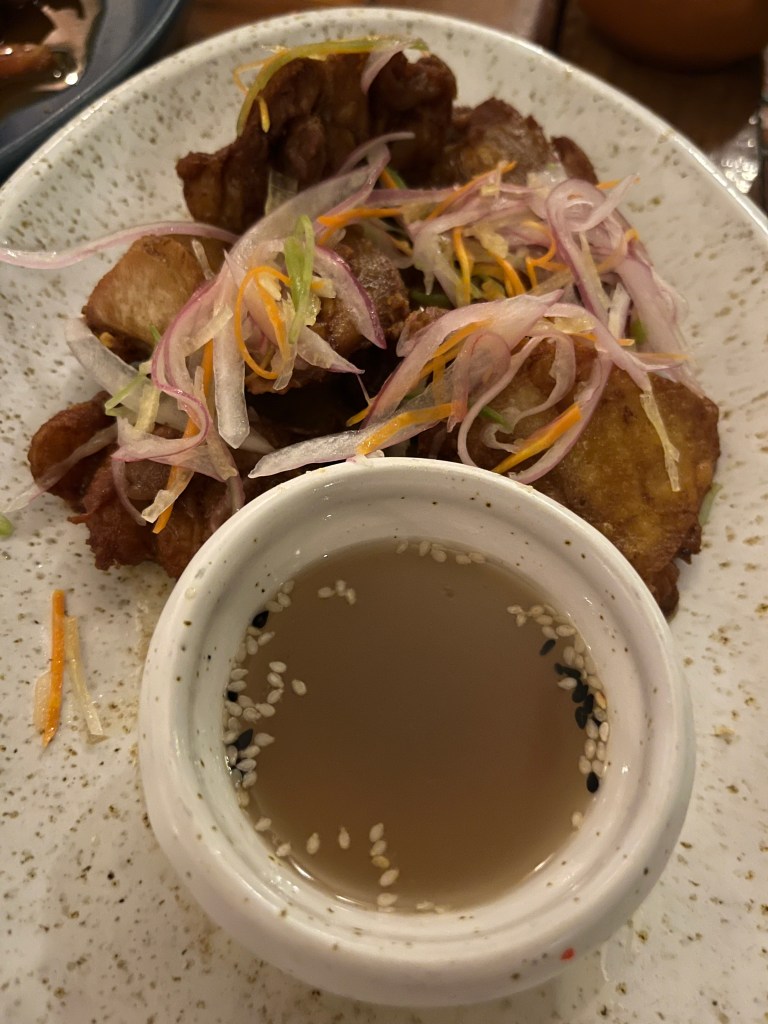
Another foray through the traffic and we arrived at Huaca Pucllana, the name of the restaurant and the ancient Inca site. This was our main meal of the evening but by then I was too far out of it to make a note of all the courses. You’ll have to make do with the photos of chicken, beef, lamb and pork.
We had an orange wine to go with the meal, reflecting the owner’s fascination with Sophia Loren!
The owner’s inspiration
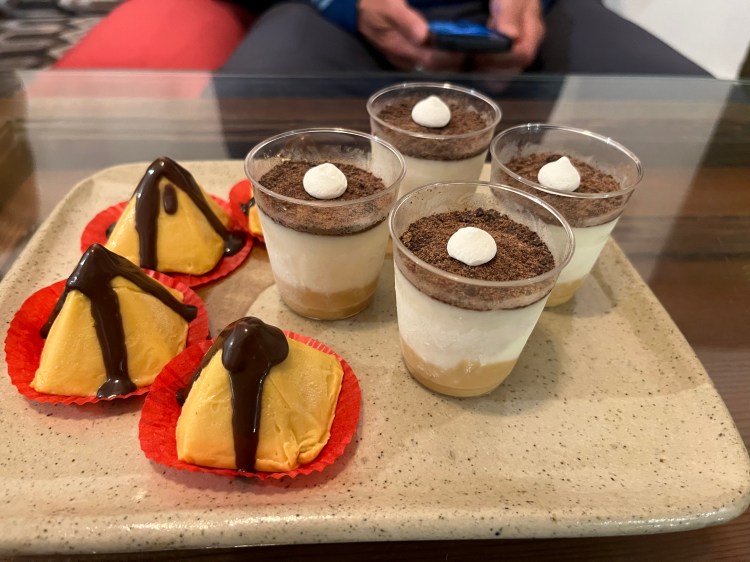
Our final visit was to Bodega Verde back in Barranco. It was originally the garage of the rather large house next door, and it specialises in lucuma fruit dishes. We had two desserts prepared with lucuma. The one in the little pot was delicious, the pyramid not so much.
This morning Cecil picked us up for our walking tour of Barranco.
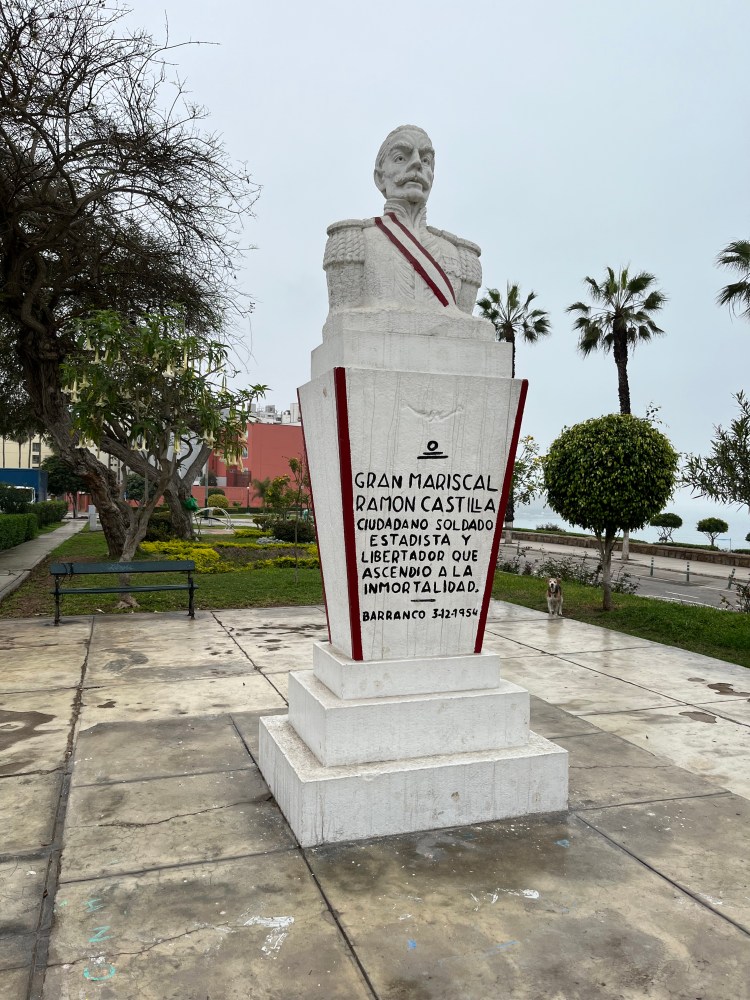
We set out towards the clifftop and soon came face to face with Grand Marshall Ramon Castilla. A three time president of Peru, he led the country to independence, abolished slavery and boosted the economy by exploiting guano deposits.
Grand Marshall Ramon Castilla
Barranco was known for its summer houses perched on the cliff tops overlooking the sea, and the architecture is very varied. Today, those houses have been turned into coffee shops, restaurants and clubs, and the area has an arty feel to it.
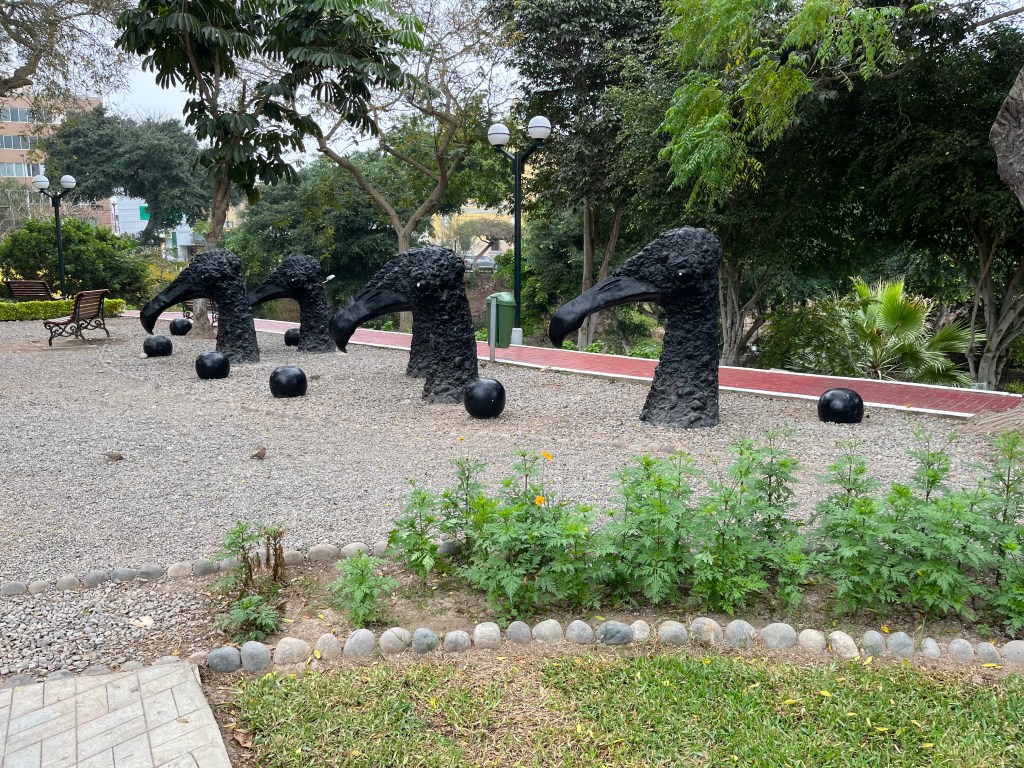
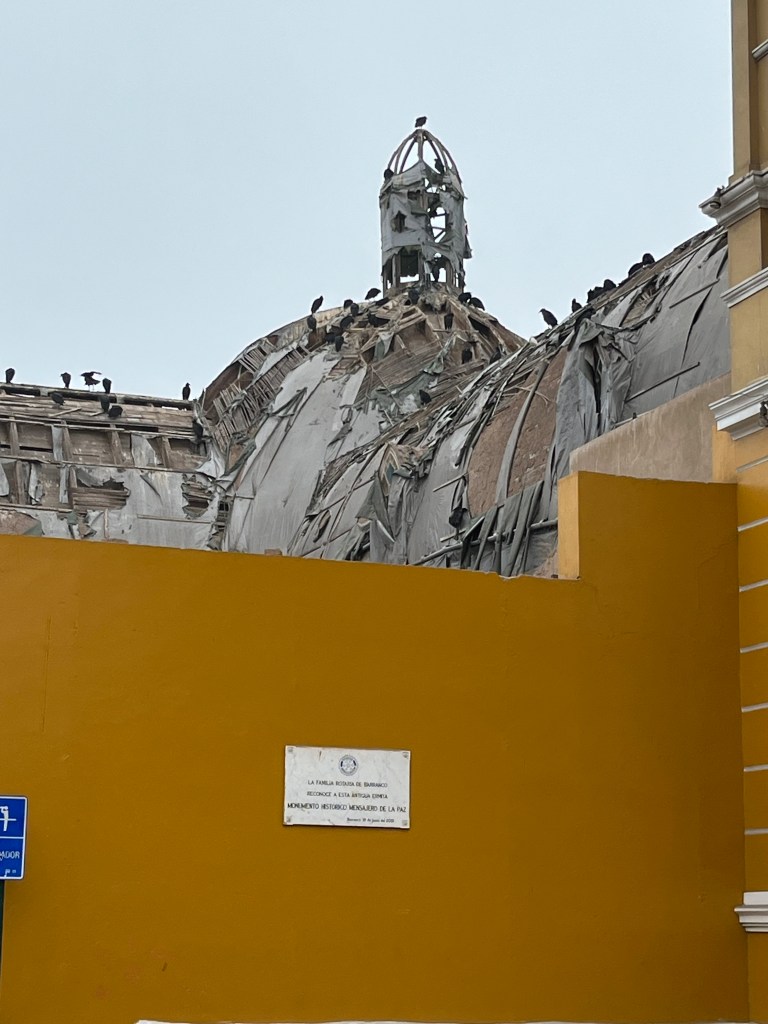
We came across this family group in the park. They are black vultures, and there are plenty of real ones perched on the ruins of the local church. Funnily enough, we also saw a lot hanging around the presidential palace yesterday!
Vulture artVultures on the ruined church
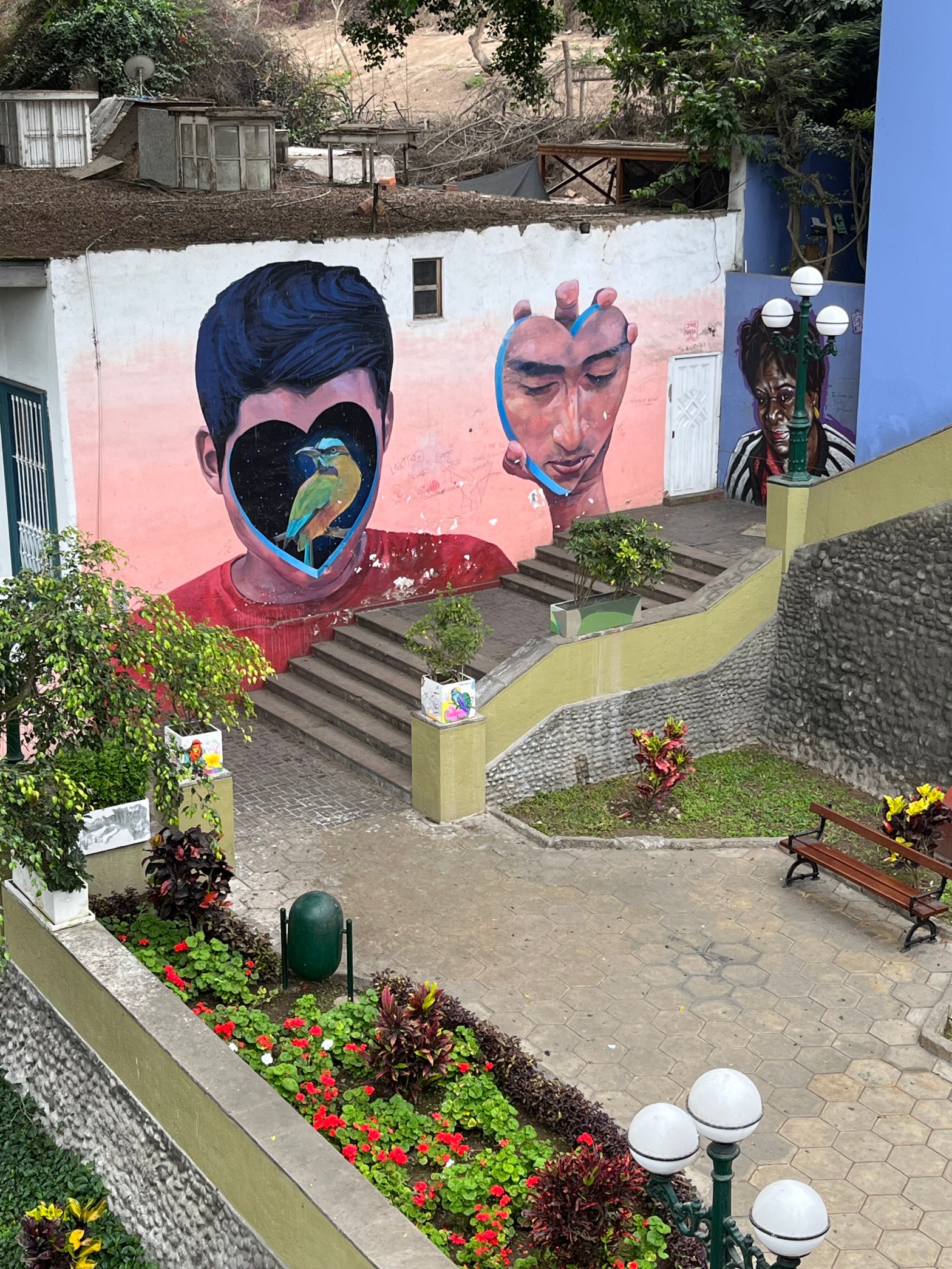
Street art abounds, but a lot of it is marred with graffiti.
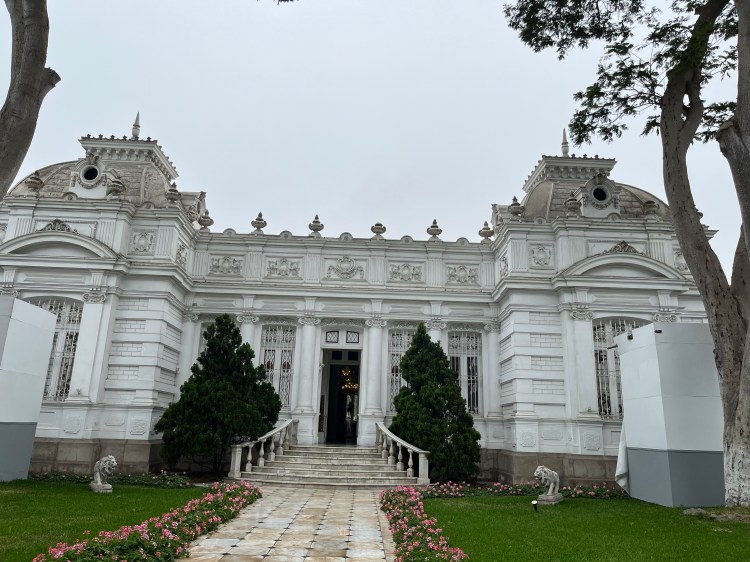
We called in at the Museo Pedro de Osma, where once again, cameras are banned. The building was Osma’s home, and was turned into a museum after he died. It contains his personal collection of religious art and colonial artefacts.
Museo Pedro de Osma
While walking, Cecil explained about “compromises”. He is originally from the Andes, where this system is still practised. Instead of getting married, a young couple will move in together with the blessing of both families. If they later decide that it isn’t working, they just separate. Cecil had several compromises before he finally got married aged about 45.
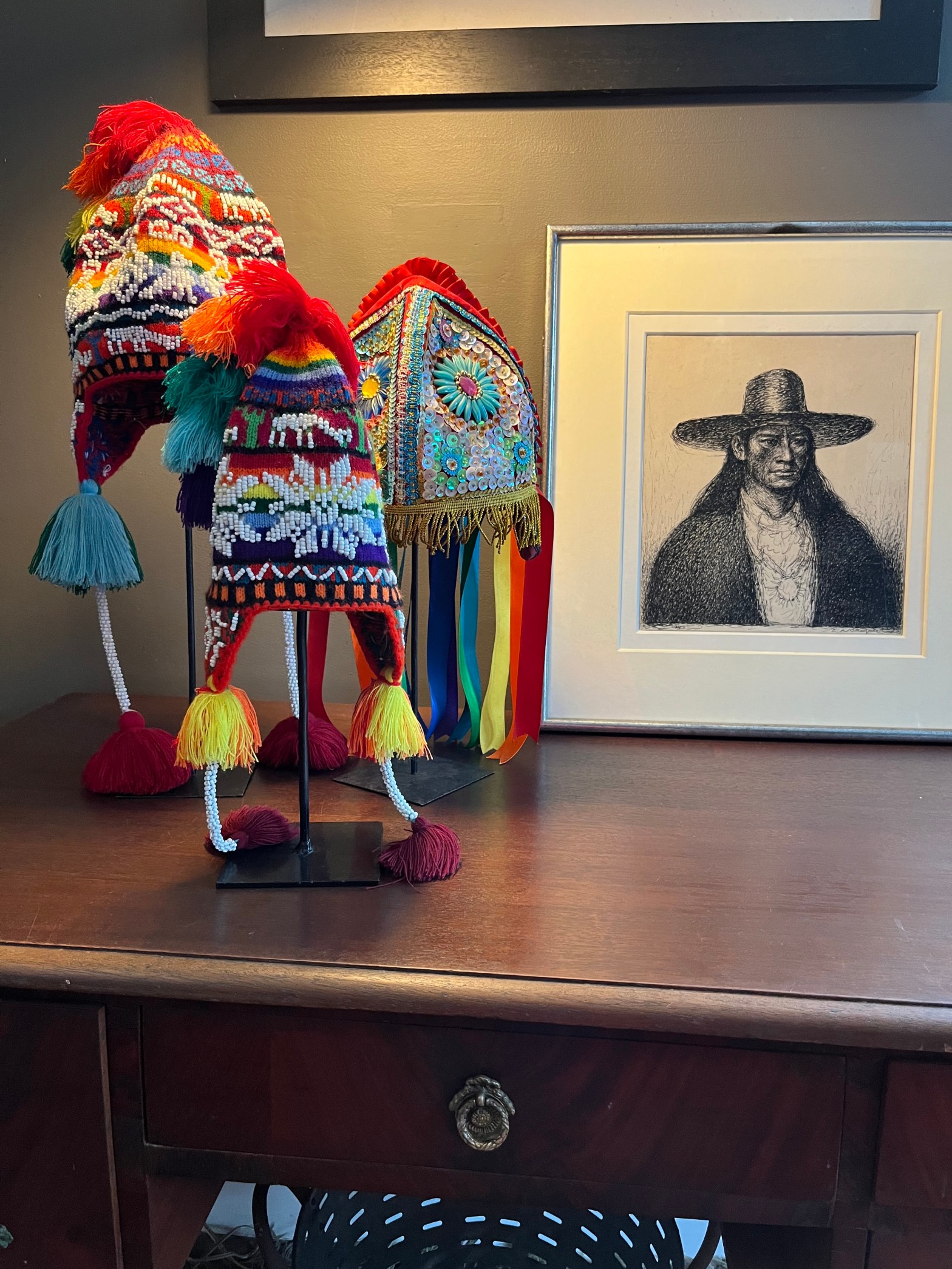
Our final call was Las Pallas, billed by the travel company as an art gallery. It is actually a shop selling indigenous handicrafts from various parts of the Peruvian Amazon and the Andes. It is owned by a somewhat eccentric English lady called Mary, who insisted on giving us chapter and verse about all the pieces in the shop and who made them. It isn’t a small shop!
And that was it. We came away feeling that Barranco has been somewhat over hyped, and is past its best before date.
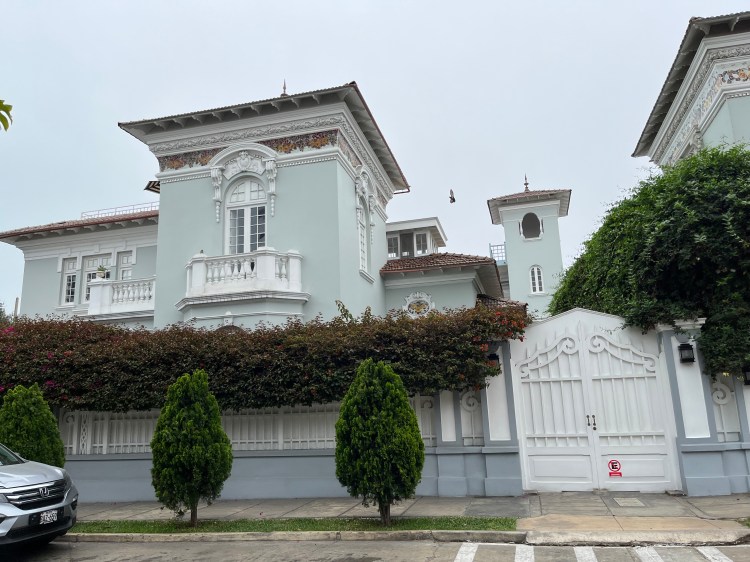
We did manage to get a photo of our hotel when we got back and then climbed to the top of its tower. The two buildings were originally built by two Italian brothers, and the tower was where they sat in the evenings to watch the sun go down over the Pacific. That was before other buildings were put up in front of it, but you can still see a bit of Pacific from the top!
The journey went well. Johnny picked us up on time and drove us to Heathrow. Twenty minutes later we’d got though baggage drop and security and were in the BA lounge to have some dinner. The flight to Madrid was on time, so we settled down to a second dinner. Getting through flight connections was surprisingly easy compared to previous trips and we were soon eating dinner on the flight to Lima.
After all those dinners, we had no trouble sleeping for most of the flight, although we had to wake up in time for breakfast.
We arrived at Lima 30 minutes ahead of schedule, beat the crowds to immigration and baggage reclaim and went out to find Celestino waiting to whisk us off to our hotel. Even at 5am, the roads were really busy and the buses were standing room only.
Lima was foggy and drizzly. Apparently, as we found out later, the coastline is blessed with a current of water from the Antarctic, so it never gets warm enough to make water evaporate. Therefore it never rains in Lima, but for much of the year you get a constant drizzle.
We arrived at Villa Barranco, “a boutique hotel in a lovingly restored 1920s republican style house” in time for another breakfast. Scrambled eggs, pancakes, fruit and excellent coffee, far better than Iberia’s offering. Unfortunately, breakfast is served on the roof terrace, which must be great in summer.
Hotel Barranco
Barranco is the cultural and artistic district of Lima and the hotel reflects the feel of the area. The rooms are crammed with colonial furniture and local artworks are scattered around the place. And the owner is charming.
Fabiola, our guide for the day, picked us up at 10am and we set out for the historic city centre with Celestino at the wheel. Lima has no trains or metro, so everyone goes by road. They are in the process of building a metro, so there is construction and diversions everywhere, so the roads were even busier than before. It took about 30 minutes to get to the UNESCO-designated centre, with Fabiola talking constantly for the duration.
Our first stop was the monastery of Saint Francis of Assisi. Unfortunately, you can’t take photos inside the building, so I can’t post any. The monastery was built by the Spanish during the 17th century and is full of Moorish influenced tiles, Spanish religious art and a huge collection of antique books in the library. We also encountered a whole host of very loud groups of school children, in their matching uniforms.
Monastery of St Francis of Assisi
After seeing what there was above the ground, we went down into the catacombs, which was the city’s cemetery for many years. With bones scattered around the place, low doorways and uneven floors, I wouldn’t like to be there during a power cut! We didn’t stay long.
We made our way back to the car via the main square with the presidential palace, cathedral and town hall on three sides. Overall, we weren’t too impressed with the area. It is quite run down, and while some of the buildings have been restored, a lot are sitting there waiting for some attention.
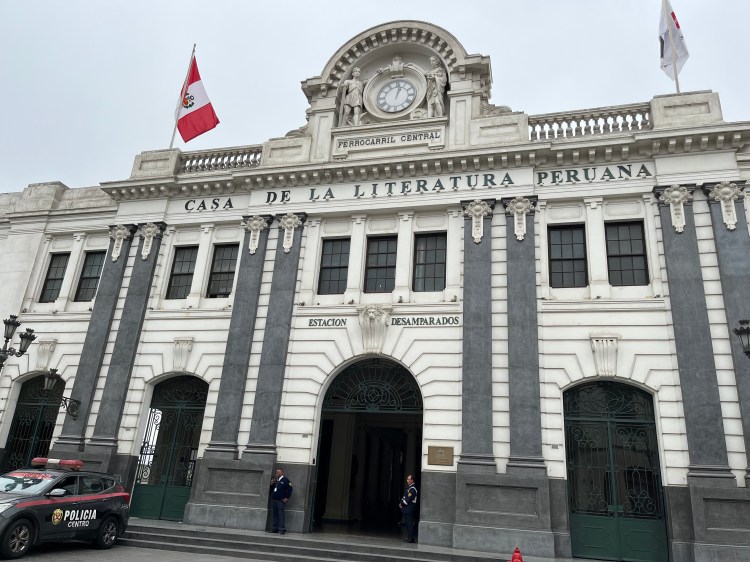
Railway station turned library
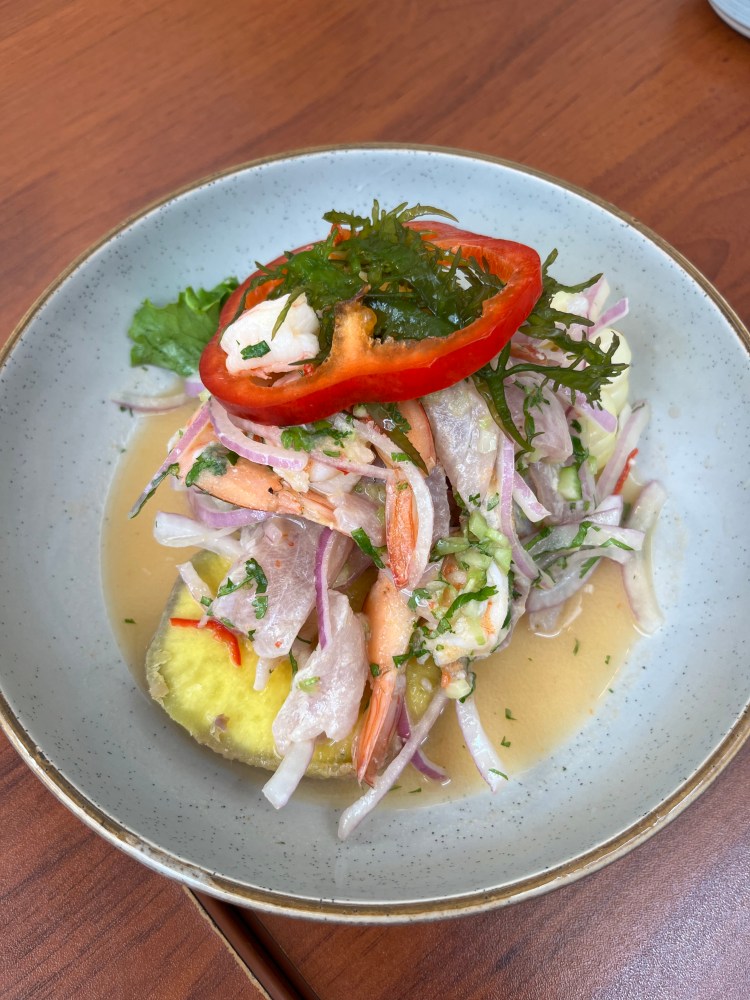
We had a great lunch in a local chevicheria, where we sampled three of their specialities. Fabiola kept warning us about the chillies, but they really weren’t that hot.
Ceviche
After that, a visit to a local market in Miraflores, one of the more affluent areas of Lima. Markets are very popular in Peru, with people preferring to use them rather than supermarkets. There is a huge variety of fruit and vegetables that we don’t normally see in the UK, including finger avocados and tumbo aka banana passionfruit.
And that was day 1. Tomorrow we’re exploring Barranco and taking a culinary tour.
Technology permitting, I’ll be blogging and posting photos as we go. If you want to follow our travels, stick your email address in the box below and you’ll be the first to find out when there’s a new post.












 Steve and Diane on Tour