Our trip home was a very long day. We were up at 3:30 because our taxi to the airport was booked for 4:15. Surprisingly, even at that time of morning, there was quite a bit of traffic on the roads.
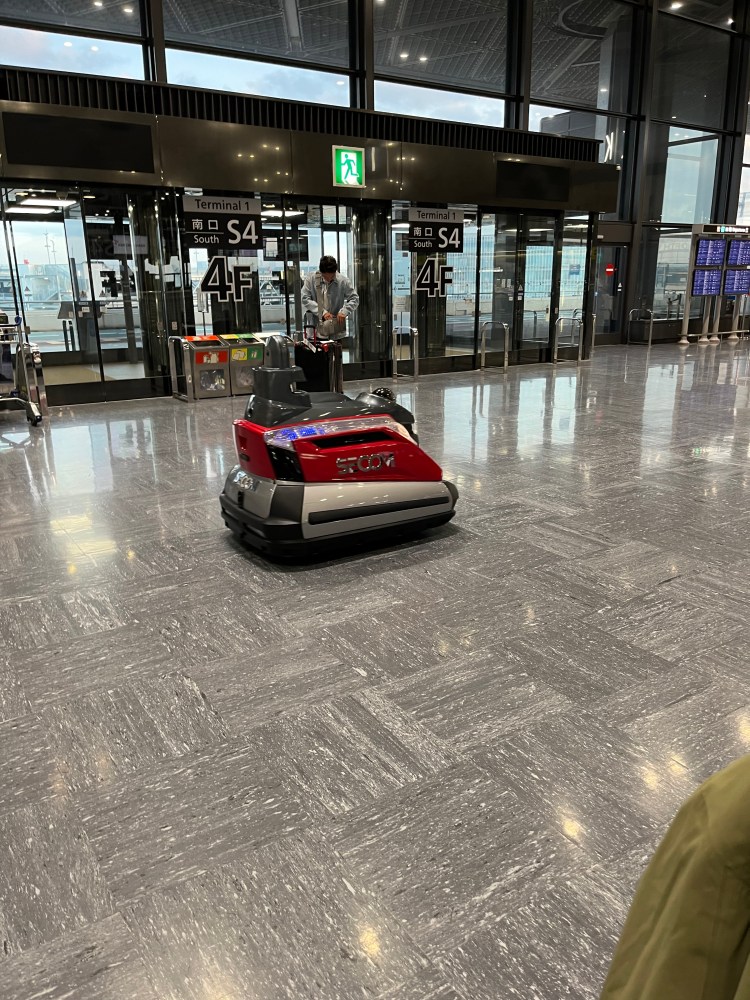
Narita Airport – It went by saying “Patrolling”!
We had to fly from Tokyo to Seoul and then had a very short time transfer to the Heathrow flight. Of course, the first flight was delayed, so our 40 minute window became 30 minutes. Asiana ground staff were waiting for us and hustled us through the transfer process, but the flight was boarding by the time we got to the gate. The flight to Heathrow was over 14 hours and then our bags were ages arriving. We finally got home about 9pm UK time, 6am Japan time.
In 26 hours we had three breakfasts, one lunch, one dinner and three random meals!
I don’t know about travel broadening the mind, but it certainly works on the waistline!
Here are some final thoughts on Japan.
Wherever we went we met happy, smiley people.
They are so organized that it is a very easy place to get around on your own. Once you get to know how things work, the railways and metro networks are brilliant, and there’s always an English translation on major signs.
The Japanese equivalent to the Oyster card is brilliant. You can use it on all forms of transport as well as in convenience stores and some other shops.
Renting a Wi-Fi router makes getting around even easier because you’re always connected.
Despite the technology, the Japanese have some very cumbersome systems, such as having to write out receipts and not being able to issue train tickets across companies.
Convenience stores are very convenient and seem to be open around the clock. The sandwiches they sell all have the crusts cut off.
The streets and other public areas are spotless, except where there are a lot of tourists, and you rarely see anyone living rough or begging.
You can always find a clean public toilet wherever you go, subject to the caveat about tourists. The vast majority have heated seats and will wash you too. Unlike those in Korea, they don’t dry you as well! However, most don’t have anything to dry your hands on and a lot don’t have any soap. We were told this is due to COVID.
Most public toilets have a map at the entrance showing you where everything is inside!
There’s always a hook for your umbrella between urinals and between sinks. In fact, the Japanese seem to be infatuated by umbrellas.
You always get hand wipes in eating places, but very few give you a napkin. Diane took to carrying a bib in her bag! And talking of bags, even the smallest places provide some kind of container to put your bag into while you’re eating.
The country is safe enough for young school children to travel alone on trains.
There’s a huge variety of good food, and even some of the raw fish isn’t bad.
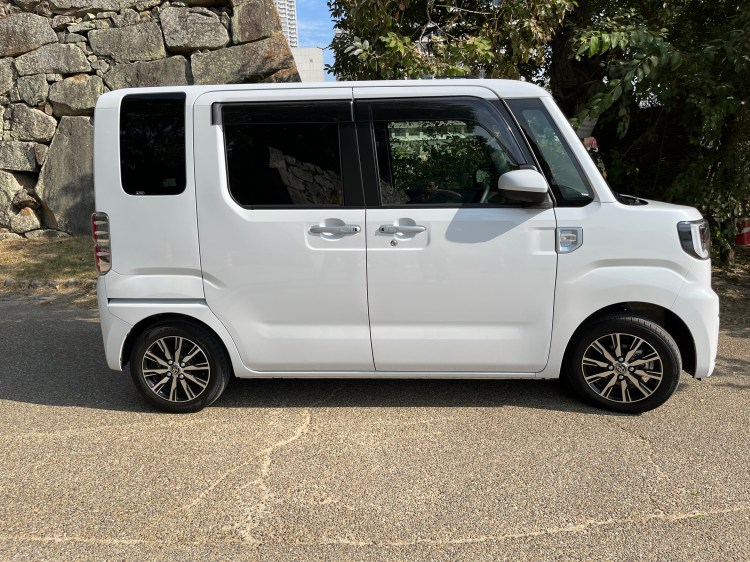
Every Japanese car manufacturer sells little boxy vans and they zip around all over the place. I half expected to see Postman Pat coming down the road.
One of the bigger ones
We highly recommend a visit.
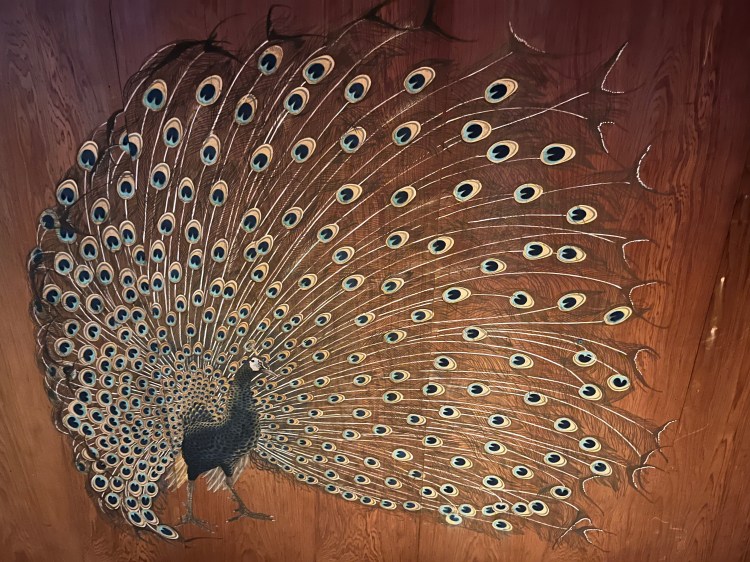
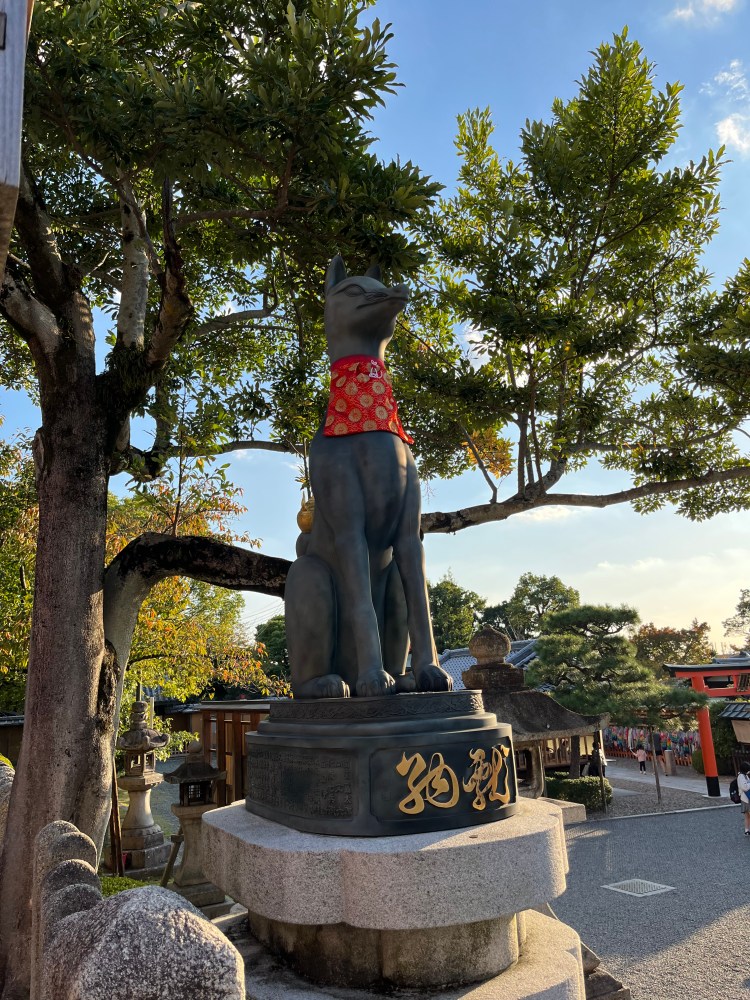
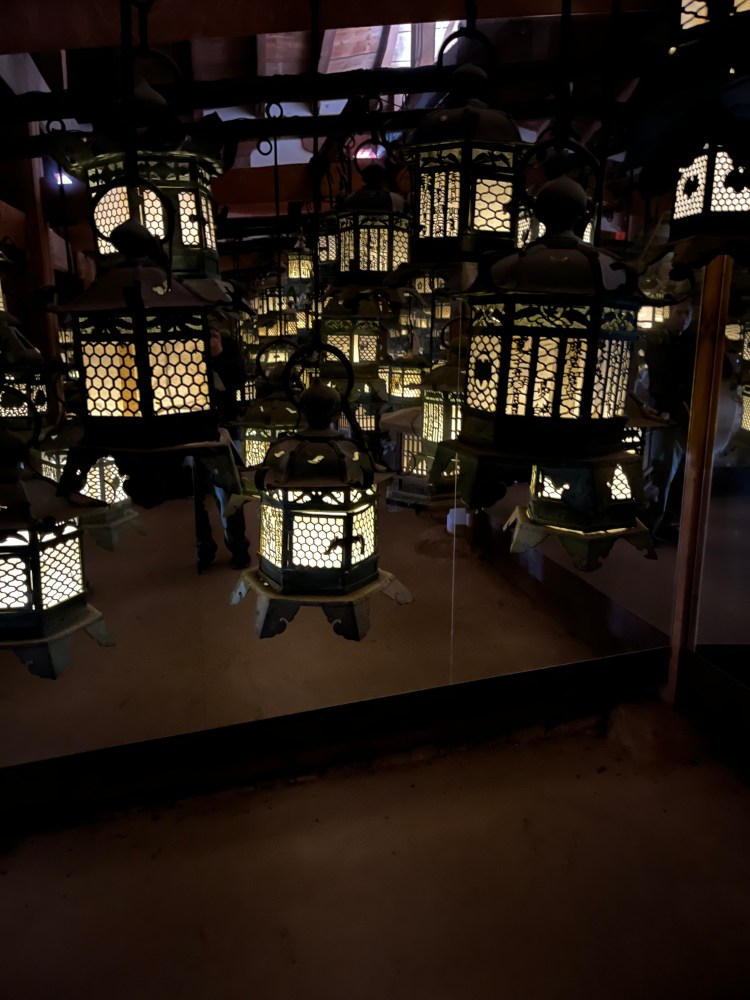
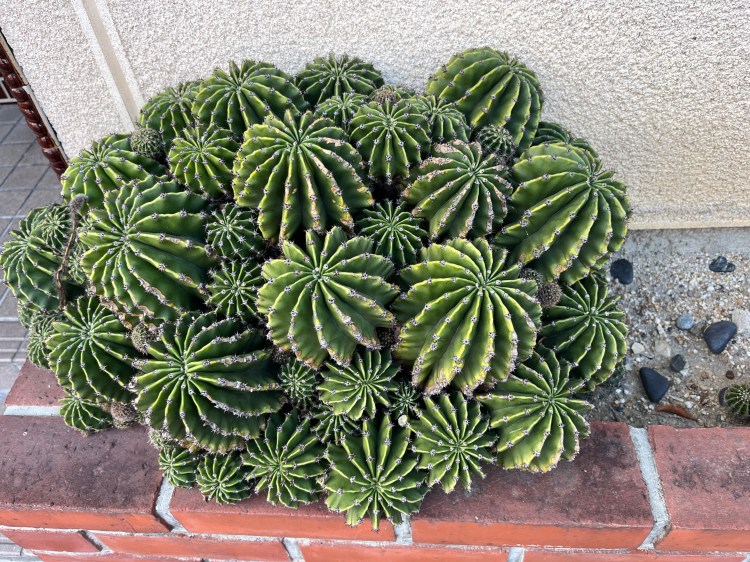
Here are some random pics that I didn’t post before.
I’ve no idea!I had to have some!Fox guardianLanterns in the dark
We had some of our most complicated transportation arrangements today, using several metro lines and a train line to get to the west of the city.
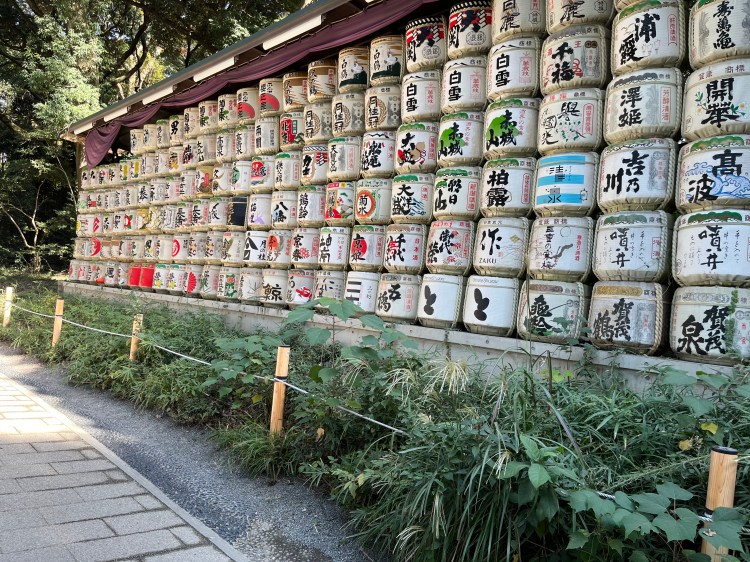
Our first port of call was to the Meiji-Jingu shrine. Set in a wooded park, this was dedicated to Emperor Meiji and Empress Shoken in 1928. There are several buildings, but there was a service going on in the main shrine and we were told we couldn’t watch unless we wanted to pray.
Sake offerings to the shrine
There was some kind of event featuring chrysanthemums, but we couldn’t work out what it was.
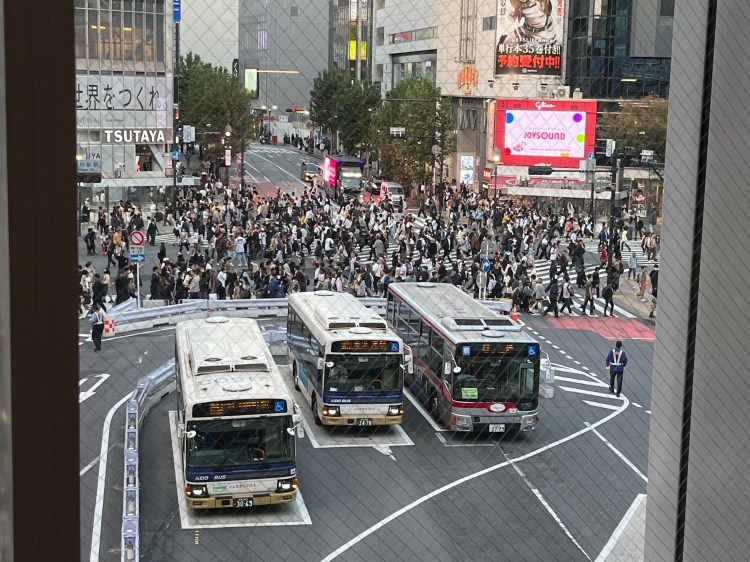
From there we travelled on to Shibuya, to see the famous crossing there. It looks like a cross between Oxford Circus and Piccadilly Circus. Like the former, it is a scramble crossing, meaning that you can cross diagonally, but it is also covered with advertising like the latter. When the little man turns green, it is a mass scramble as people pour across in all directions. We didn’t stay long.
Shibuya crossing
We next had to get to Setagaya Daita, which was a few stops further west but on a different line. Finding the platform was a real mission, as this was an elevated railway in a totally different building. However, find it we did and we were also lucky enough to get an express service that missed out the next three stops.
We then went in search of some lunch. We spotted a likely looking place located near a level crossing. They only had three things on the menu, but it turned out that two of them are only available on holidays. So we settled for three sandwiches and a bowl of pickles. The level crossing seemed to close every couple of minutes, but it didn’t seem to cause any problems. Maybe the people complaining about the level crossing in Bicester should come and see how easy it can be.
Shimokitazawa, the area we were in is one of Toyko’s trendiest neighbourhoods, and we were booked on a tour called Cool Tokyo. We were a bit early at the meeting place, so we went into a nearby coffee bar to pass some time. A few minutes later, this guy comes in and asks if we’re Steve and Diane. This was our guide and that’s how few westerners there are in this area!
For once, we didn’t have to struggle with his name – Brad. He’s an American who now lives in Japan doing walking and cycling tours in the summer and skiing tours in the winter.
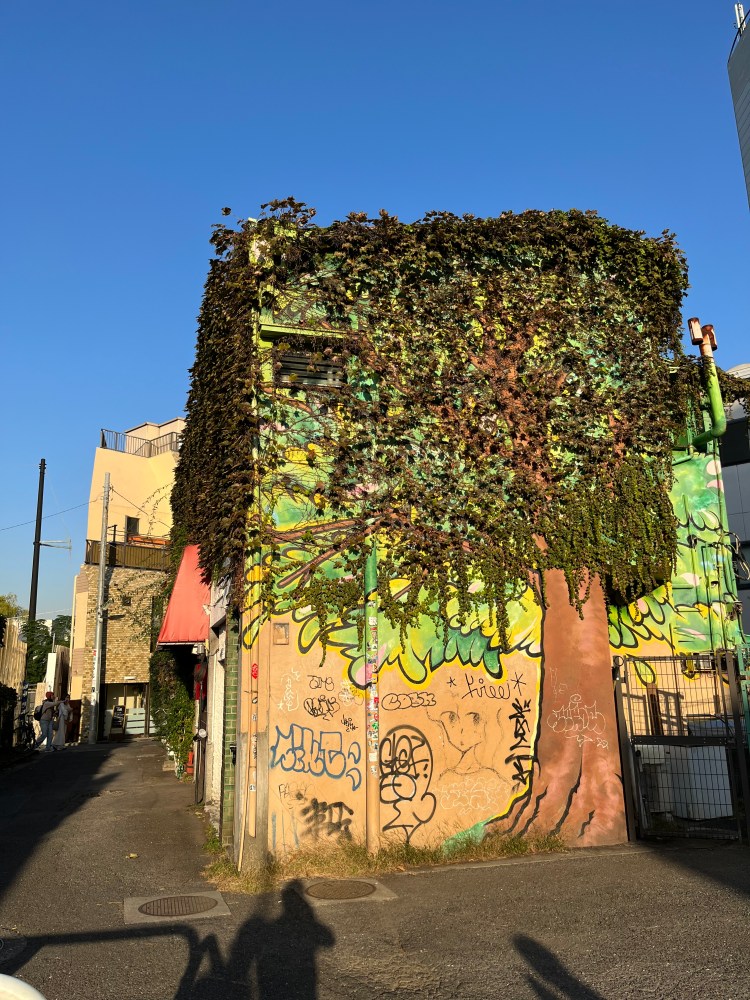
He gave us some history of the place and then took us around the narrow streets and alleys of the area. There are vintage clothes shops, arty cooperatives, vegan and vegetarian stores, graffiti and food!
Graffiti
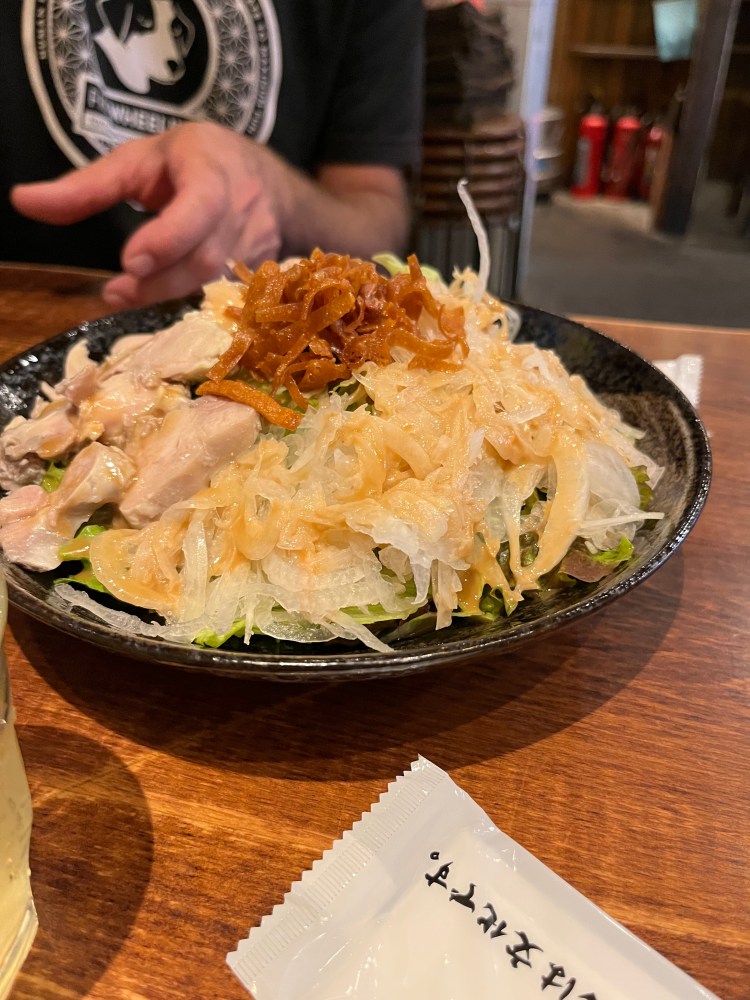
At one place Brad introduced us to Mushi Dori, steamed chicken salad, and gyoza, dumplings stuffed with minced pork, washed down with jasmine tea.
Mushi Dori
Further on we had sweet doughnuts with ice cream and at a third place we had some excellent coffee in a shop owned by a famous music producer. All in all, this was one of our favourite tours.
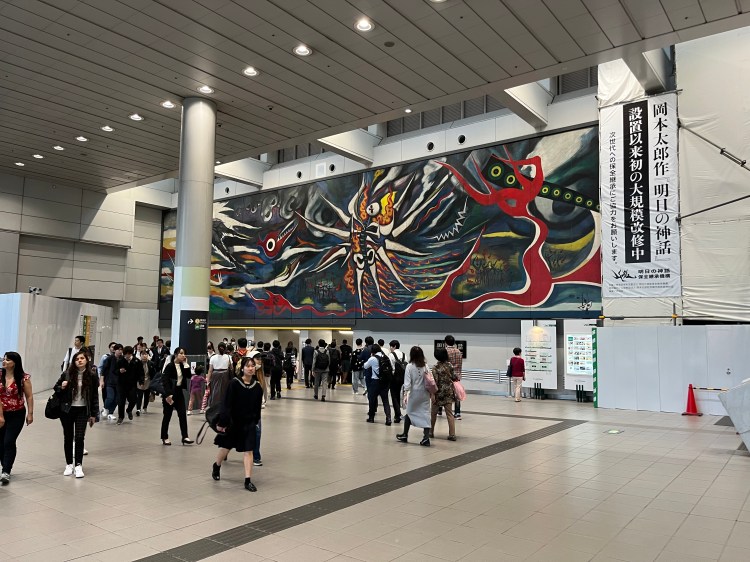
The bonus was that he told us how to switch from the railway line to the subway line at Shibuya so that we could look down over the crossing and see a famous artwork by surrealist artist Taro Okamoto. Called “The Myth of Tomorrow”, it is 30 metres wide and was painted in response to nuclear proliferation in the 60s. It was installed in Mexico City in 1968, but vanished in 1969. It reappeared in 2003 and was returned to Japan in 2008.
The Myth of Tomorrow
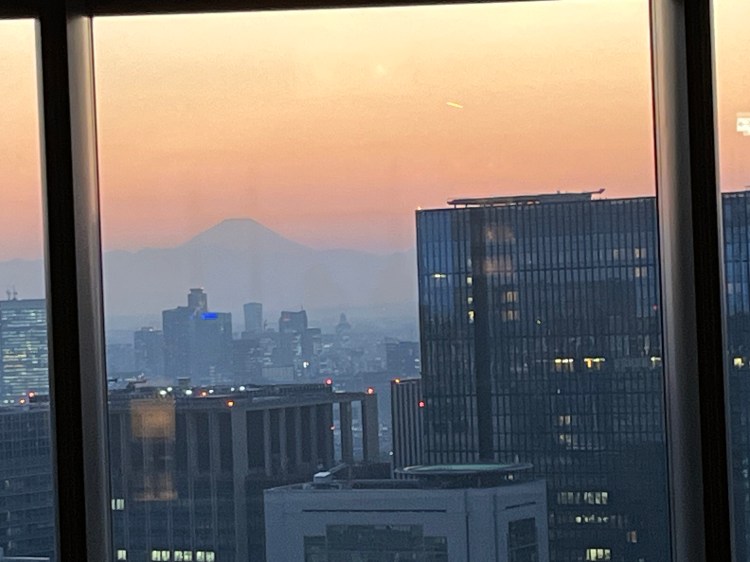
Back at our hotel, we finally got to see Mount Fuji. Since we’ve been here, it’s been too hazy to see, but we walked in just as the sun was setting and finally managed to get a glimpse of it.
We had a free morning today, so decided to head to the Yanaka area, a few stops north from our hotel. According to Audley, it has “an artsy ambience, with lots of craft stores, coffee shops and the odd friendly cat”.
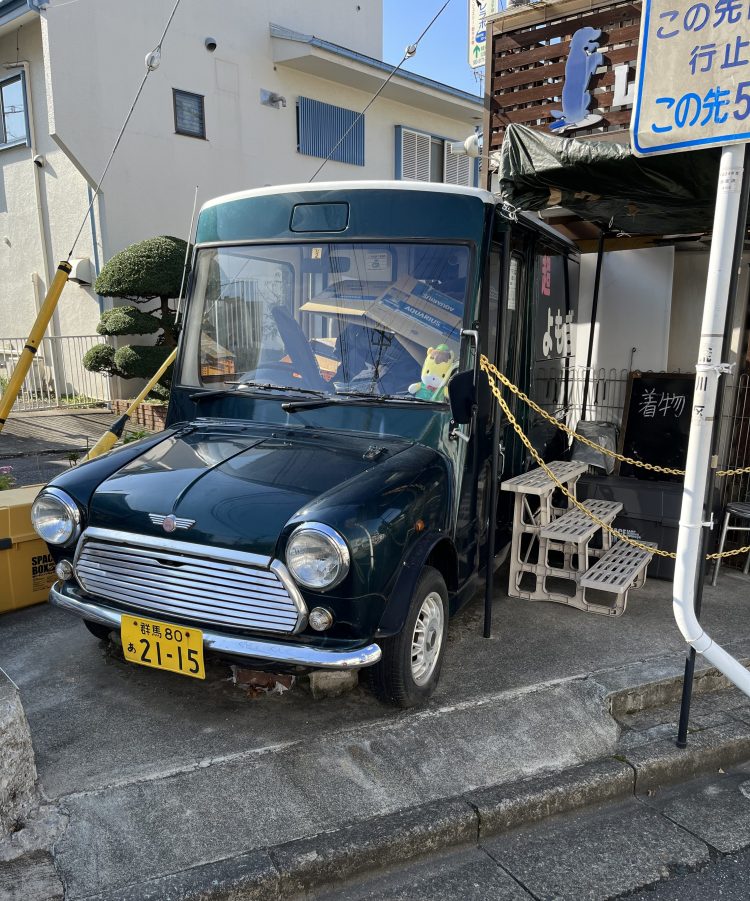
We negotiated the railways successfully and struck out for Yanaka Ginza, a “shopping street” with a very different feel to the main areas of Tokyo. Some of the shops were no bigger than the average living room, and you could get all sorts of weird and wonderful things. There was a delicious smelling organic bakery, which would have been a great place to stop if we hadn’t just had breakfast.
Slightly modified mini
As we walked down the street, I felt it looked a bit like an oriental Petticoat Lane. At the end, we turned the corner and there was a shop called Petticoat Lane! No idea what it sold, it was closed.
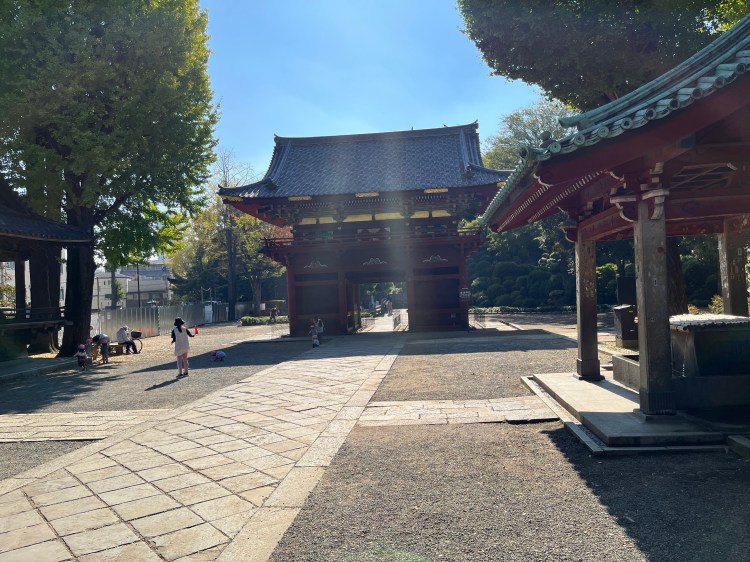
From there we walked on to the Neju Jinja shrine, one of the oldest in Japan. It was a bit like a commuter’s place of worship really; people would turn up, say a quick prayer and then continue their journey. It was a lovely day, the sun was shining brightly and there was a bunch of tiny children playing wherever you tried to get a photo!
Neju Jinja shrine
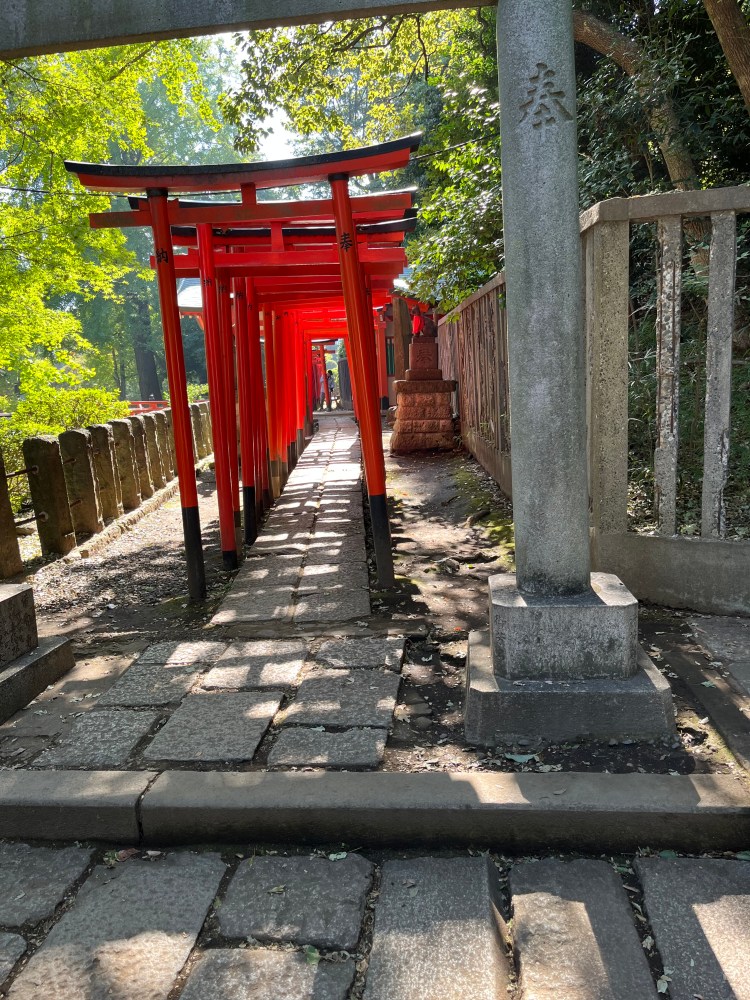
As well as the main shrine, there was also a series of tiny Torii gates meandering around the area.
Small Torii gates
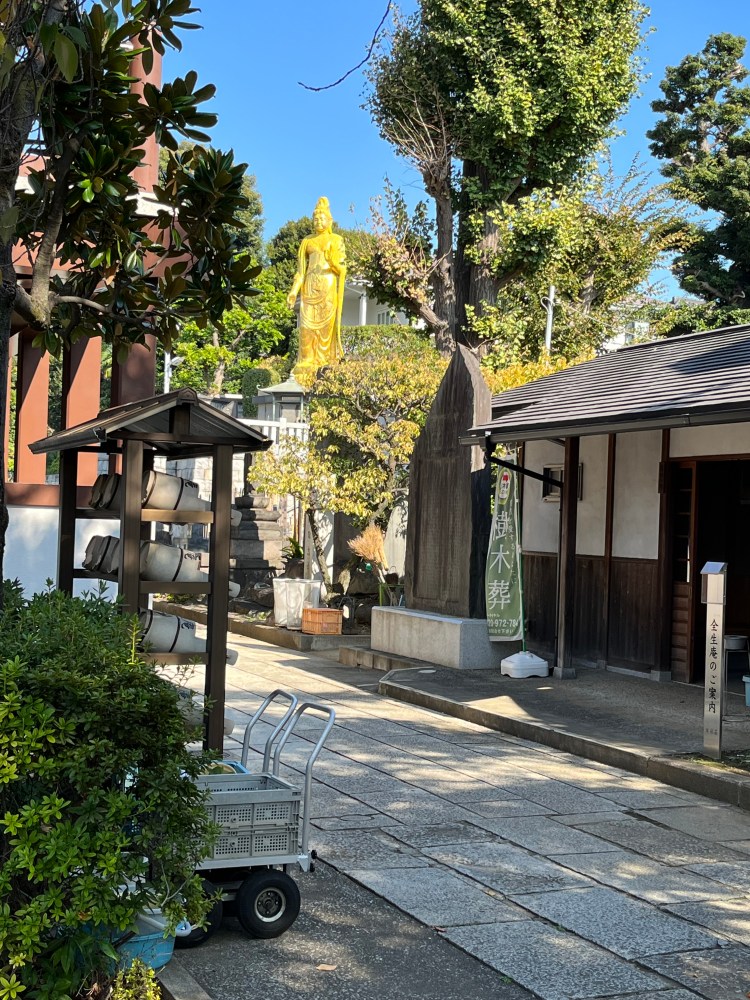
From there we headed off to Yanaka cemetery. On the way we just happened to stumble upon the Zensho-an temple. I can’t find out anything about it, but it does have a huge golden Buddha guarding its cemetery.
Golden Buddha
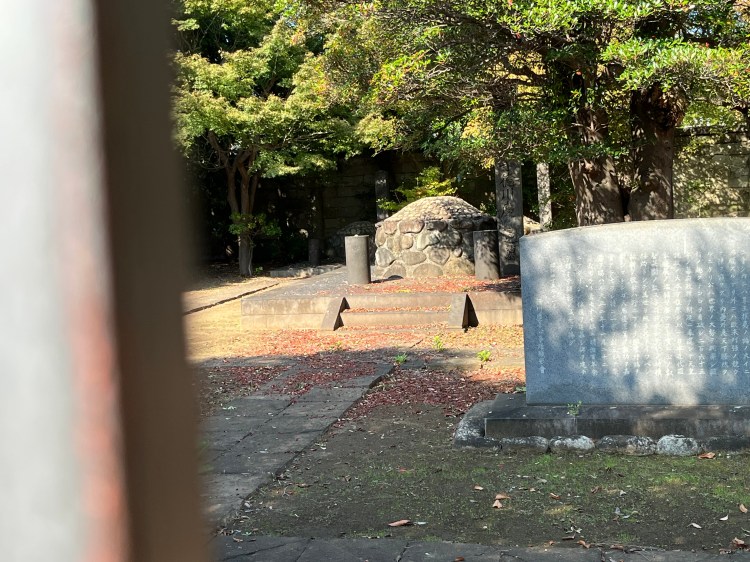
After a coffee stop, we finally arrived at Yanaka cemetery. It seems a bit like Highgate cemetery, full of celebrities, most of whom you’d have to be Japanese to know about. We did manage to locate the tomb of Tokugawa Yoshinobu, the last Shogun before Imperial rule was restored.
The last Shogun
We then headed back to the station and were fortunate to get there just as a train arrived. It turned out to be an express train and we couldn’t work out where it was going, so we got off at the next station to change onto the orange metro line. Which worked out quite well, because between the barriers we found a nice little restaurant and had a rice bowl instead of noodles for a change.
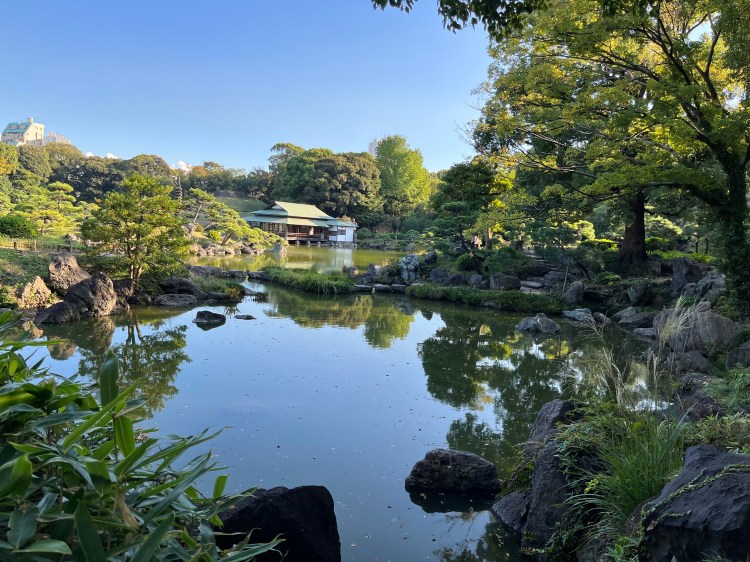
Back at the hotel, we met up with Tomie, our guide for the afternoon’s tour. We started off at Kiyosumi Gardens, originally created by Iwasaki Yatara, founder of Mitsubishi. He had a penchant for rocks, and brought them in from all over Japan. Apart from that, there’s a man-made lake with an island in the middle and walkways all around the garden. As ever, there are koi carp living in the lake, but this one also has turtles, heron and egrets.
Kiyosumi gardens
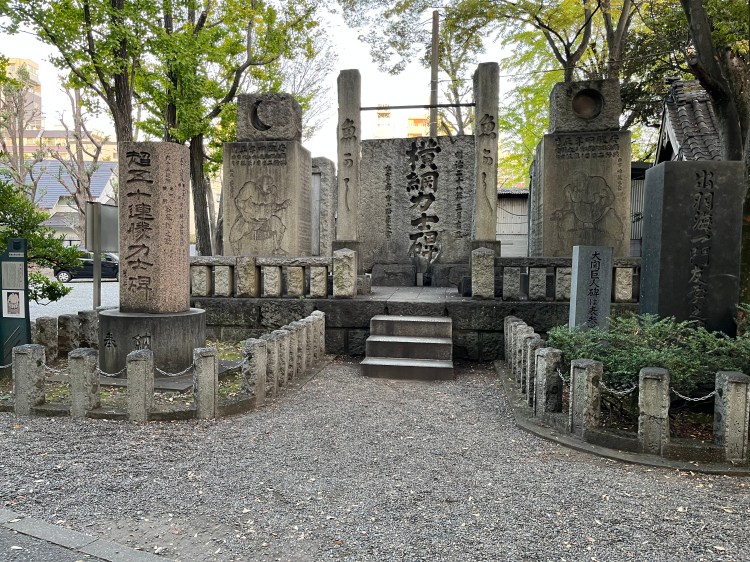
Back on the metro, we then went off to visit the Tomioka Hachiman shrine, birthplace of Sumo wrestling. The shrine itself looks much like any other shrine, but on one side there’s a series of stone blocks inscribed with the name of every top-ranking sumo until the 73rd.
Sumo Monument
There’s also a statue of Ino Tadataka, who completed the first map of Japan using scientific methods. He walked the coastline counting the number of steps he took.
Japan’s cartographer at work
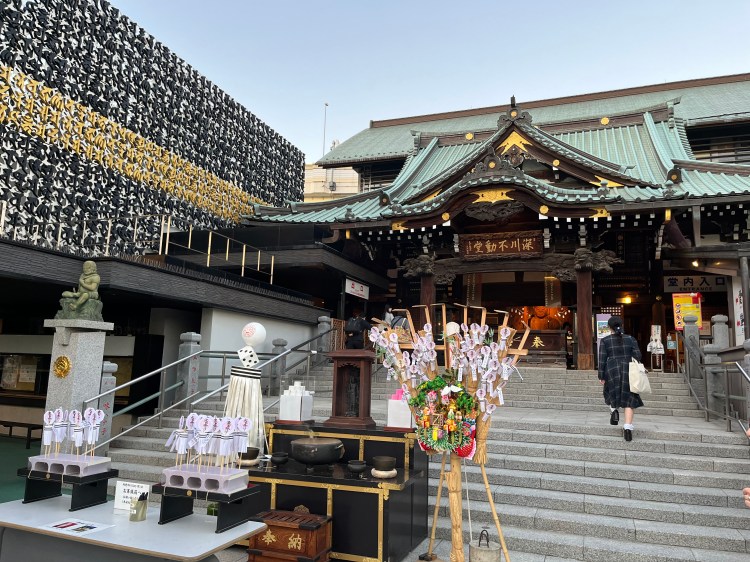
We were very lucky to be in the area on one of the days that the Goma fire ritual takes place in the Fukagawa Fudo-do temple next door to the shrine. The main deity of the temple is Fudo Myo, who drives away evil spirits. His statues are always very fierce, with fangs and weapons for doing his job.
Attached to the traditional prayer hall is a new hall in an incredibly modern design.
Fukagawa Fudo-do temple
Unfortunately, cameras aren’t allowed inside. You enter through the old building and move into the new one, with rows of seating, a low stage with an altar and statues of Fudo Myo at the back. The statues and other decorations around him are all black, and his eyes are lit from behind. Gold lanterns hang in front of the statues.
On the stage there are two huge drums and two bigger drums, all hung horizontally. At the start of the ritual, ten monks in very rich coloured robes enter, some of them playing conch shells, and they sit down with their backs to the worshippers. The head monk sits at the altar, the others in a line behind.
Somehow, a fire is lit in the altar and the monks start chanting. The fire is fed with firewood on which people’s wishes or prayers are written, until the flames are literally shooting out of the altar. At various points, two pairs of monks take turns at drumming, and someone I couldn’t see is beating out a tune. At the end of the chanting, worshippers move to the front and each one hands off a personal item to the monks, a child’s toy, a handbag, and so on. The monk takes the item, puts it close to the flame and then gives it back. Our guide wasn’t very clear on the reason for this, but it seems to be some kind of purification or blessing.
It’s difficult to describe this in words, but it is a spectacular ritual and very moving; we felt privileged to be part of it.
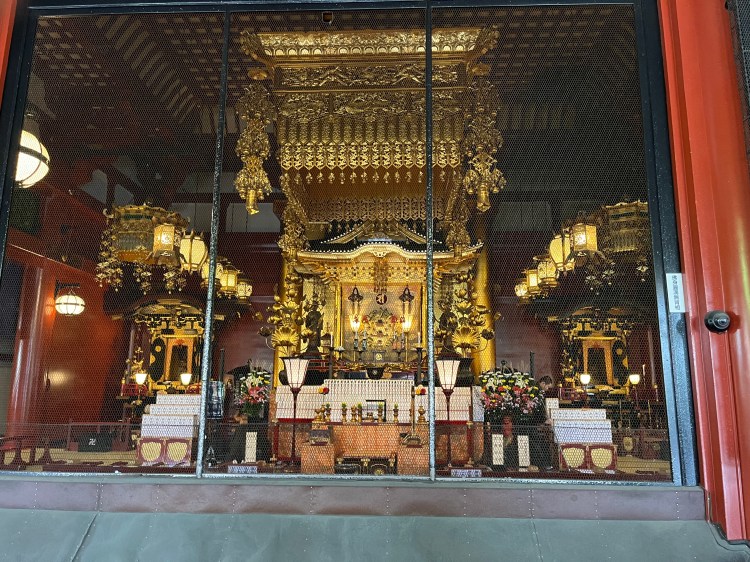
Our guide this morning was Momoko, and she was taking us on a classic tour of Tokyo. We headed down to the Metro station and travelled to the end of the orange line to visit the Sensoji temple, the oldest in Tokyo.
Legend has it that in 628, two brothers fished a statue of Kannon, goddess of mercy, out of the Sumida river. Even though they threw it back into the water, the statue kept coming back to them. In the end, they decided to build the statue a temple, which has been added to over the years making it rather grand today. Trade sprang up too, so the space between the first two gates, about 200 metres long, is now a series of tacky souvenir and food stalls.
Sensoji temple
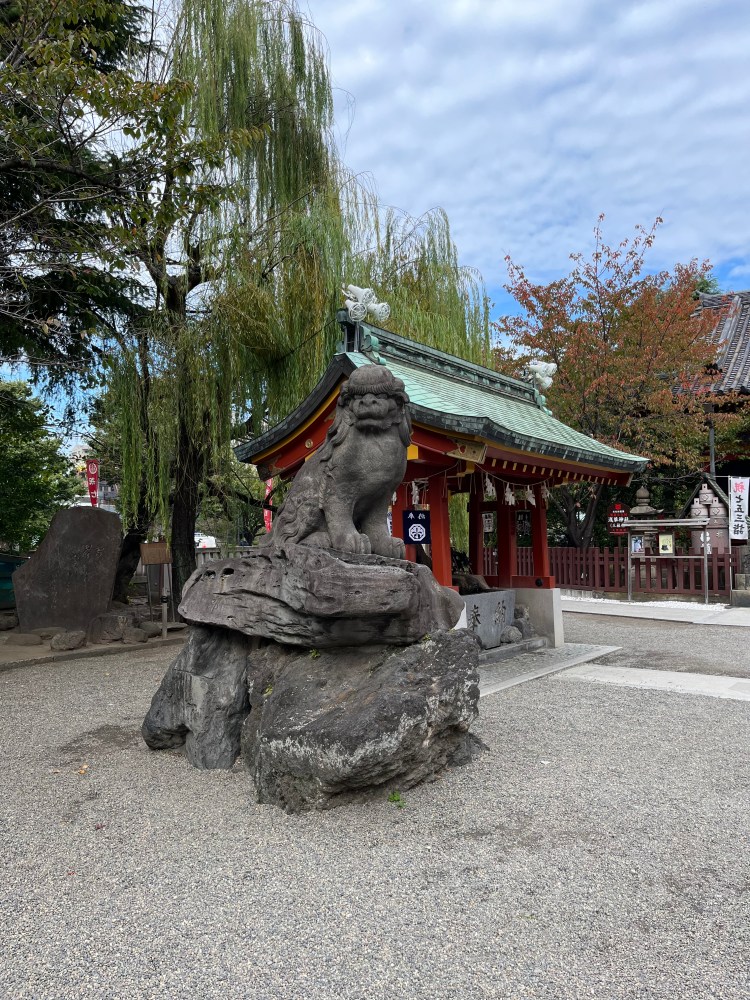
The location is unusual in that it also contains the Asakusa Shinto shrine, along with it’s guardian dogs.
Shrine guardian
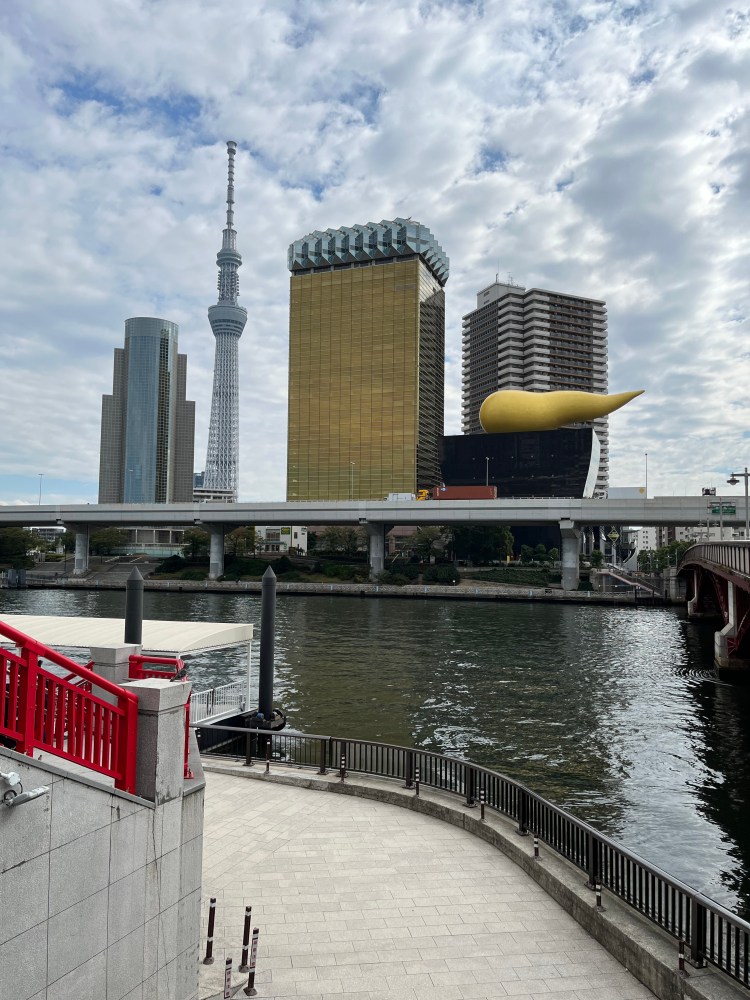
After a coffee stop, we went to see Sumida river. The most interesting thing about the river is the HQ of Asahi, one of Japan’s biggest beer manufacturers. The building was built to resemble a glass of beer with a head on it. Our guide didn’t know what the yellow parsnip was about, so we googled it. The lower black building is the Asahi beer hall and the parsnip is supposed to represent the burning heart of Asahi. The flame is often referred to locally as the golden turd and the beer hall as poo building!
Asahi HQ building
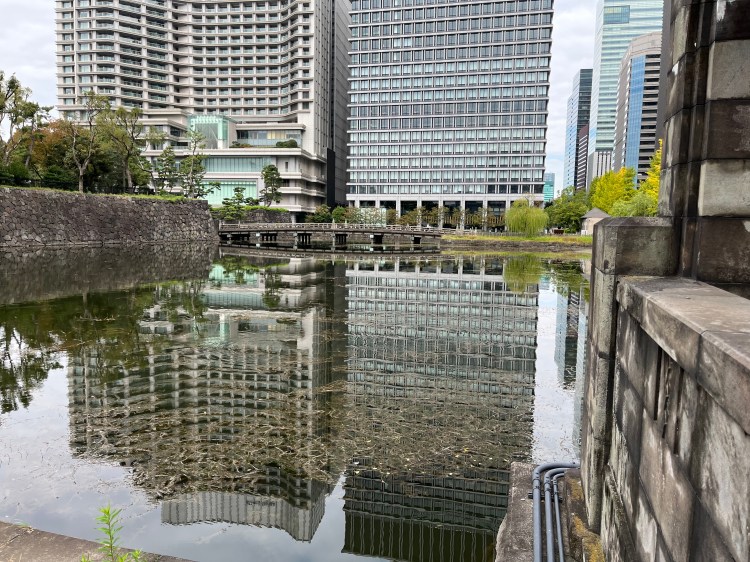
We then returned to the subway and took a train to Tokyo station to visit the Imperial Palace. During the Shogunate, the Emperor used to live in Kyoto, which was the capital. The Shogun lived in the palace in Edo. When imperial rule was restored in 1868, the Emperor moved into the Shogun’s palace and Edo was renamed Tokyo and became the capital. And that’s about as much as we know about the place. It is quite a walk from the station and you can’t get anywhere near the palace itself.
Old and new
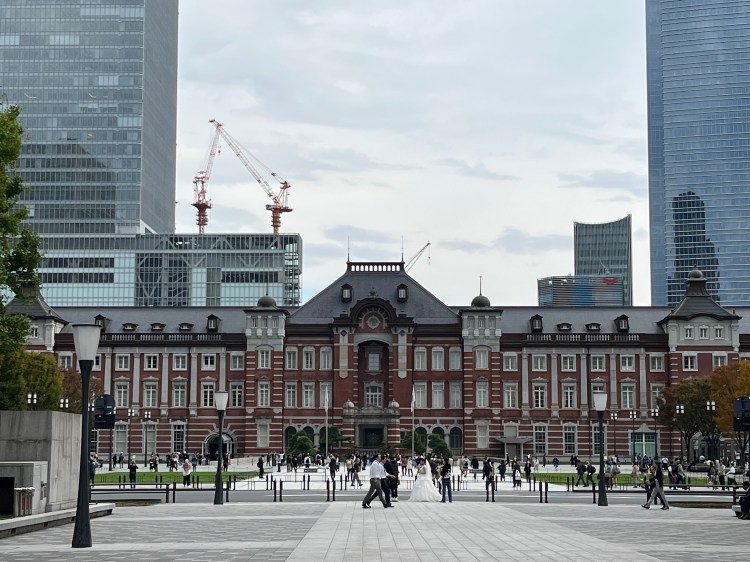
We didn’t see the outside of Tokyo station when we first arrived, so Momoko took us back a different way. The station building was one of the first brick built buildings, due to the fact that it was built after Japan opened up to the west and bought steam locomotives from the UK. With all the sparks flying, it was considered too dangerous to build a wooden station! The front entrance is only ever used by members of the royal family, lesser mortals have to use a different entrance.
Tokyo station
Our tour ended here, so we said goodbye to Momoko and went looking for noodles.
After that, we had to do some more navigating of the Metro. Having been right to the end of the orange line, we now had to go almost to the start to find a Taiko drumming school. We were booked onto a private Taiko experience.
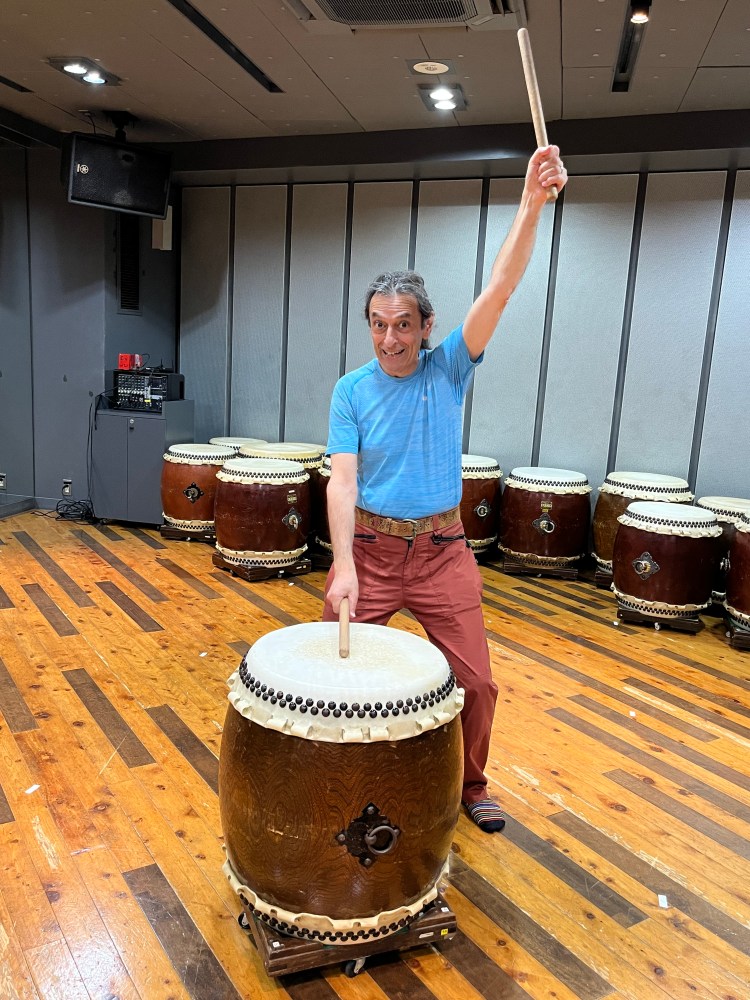
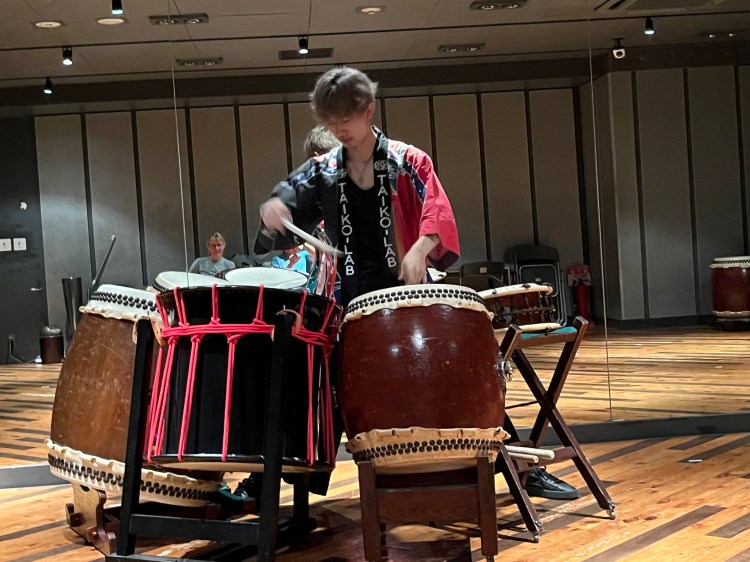
Our teacher was Ikkei, and he started by showing how to hold the sticks and bang the drum. After that, we learned three basic sequences and eventually put them all together. He then dimmed the lights and got one of his colleagues to video us going through the complete sequence as a performance. It was exhilarating, but also very hard work.
Taiko Diane
Ikkei then gave us a private performance playing five drums, which left him totally bathed in sweat. And he does this for a living!
Taiko Ikkei
Not knowing how long we’d be out, we made a reservation at the Chinese restaurant in the hotel this evening. I’m not sure how authentic it was, but it was very different from an English Chinese meal. Once we got it over to the waiter that we didn’t want squid, abalone, whelks, sea urchin or swallow’s nest, we had a very nice meal. But each course came separately, which makes for a very long meal.
Since Kyoto, we’ve been in relatively small places with relatively small buildings. That changed today! We caught the bullet train to Tokyo and when we finally found the exit from the station we were surrounded by very tall buildings, to the point where our map app was struggling to find us.
We decided to walk to the hotel to get a feel of things, but we made a pit stop on the way for a coffee and pastry. It was a bit like being in Caffè Nero in Oxford, full of young people studying.
We found the hotel without any trouble, it had Mandarin Oriental plastered across the ground floor facade, but we couldn’t find reception. We asked at an information desk and they directed us to the hotel’s elevator and told us to take it to the 38th floor. Our room is only on the 35th floor, but it still has a great view from the wall to wall windows at one end.
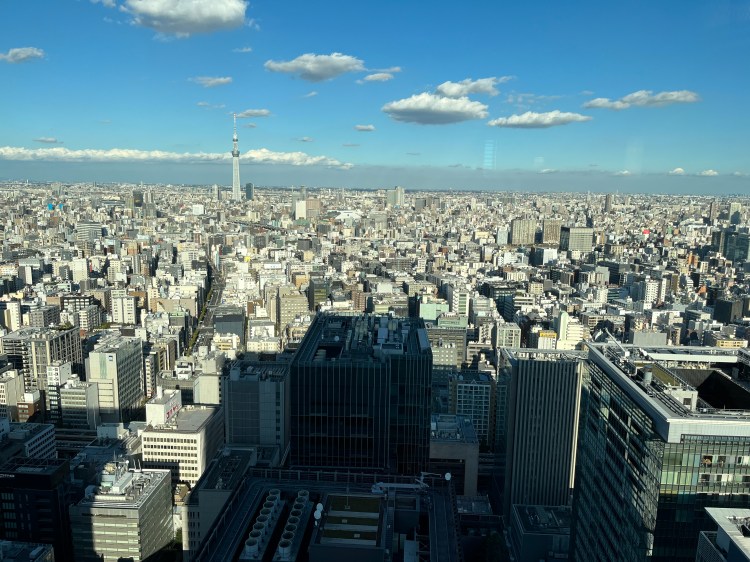
Daytime view from our room
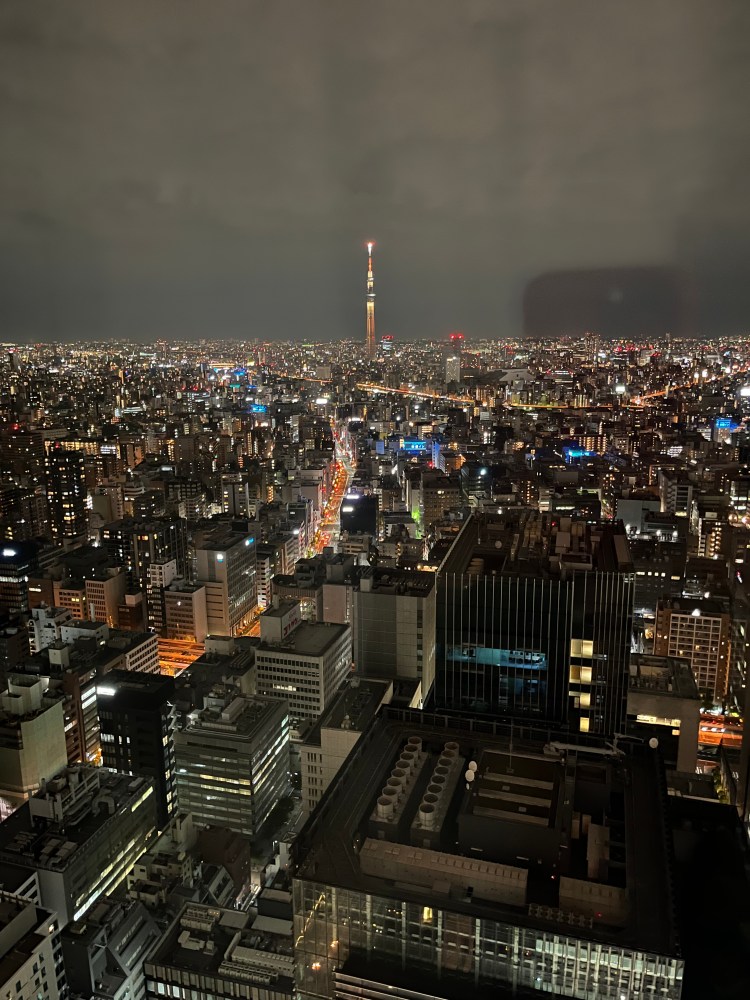
They even supply a pair of binoculars in the room to give you a better view. You can look down on the bay and look up at the Tokyo Skytree, the tallest tower and third tallest structure in the world. It was built because the Tokyo Tower was no longer tall enough to provide full TV broadcasting coverage because of all the other high rise buildings around it.
This evening we had a special meal laid on for us by the travel company to apologise for some issues we had earlier in the year. We decided to go on the metro, one line of which has a station right under the hotel. It isn’t the line we wanted, but there is an interchange with our line if you don’t mind a 10 minute walk against the tide of home going workers. We travelled one stop on the purple line to another large station that seemed to be an interchange to lots of other lines. They give each exit a number, which makes it very easy to find your destination, in our case exit A13c, which is in the basement of the Palace Hotel.
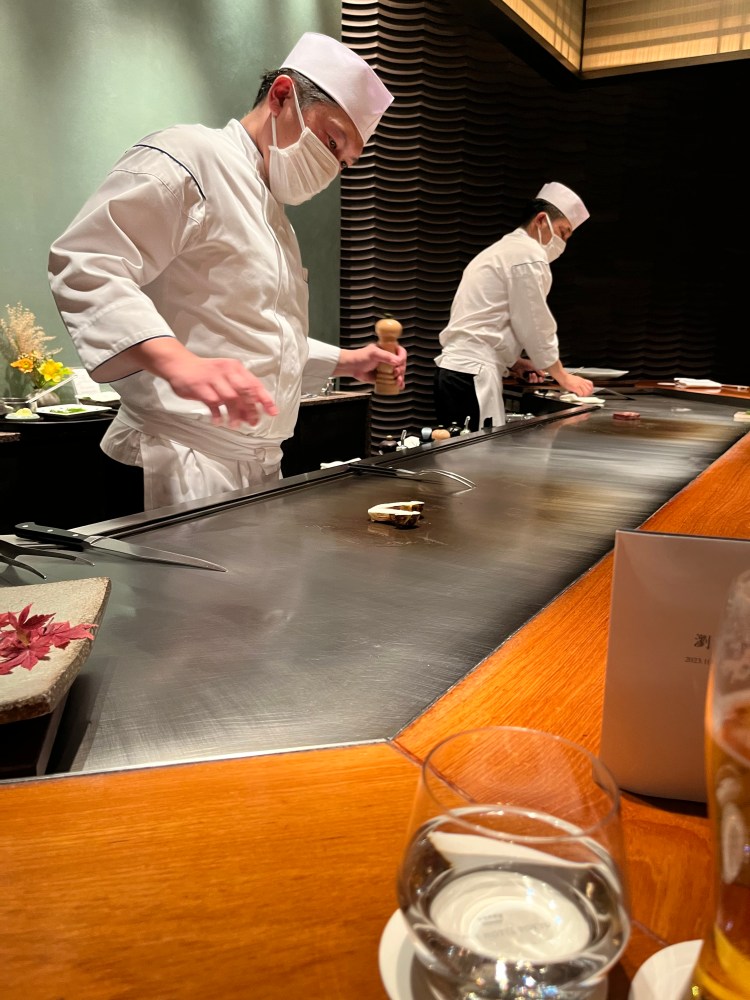
We found our restaurant on the sixth floor. We’d booked a Teppanyaki meal, where the chef cooks the food on a grill in front of you. And because we couldn’t decide, we went for a set meal with 10 courses! The place setting included a bib, which the waitress very firmly covered us up with. Things we’d never had before included soft shell turtle, abalone and sea urchin. Things we are unlikely to ever try again include soft shell turtle, abalone and sea urchin!
Our chef at work
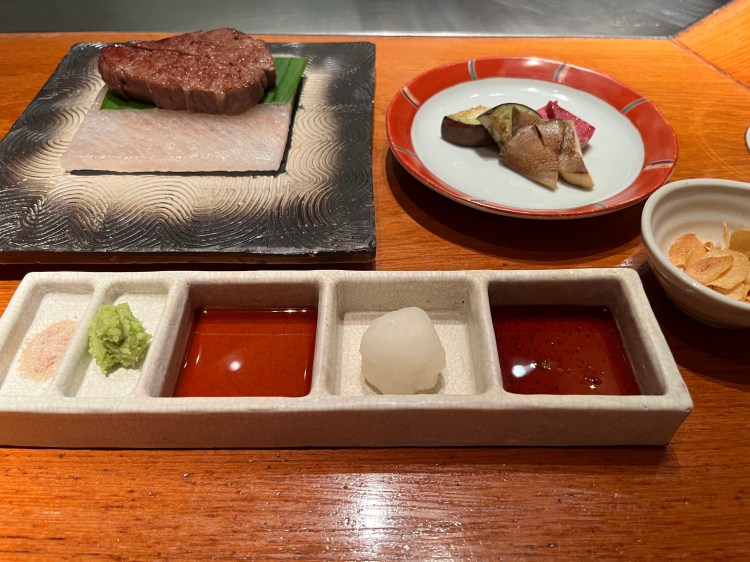
The other courses were excellent, especially the Kobe beef chateaubriand, something I wouldn’t normally eat.
Kobe beef
The whole meal took over two hours, and it’s fair to say we were both feeling pretty chubby when we left.
We set off on foot with Kiyomi, our guide, to explore the Samurai area. To get there, we had to go through the Oyama-jinja shrine, belonging to the Maeda family, the richest of the feudal lords. It would have been very peaceful if it weren’t for the helicopters buzzing around filming the marathon!
The shrine itself is very simple, but there are several other buildings, as well as formal gardens and some more modern artworks.
Maeda Shinto shrine
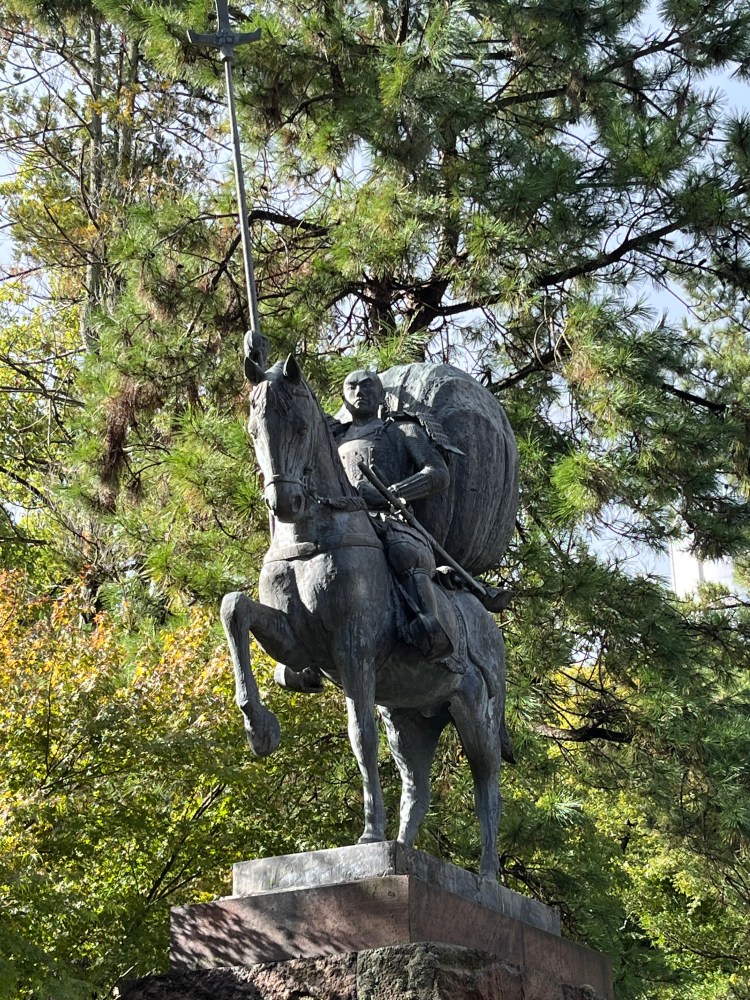
We even met the first Maeda lord on his horse.
First Maeda feudal lord
Several buildings from the Samurai or Edo era have been moved to the area, to illustrate what life was like at the time. I was quite surprised to hear that there were middle and lower class samurai too. First and foremost they were soldiers, but in times of peace they were administrators, artists, teachers, etc.
In one house, we saw an indoor fireplace, which explains why there were so many fires in these buildings. There was also a well. We visited the Nomura house which belonged to one of the richer families and has now been turned into a museum. The feudal lord collected all the taxes from his lands and then paid his followers in rice. Nomura was awarded enough rice to feed 1,200 people for a year, so he was quite well off.
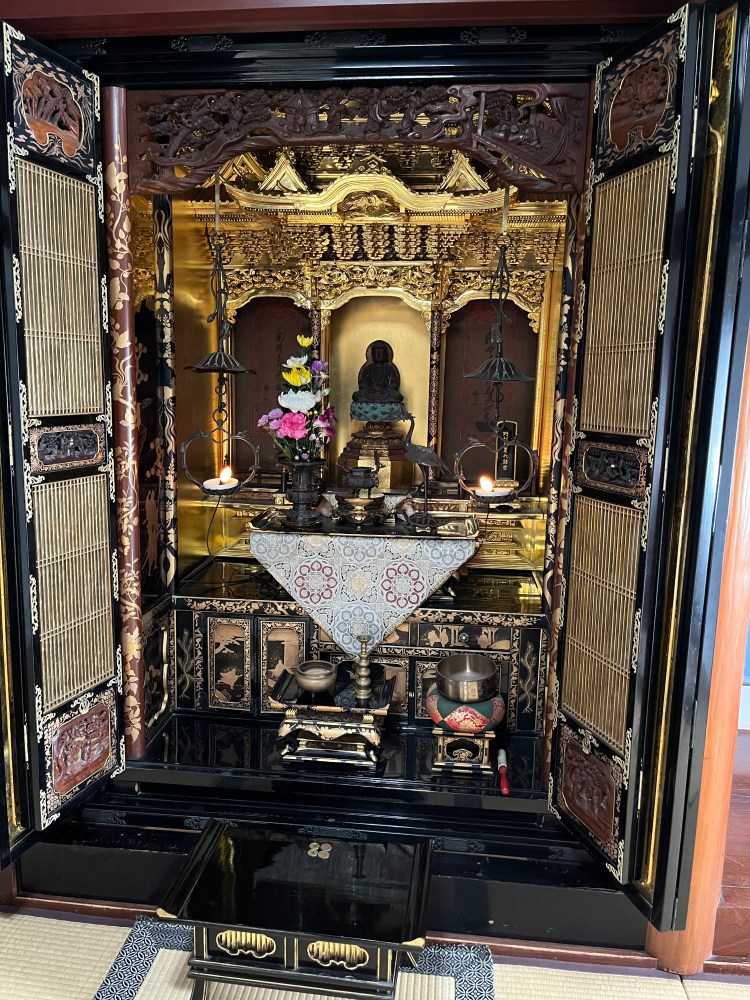
Nomura Buddhist shrine
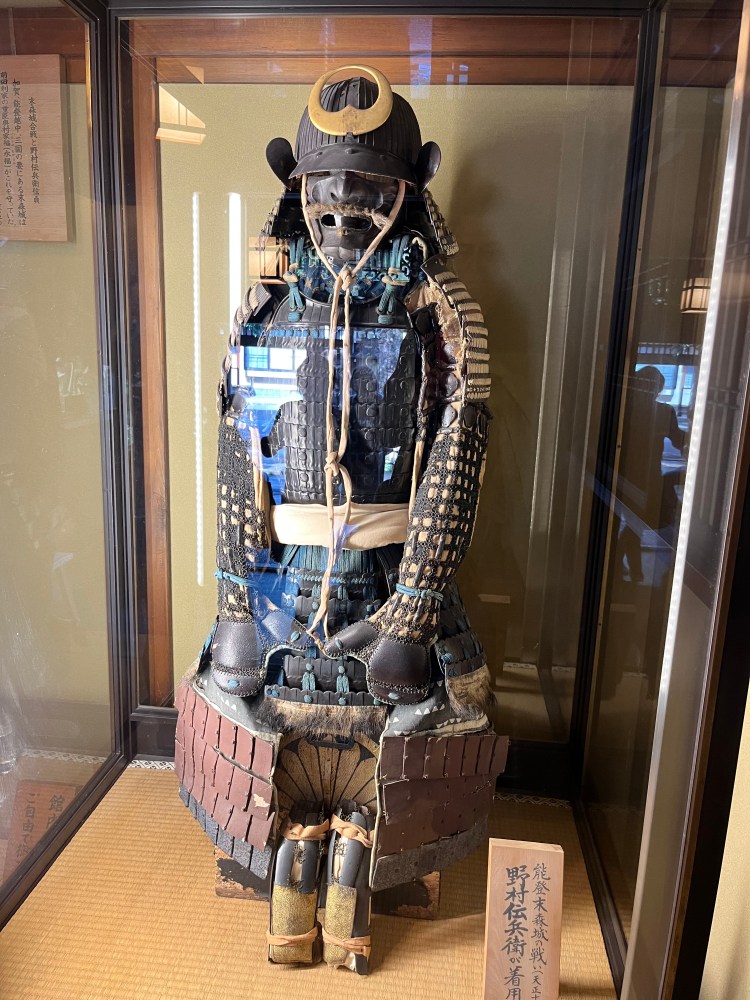
Among the exhibits in the house was a suit of samurai armour and a thank you letter for killing a rival and sending his head!
Nomura samurai armour
By this time, we needed a coffee break so we stopped at the strangely named Moron coffee shop.
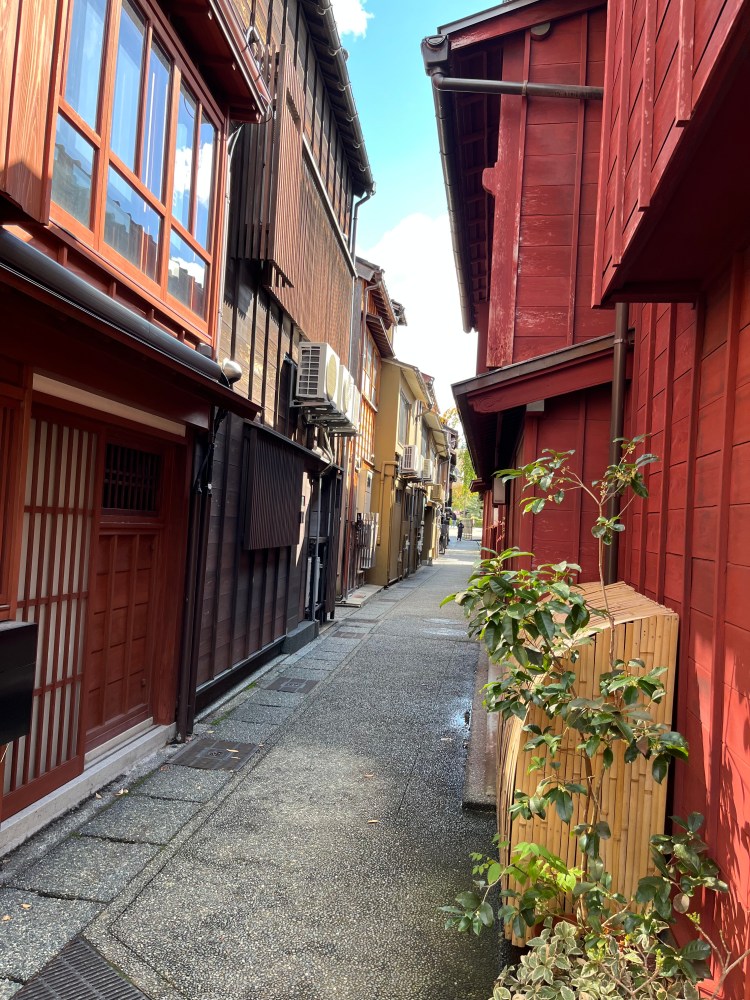
From there we took a taxi to the Geisha, or Chaya, district. Well, we would have, but the last part of the road was closed due to the Marathon. We walked through Kazuemachi Chayagi district, one of the smallest of the the three areas. Kiyomi explained that the Geishas are self employed, but to work they need to belong to a Chaya, or tea house. In the past, the Chayas might have been brothels, but prostitution is now illegal in Japan and the Geishas are entertainers instead.
Kazuemachi Chayagi Street
We were heading to Higashi Chayagai, the biggest of the three Geisha districts, but we still had to cross the route of the marathon. This was handled in a typical Japanese orderly way. We queued on one side of the road. The marshals directed the runners to the far side of an island in the middle and then let us through onto the island. Then they directed the runners to the near side and let us cross to the far side.
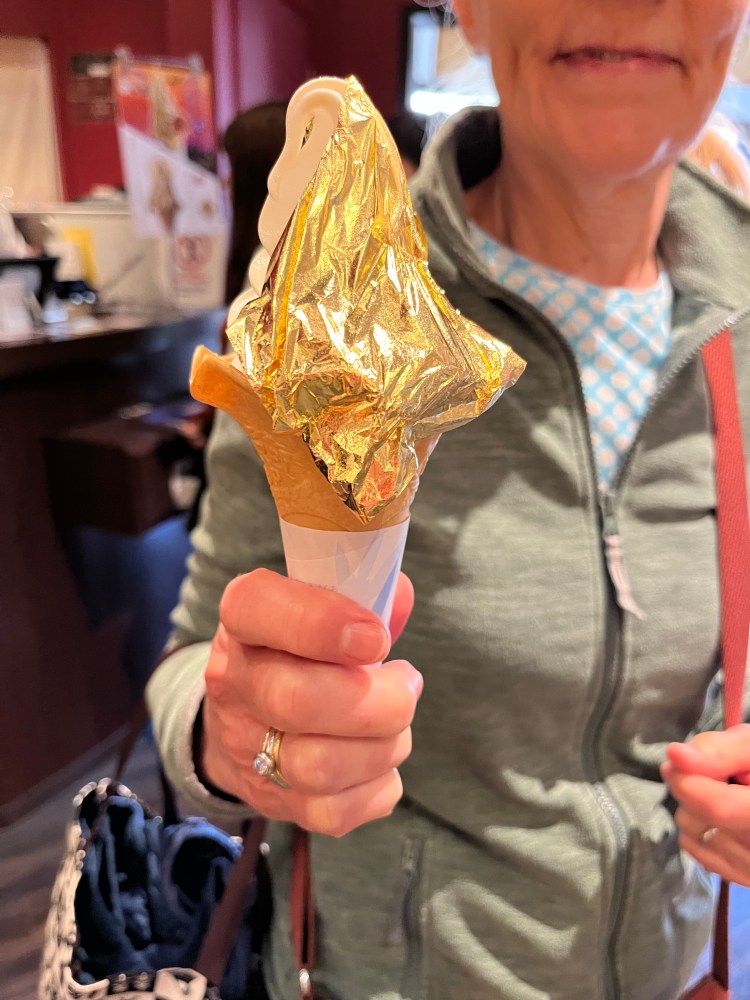
Whereas Kazuemachi was very quiet, Higashi was teeming with people. It is a warren of little streets, and most of the houses are externally as they were in the Edo period. However, there are only about 35 working Geishas left in the area, so a lot of the tea houses have been turned into restaurants, cafes and other types of shop. We visited one of these, a gold shop. Kanazawa means “gold pond”, and it is famous for its gold leaf products. One of these products is gold leaf ice cream, which we had to try. It tends to stick to your lips, but otherwise it’s like any other ice cream.
Gold leaf ice cream
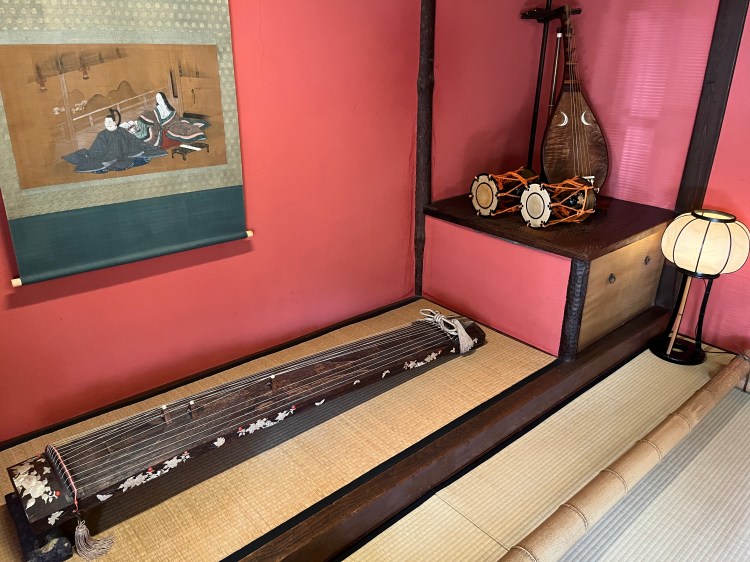
Our final port of call was a Geisha museum. This was another shoes off building, but this time we had to put all our bags into a locker as well. Geishas only entertain upstairs, which is where we started, looking at the variety of musical instruments they played.
Geisha entertainment room
The house has a tiny central garden and a room on each side.
Geisha house garden
Downstairs is the (female) owner’s domain, with a kitchen and office area.
Geisha kitchen
To visit a Geisha, you have to be introduced by someone known to the house; this helps ensure their safety. Samurai and Buddhist monks weren’t allowed to visit!
That ended our tour, so we parted ways with Kiyomi and went looking for some food. We ended up in another noodle bar, dining on Udon noodles and tempura. Then we meandered around the little alleyways, sheltered from the rain in a cafe and made our way back to the hotel.
When we checked in at Eiheiji yesterday, they gave us the opportunity to join in the morning prayers from 4am to 7am today. We politely declined! However, at 3:55 this morning, they rang a very mellifluous bell to wake everyone up, just in case. It failed to enthuse us to climb the mountain in the cold and damp.
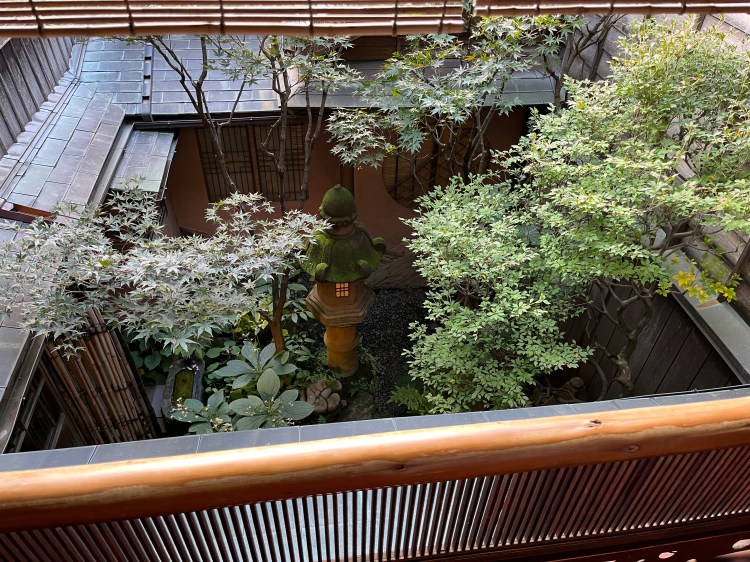
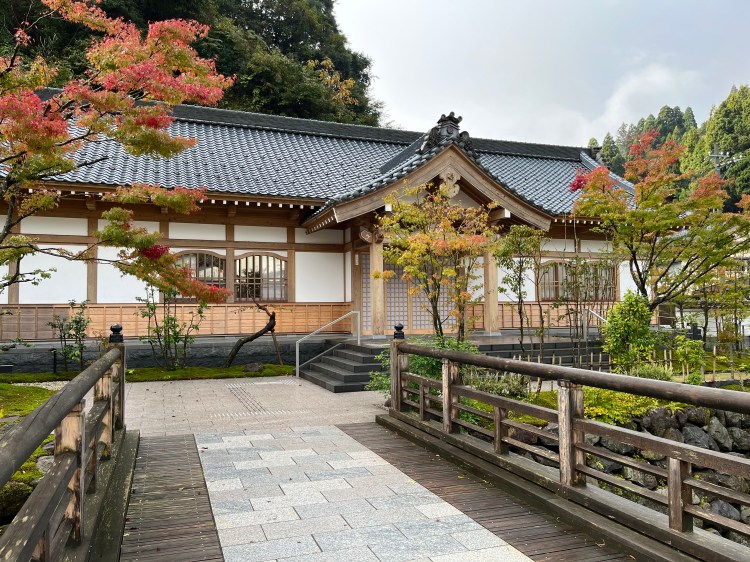
Eiheiji hotel
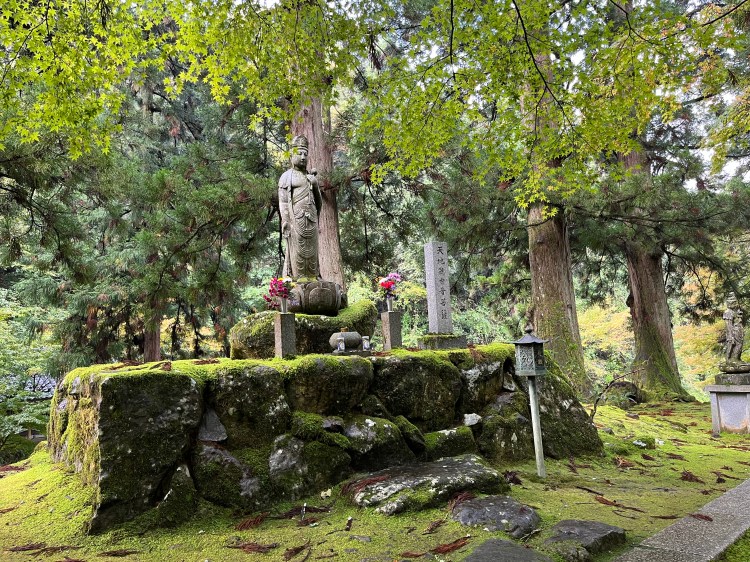
After a very nice breakfast, we did walk up to the temple to have a look around. We could only scratch the surface, as there are about 70 buildings in total.
Eiheiji grounds
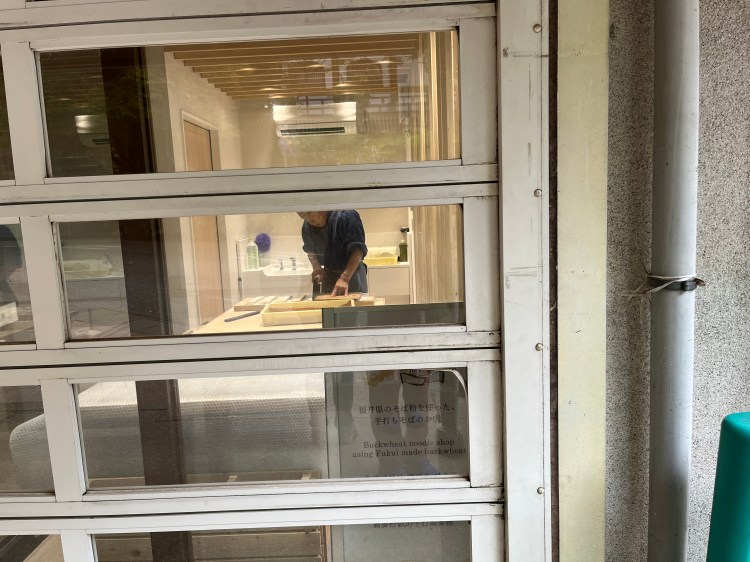
We also walked down the hill and into the village, where, among the souvenir shops and suchlike, we were able to watch a buckwheat noodle maker making buckwheat noodles by hand. He had a layer of dough covered by a metal tray and a very large cleaver. He cut against the leading edge of the tray, creating one noodle and pushing the tray back by the same width. At the end of the exercise, he had five bunches of noodles.
Noodle maker
Returning to the hotel, we took a taxi back to Fukui and boarded the Thunderbird to Kanazawa. Whereas we had a whole carriage to ourselves yesterday, today’s train was fairly crowded. As was Kanazawa station, the whole place was packed, along with the bus terminus outside.
We extricated ourselves from the crowds and headed towards our hotel. We were in what looked like a commercial district, so detoured onto a side street instead and found ourselves in a residential district.
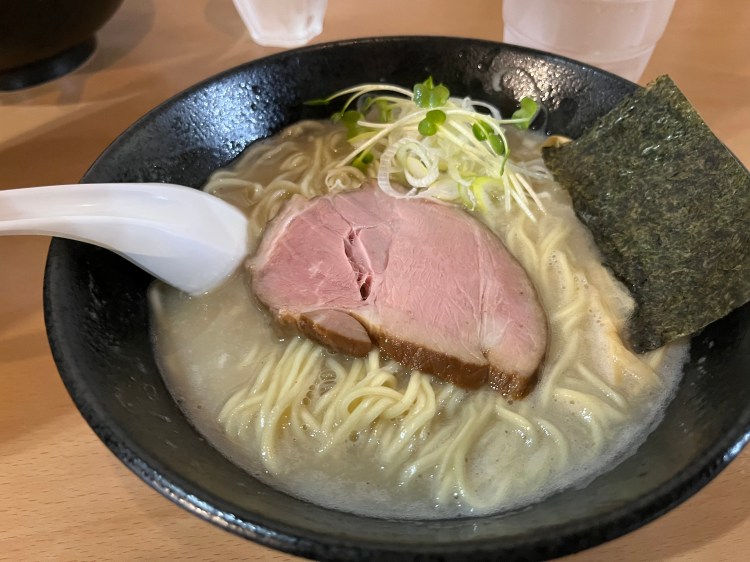
Up ahead, we saw a guy duck through a doorway and realised we’d stumbled on a ramen noodle bar. It was a tiny place, little more than a bar with stools where you could watch your food being prepared, plus a couple of tables at the end. It was so narrow, they even had a one way system; in through the front door and leave through the back.
But they didn’t speak English. We managed to understand that we had to pick what we wanted from the menu, put some cash into a machine and press the button for the item we wanted. The first step was easy, we decided on two number 7s, ramen noodles with creamy chicken and seafood soup. The second step was fine too, wave a 2000 yen note at the machine and it gobbles it up. The third step didn’t go so well.
I looked at the top row of buttons and pressed the one with a seven on it. Diane said “that’s 27!” And it was! Number 7 was on the bottom row, because that’s how they count in Japan. “So what is a 27?” I asked, thinking I could try that instead. The list only goes up to 24! So we had to get the guy from behind the counter and try to explain that we wanted 2 times 7 not 27! It took a while, but eventually he twigged we’d made a mistake, unlocked the machine and did some kind of reset and we started again. It seemed to keep the rest of the customers entertained, because we got a lot of smiles as we ran the gamut of walking past everyone to get to the table at the back.
Still it was well worth it; we’ll never see those people again, but they’ll be able to tell everyone about these dumb tourists.
Number 7
After that we started out for our hotel again, but it started raining heavily. I spotted a coffee shop, so we sheltered there for a while.
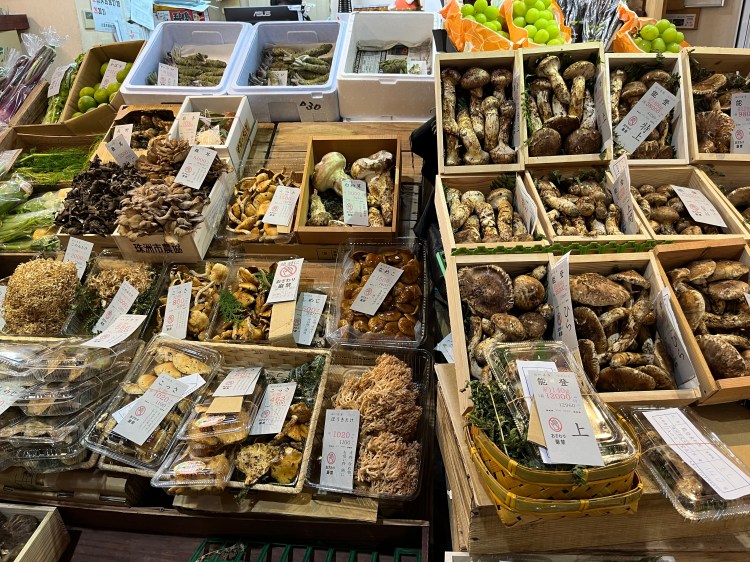
Then we came across Omicho market, the city’s biggest fresh food market which has been going for 500 years. They specialise in seafood, but there are all sorts of other exotic things, as well as several craft beer stalls. There were also several eating places, all of which had long queues outside.
They’re all mushrooms!
And finally … we made it to our hotel. We hadn’t expected to be able to check in, but they said our room was ready and our forwarded bags were already there. Which was useful, because Diane’s raincoat was with them because we hadn’t thought she’d need it.
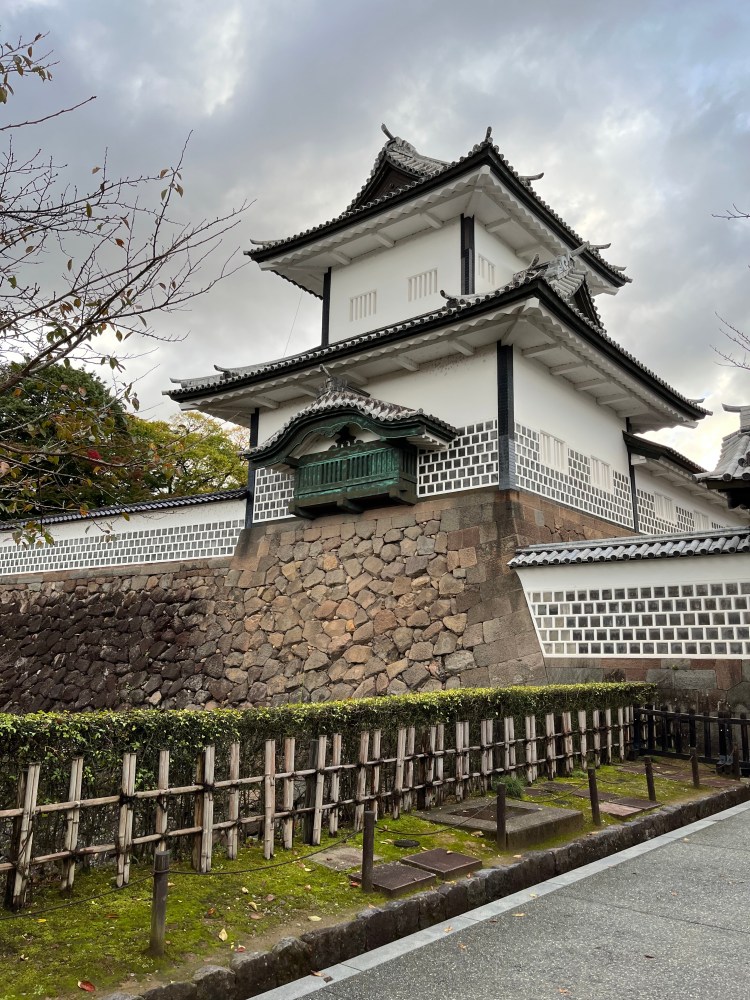
After a quick look at the room, we went out again to go and visit the castle and the Kerokuen Gardens. Originally built around 1600, the castle has burned down and been rebuilt several times. It has been a fortified temple, a residence of the ruling clan, HQ of the 9th Imperial Japanese Army and part of Kanazawa university. Pretty much all of it now is a reconstruction, and it was swarming with tourists today.
Kanazawa castle keep
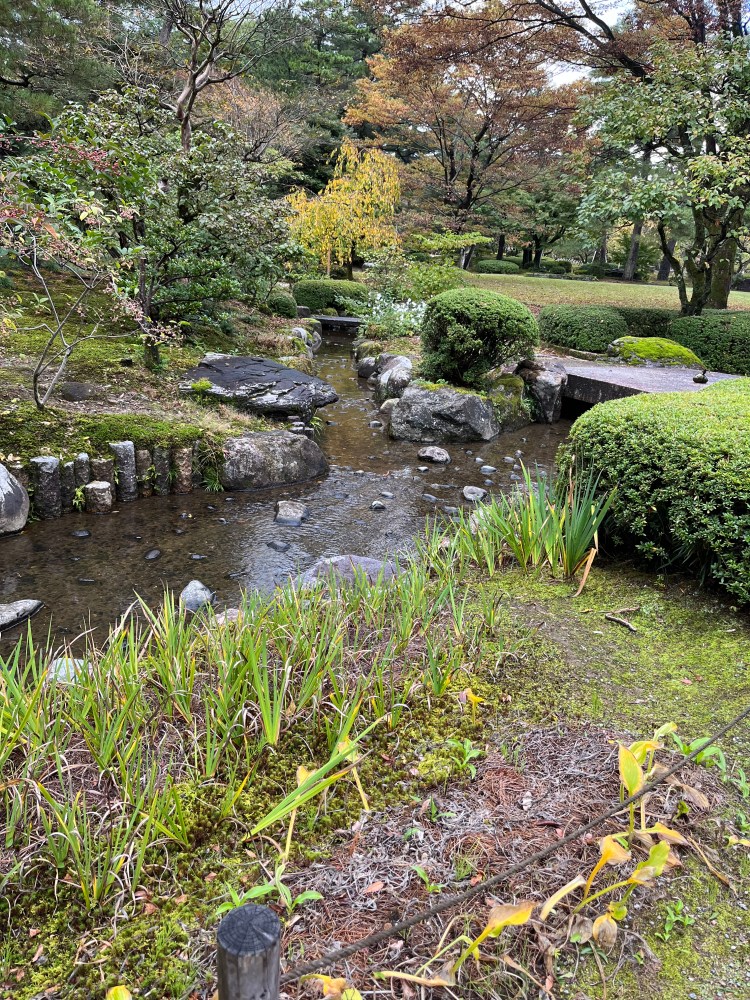
The Kenrokuen Gardens were originally part of the castle complex and also date back to the 1600s. Kenrokuen translates as “a garden combining 6”, referring to the six attributes of a perfect landscape garden. It is full of paths meandering around ponds, gardens and tourists, but very peaceful all the same.
Kerokuen Gardens
One other thing we found out about Kanazawa is that they are holding their marathon tomorrow, which should make our tour interesting!
Once again we set out to catch the ferry to Miyajimaguchi and then the train to Hiroshima. After a pastry in our favourite pastry shop, we negotiated the ticketing system to catch the Shinkansen back to Kyoto. It was two minutes late getting there! We noticed, because we only had 20 minutes to catch our connecting train. We called on our experience of commuting to London and powered through the crowds to reach platform 0 in record time.
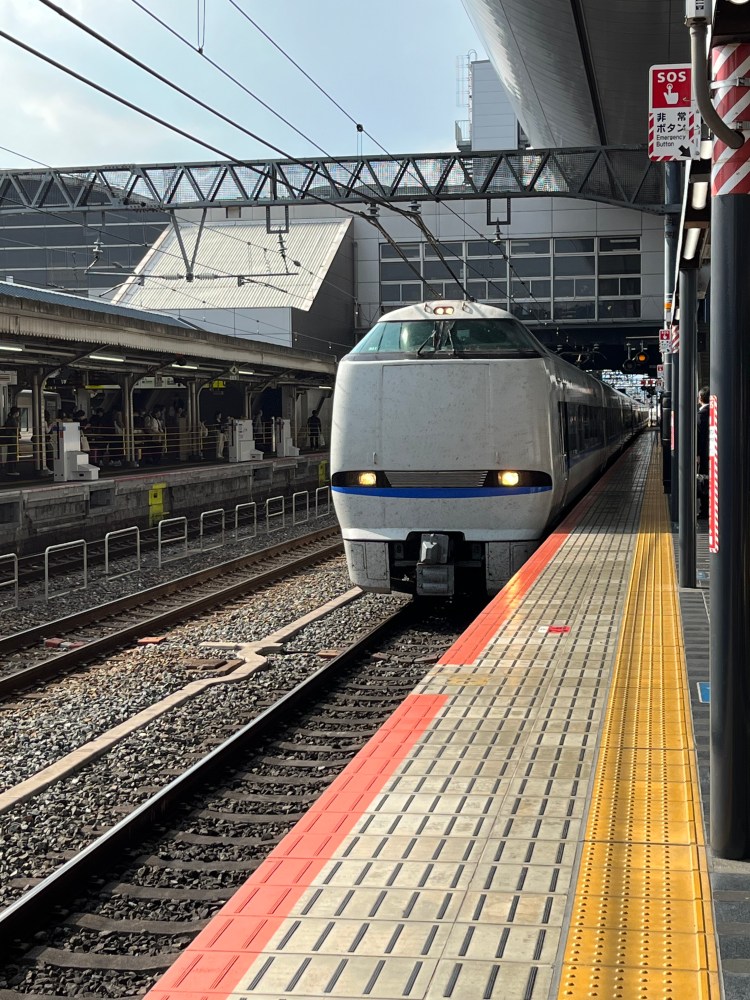
We were catching the Thunderbird service to Fukui. While nowhere near as fast as the Shinkansen, it is the fastest regular non-Shinkansen service. The front and back look quite threatening!
Our Thunderbird
It was scheduled to get to Fukui at 2pm, and we then had to take a taxi to reach our hotel by 3pm. Once again, Japan Railways let us down. It arrived 15 minutes late due to a level crossing problem. We managed to find a cab and get him to understand where we wanted to go – namely Eiheiji, a Zen Buddhist temple in the hills above Fukui. He drove through three stop lights to get us there!
We checked in and went through all the formalities – dinner time, breakfast time, communal bath times – and then had to dash up to our room, dump our stuff and get back down to reception. There were about thirty other guests there, about 75% Japanese, and we were all off to do a Zazen meditation “experience” at the temple itself.
They issued us all with lanyards and umbrellas and off we went walking alongside a stream to get to the Eiheiji temple itself. Once there, we all had to put our umbrellas in a rack, go inside, remove our shoes and put on indoor sandals. We were then lined up in twos and marched off to the meditation room by a very scary monk!
I’d love to say it was an enlightening experience, but the reality is that the scary monk spoke mainly Japanese with the odd sentence in English, so I didn’t have a clue what was going on! I believe I might have dropped off a couple of times.
But if the meditation disappointed, the hotel, when we finally got to see it, and the restaurant more than made up for it.
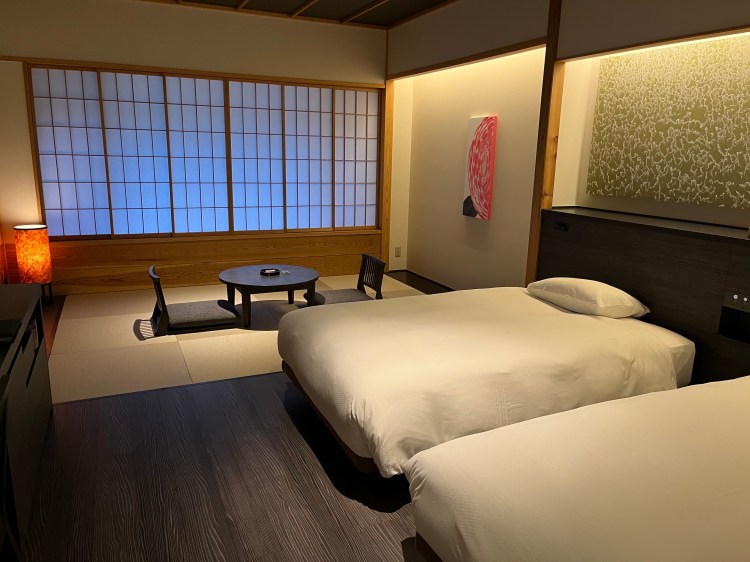
Our room
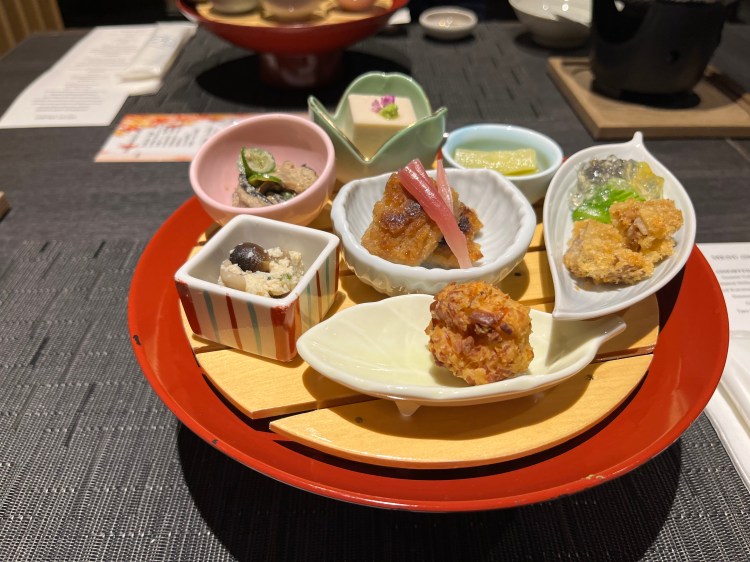
Our room is lovely and dinner was superb. We had a choice of traditional Japanese or a Buddhist meal and we selected the latter. From the appetisers to the desert, everything was top quality and perfectly prepared and presented.
This morning we walked down to Miyajima docks and caught the “fast ferry” to Hiroshima port. After crossing the sea, the ferry slowed down to navigate up one of Hiroshima’s river channels to arrive at the Peace Park.
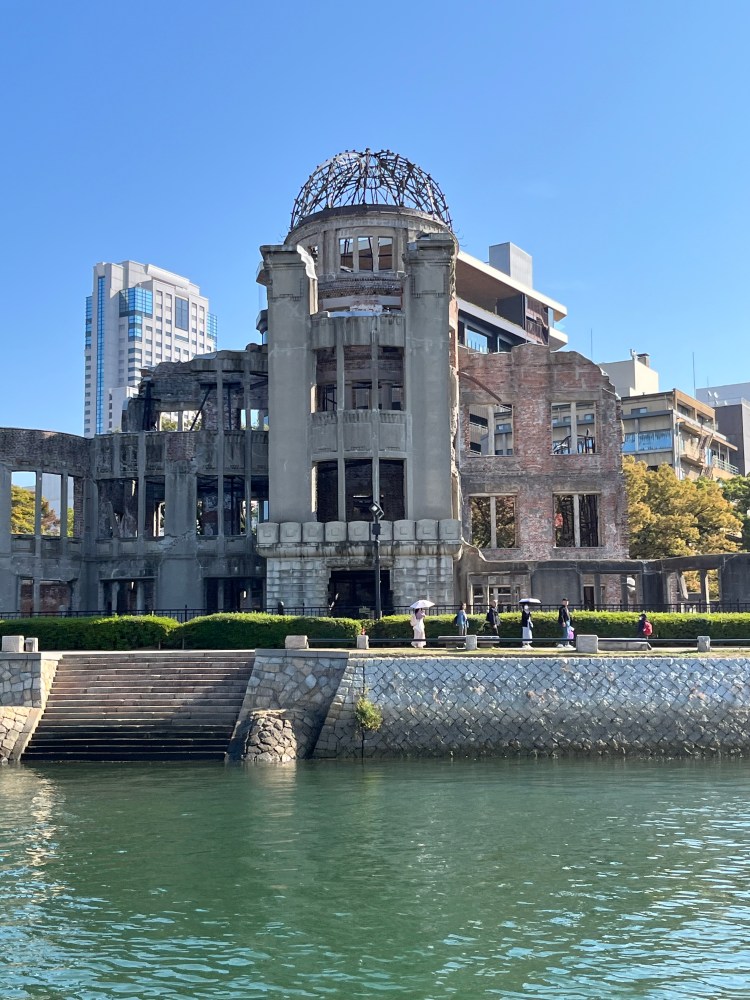
As we approached our destination, we sailed right past the A bomb dome. Once known as the Hiroshima Prefectural Industrial Promotion Hall, this was one of the few buildings left standing after the bomb hit Hiroshima in 1945. The bomb exploded almost directly over the dome which, due to it’s construction, wasn’t totally destroyed, unlike all the people inside. It has been preserved as it was on that morning as a memorial to over 140,000 people who died in the bombing.
Atom Bomb Dome
From there we walked across to the Hiroshima Peace Memorial Park, which occupies what was once the city’s busiest commercial and residential area. Within the Park is a series of monuments and exhibitions designed to keep the memory of the horrors of the atom bomb alive in the hope of it never happening again.
The tourist office is located in one of the other buildings that wasn’t totally destroyed, and is the only bombed building still in use today. Originally the Taisho-ya kimono shop, by 1945 it had become the head office for fuel rationing. On the top floor there is a history of Hiroshima through the ages, with photos showing life as it was until 1945. In the basement, you learn the story of Nomura Eizo, the only survivor of the 37 people working in the building on that morning. He was in the basement looking for some files when the bomb exploded. He tells how he managed to escape the building, despite being injured, and the horrific sights that he saw when he emerged.
Further along you have the cenotaph for the bomb victims, which contains the names of 300,000 people who died as a result of the bomb. Looking through the monument, you see first the Flame of Peace and beyond it the A bomb dome.
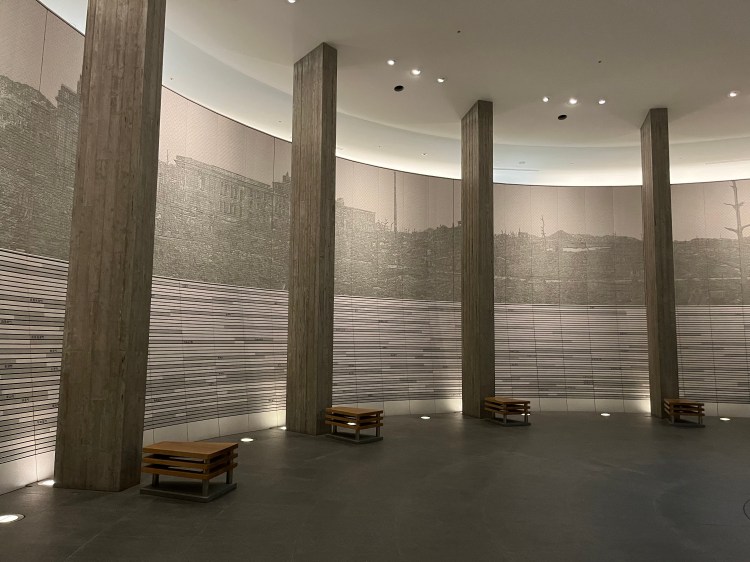
In the National Peace Memorial Hall further along, you can call up each of those names and find a photo of the victim and their age when they died. A circular building, it contains a panorama of the city as it was after bombing, made of 140,000 tiles to represent those who died that day. In an exhibition alongside, there are film clips from survivors from the meteorological observatory describing their experiences; the weatherman who kept taking readings because he didn’t know what else to do; a student who couldn’t walk due to injuries who managed to find help; a labourer who still regrets not being able to find his sister’s body.
Peace Memorial Hall
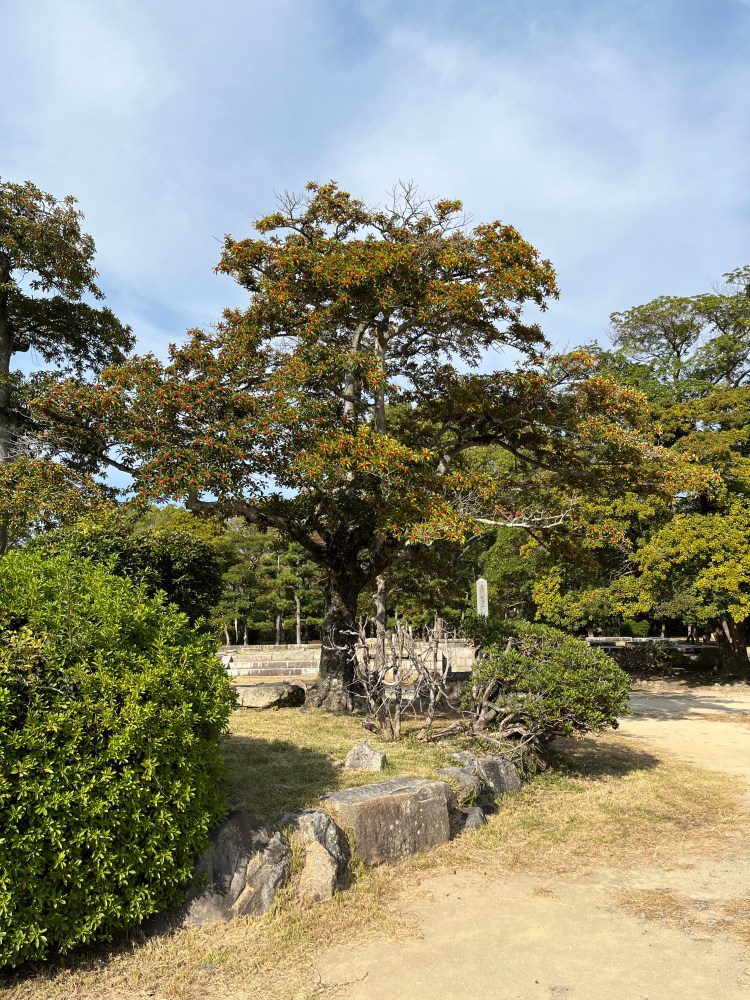
Dotted around the city are 170 trees that survived the bomb. They were all stripped bare by the blast and, in some cases, burned, but all came back to life and are still surviving.
Survivor holly tree
While I’ve always been aware of what happened at Hiroshima (and Nagasaki), visiting the city makes it personal somehow. We only had time to visit the main monuments and we couldn’t get into the museum because of the size of the queue. You could easily spend a whole day there.
After grabbing some lunch, we headed off to look at the castle and then to the station to catch our train and ferry back to Miyajima.
Hiroshima Castle
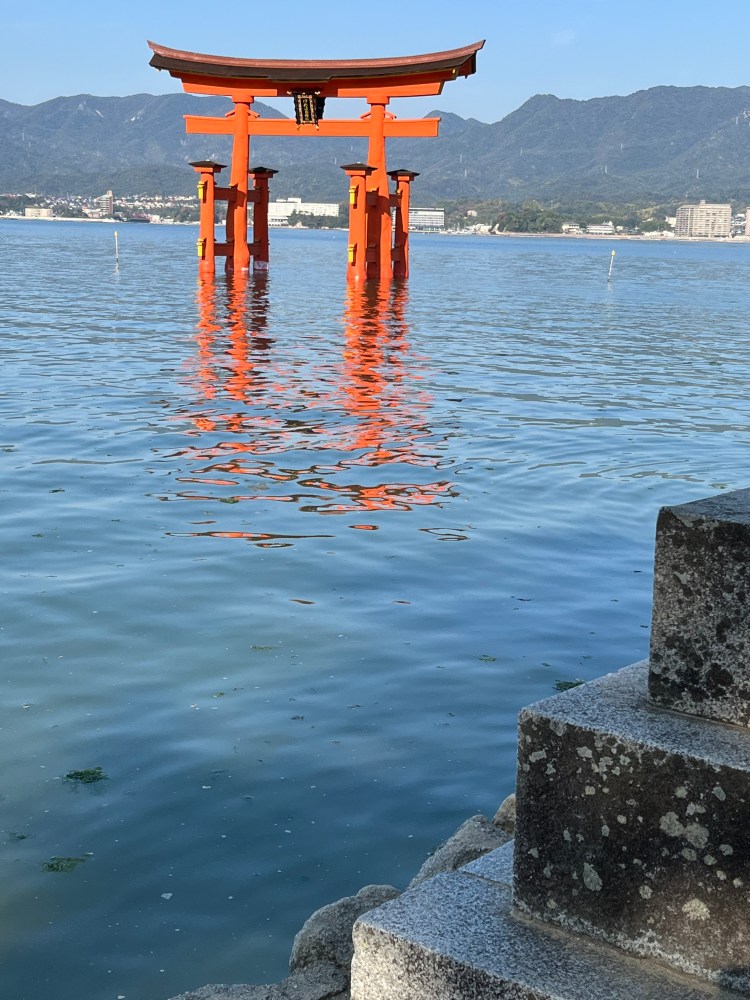
On the way back to the hotel, we stopped to admire the O-torii or Great Torii Gate, which is unusual because it was built in the water. It doesn’t float, it just looks like that. Equally, it isn’t embedded in the sand. It just sits there because it is so heavy!
Today we had to take the Shinkansen, or bullet train, from Kyoto station. The first part was easy, get onto the subway at the hotel and get off four stops later at Kyoto station. We had quite a wait at Kyoto, so we hunted round for a coffee shop. We didn’t find one. We found a Starbucks, but we weren’t that desperate. We found a Shinkansen information office and asked if there was a coffee place on the platform. He showed us a map with a Starbucks on it. We also asked when we would be able to board the train. He said two minutes before it leaves!
Eventually, we discovered a lower level to the station with a food mall and were able to find an “Italian” coffee bar.
Suitably refreshed, we headed for the gate to the Shinkansen platforms. In Japan, to get from A to B, or Kyoto to Miyajimaguchi in our case, you buy a standard ticket for the complete journey. Then you also purchase a ticket for any express portion of the journey – or Super Express in the case of the Shinkansen. We found the gate and I put my ticket in the machine. As I walked through, the barrier closed in front of me. A guard rushed over, made the machine spit out my ticket and told me to put both tickets through at the same time!
Surprisingly, this worked and they both came out of the other end!
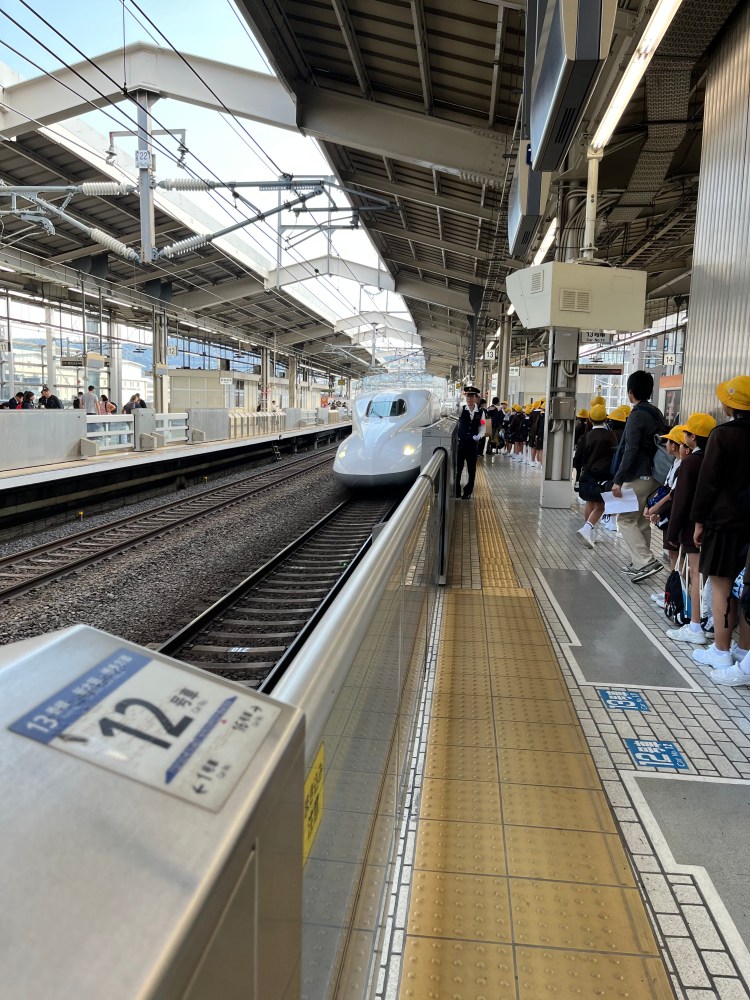
The ticket has your carriage number and seat number printed on it. When you get to the platform, you look for signs for your carriage number and row number. There is one gate at each end of the carriage, and the train stops exactly at the gate, so you all line up at the point corresponding to your seat. This included the party of school children at the gate next to ours, lining up two by two along the platform.
When the train arrives, people leaving have enough space to get off and then the line moves forward like a bunch of newly created cybermen and gets on the train.
I didn’t think it would work with three separate parties of children getting on, but we left exactly on time!
Bullet Train
There’s plenty of legroom at your seat, and there’s a map on the back of the table that shows you where you are and where the toilets and rubbish bins are. The train was quite crowded, but also very quiet; you are only allowed to use your phone in the space between carriages. Most people were asleep. The first stop came after about 10 minutes; a bunch of people got off, a bunch more got on and away we went, each stop 90 seconds. Nobody ever took someone else’s seat.
Eventually, we got to Hiroshima, and got off the train during the allotted 90 seconds. I found out where our connection was going to be and put my ticket in the machine. It spat it out again! So I put both tickets in, it let me through and returned only my standard class ticket.
Trains to Miyajimaguchi run every 15 minutes, but I’d spotted a lovely little bakery, so we thought we’d stop for a little bite. The process is to take a tray and a pair of tongs from the entrance, select your products and go to the cashier. There, they bag it if you’re taking away or put it on a tray in a little basket with an oshibori, a hand towel. Every few minutes, someone would bring the newly sanitised trays and tongs back to the entrance. Perfect. I had a doughnut filled with red bean paste and Diane had something to do with Halloween with no English description. Both were delicious.
We then went though the barrier and down to our platform, where we were surprised to see long lines at each point where the doors would open. Surprised because this was a local train that runs every 15 minutes. However, when the train arrived, the cybermen routine kicked in and we were soon on our way. Being a local train, it took about 30 minutes to get to Miyajimaguchi, where we needed to catch the ferry to the island of Miyajima. We had an A4 sheet that was supposed to be our ticket, but when we got to the ferry, we were made to queue at the ticket desk. There we had to pay another 200Yen before they’d let us in. No idea why, but we missed the ferry and had to wait another 15 minutes for the next one.
Once at Miyajima, we asked the information desk to call the shuttle for our hotel. She said to wait by the taxi rank and it would be about 10 minutes. As we headed for the taxi rank we realised that a van with the name of our hotel on the side was already there. The hotel had just rung the driver and told him to wait for us.
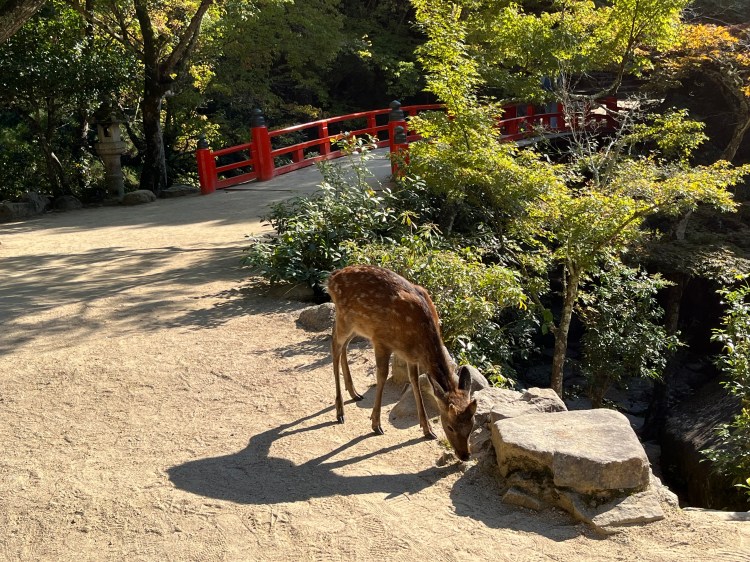
The drive up to the hotel was very steep and winding, but the place itself is gorgeous, a traditional Japanese building set in a woodland, with ornamental pond, bridge and a resident deer.
Our receptionist
We weren’t allowed to check in before 3pm, so we decided to head for the cable car to the summit of Mount Misen. This is a six-man car so we were sharing with two Japanese couples. When we got to the top the worker shouted “change cars here” and we found out that the ascent was in two parts. The final stage was two fixed cars for about 20 people, like a free standing funicular.
Up we went again, looking forward to the observatory at the top. Which was just a rail and a pay telescope. There wasn’t actually that much to see, so we retraced our steps and got back to the hotel at about 3:30. The receptionist told us to take a seat and our room maid would be with us soon! A couple of minutes later an older lady in traditional costume turned up along with a young apprentice and showed us to our room, where we were reunited with the luggage we forwarded yesterday.
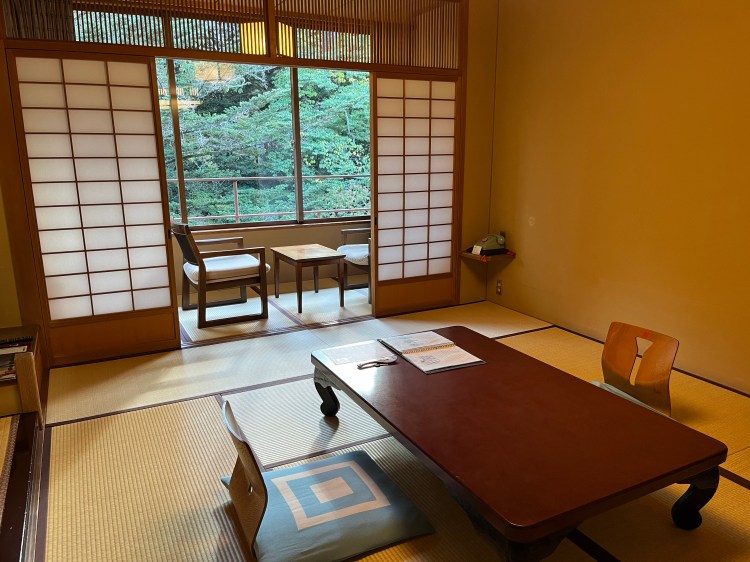
The room has a little lobby where we were made to remove our shoes before she showed us into the room proper. It is very Japanese style, with sliding paper doors everywhere and a glassed in balcony looking onto the forest. There’s a huge table in the middle of the room with a legless seat either side. Fortunately there’s also a coffee table on the balcony with two seats you can sit on.
Our room
They brought in our welcome tea, along with a little cake filled with red bean paste and explained what was in the room. This included Japanese outfits for us both plus housecoats, toed socks for wearing the Japanese sandals and a fancy bag to carry your towel between room and communal Onsen bathhouse.
The only thing missing was the bed!
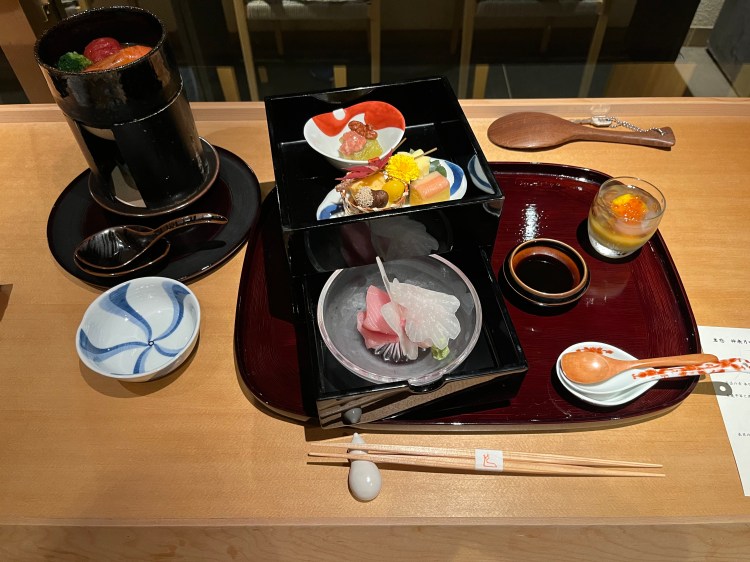
There’s a set menu here for dinner, and when we went down, we found that there were nine courses. Actually, make that eight because oysters really don’t do it for me. This included sashimi, a gorgeous bouillabaisse and a very nice beef and mushroom stew.
First three courses
When we got back to the room, we found that they’d moved the huge table to one side and created beds in the middle of the room. Very low beds!





 Steve and Diane on Tour