Two Days in Kyoto

We spent two more days in Kyoto with our guide, Yumi.

First we took a train and taxi out to the Golden Temple/Pavilion, which was packed with school parties and groups of tourists. The place was built around 600 years ago by a “retiring” Shogun, although he continued to rule the country from here.  It became a Zen temple after his death.

Golden Temple

There are 20kg of gold lining the top two floors.  There’s no gold on the ground floor because that’s where he used to receive common people!

It was burned down by a young monk in 1950 and then rebuilt, like so many other places. We were lucky to visit on a sunny day.  Imagine waking up in the morning to this – minus the tourists!

The temple is surrounded by lovely gardens and a circus of souvenir shops.  You can even buy gold flake ice cream!

Next we took a taxi to Ryoanji Temple, a Zen training temple in the Arashiyama area.  The main feature of this place is the rock garden, with white pebbles raked into a Zen pattern.  There’s also a central building with the life of a dragon painted on the panels around the rooms.  From right to left, of course.
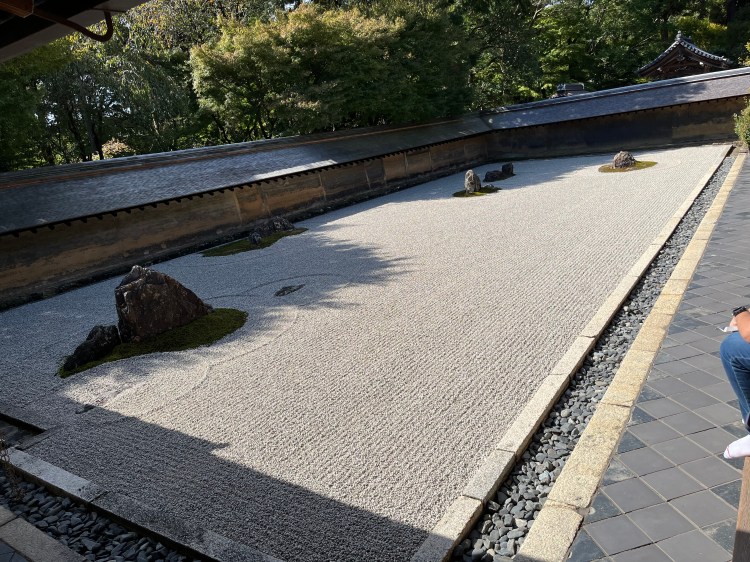
Stone Garden

Another taxi and we arrived at the Otagi Nenbutsu-Ji temple, another ancient temple that has been destroyed and rebuilt several times.  The last restoration was completed by a master stone mason, who invited people to come and learn how to carve images of Buddha.  There are 1,200 of them lined up in rows about the place! 
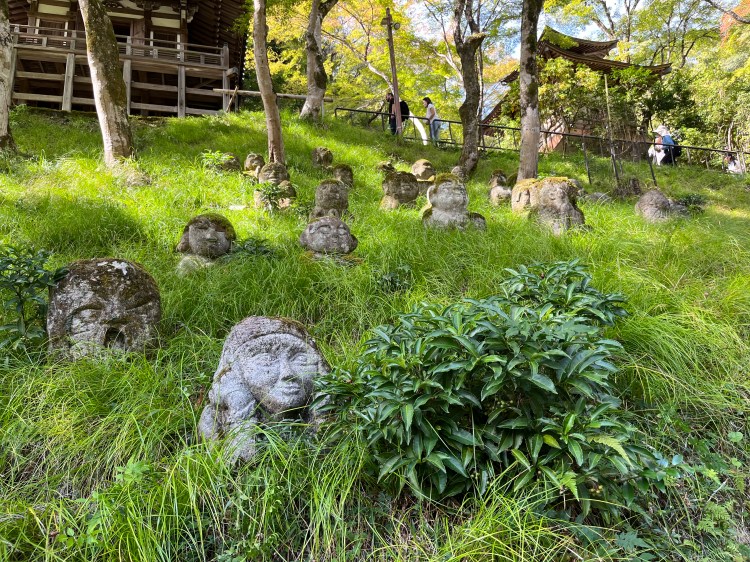
Carved Buddhas

There’s also the 800 year old shrine containing a Buddha with two faces and lots of hands.
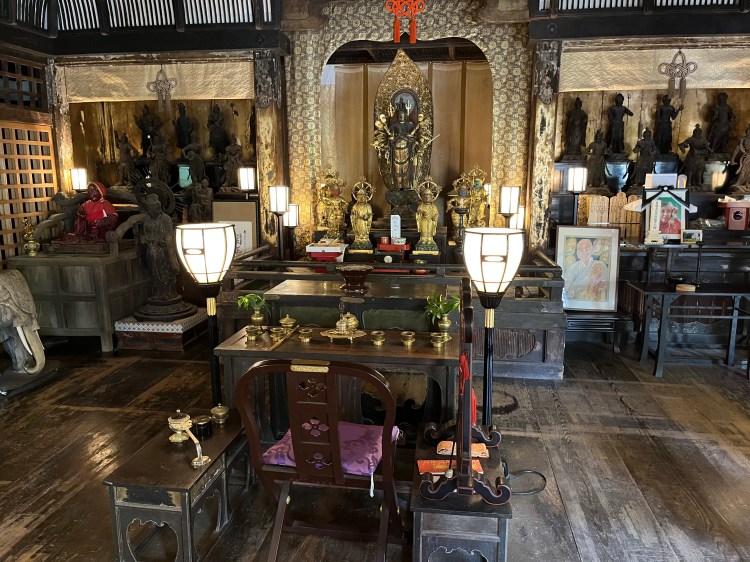
Otagi shrine

By this point we were somewhat off the beaten track so it was a bit less frenetic.  Other tourists just got in your way slowly!  We were also coming to see that with every ticket you buy you get a free brochure.  I’m not sure what happened if you collect a complete set.

From here on we walked on down through the rest of the places.

The next place was Nenbutsuji temple, a cemetery where people bring the ashes of their relatives after a period of mourning.  It also holds about 8000 Buddha stones that were collected from the area and lined up here.
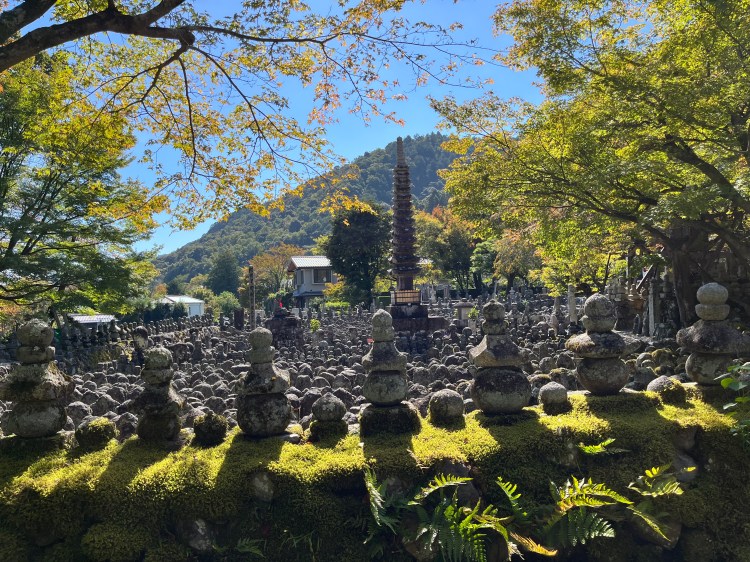
Nenbutsuji

Plus a display of raccoons, which bring happiness.
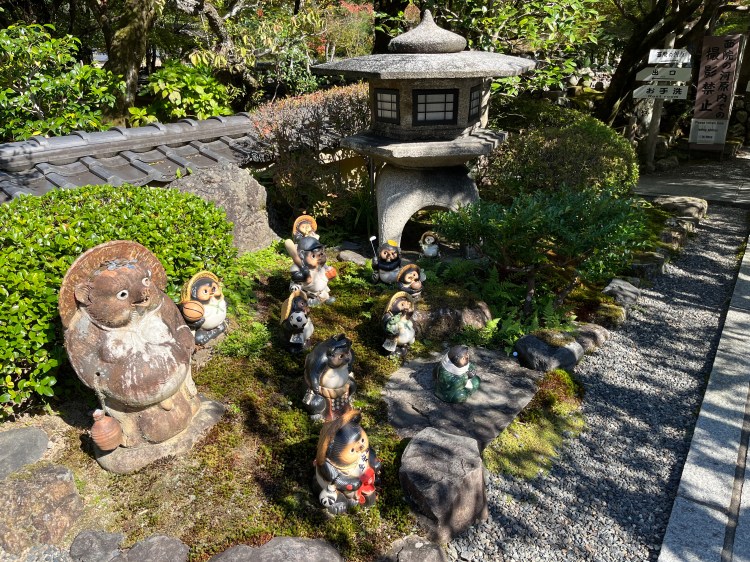
Raccoons for hapiness

By this point we needed a break, so we went into the nearest cafe, which was quite bijou and run by a bijou man and wife.  Their special drink is iced ginger tea, so I had to try it.  Delicious!  While we were there, a group of 14 came in, but the owner said he didn’t have room.  They went away, but 7 of them came back and their kids decided to sit at two tables and play with the condiments.  A very stilted conversation ensued until Yumi jumped in and interpreted.  The upshot was that they went away again.  Yumi then had a long discussion with the owner – turns out he doesn’t like having tourist children in the place because they’re too noisy.

From there we went on to Gioji temple, which is famous for its moss garden.  They grow over 30 types.  There’s also a shrine dedicated to Gio, a great beauty who renounced the world after being rejected by a 12th century clan chieftain.  It houses a statue of Buddha Dainichi, who symbolises oneness with the universe.
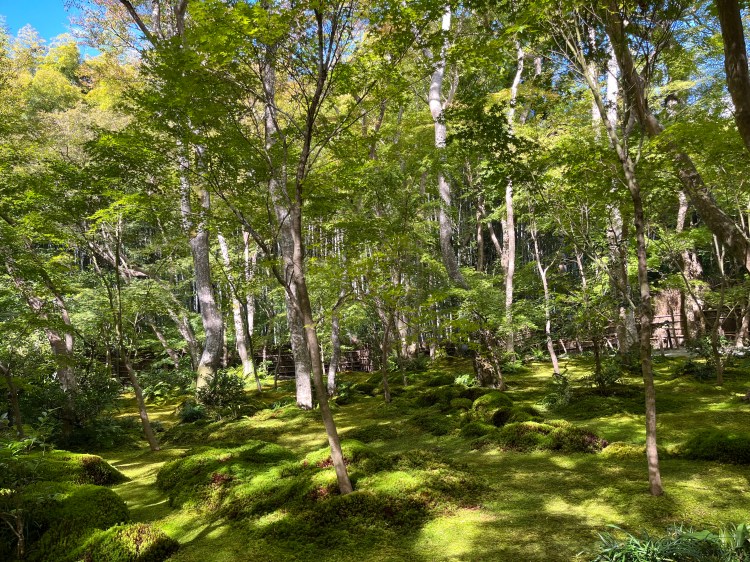
Gioji moss garden

Lunch came next, in a little place not much bigger than your average living room.  We had some noodles in miso soup, which was delicious but uncomfortable because their chairs seem to have come from a school classroom.

We then had to run the gamut of tourists again to walk down a path through a bamboo forest.  Having seen bamboo forests before, we got through it fairly swiftly and came to Tenryu-Ji Temple, the temple of the Heavenly Dragon. Established by Shogun Ashikaga Takauji, it’s the head temple of Rinzai Zen Buddhism and a UNESCO site.  It has burned down eight times and been reconstructed, but the landscape gardens date back to the 14th century.

From there we took the train back to the hotel.

Miwa had given us a couple of ideas for dinner and said we should ask the hotel to make reservations for us.  We tried, but the hotel needs a full family tree, indemnity against anything that could possibly go wrong and your credit card details and signature before they’ll book anything!

We decided to take a chance and turn up at opening time at Kushikura, a Yakitori restaurant near the hotel.

They put us on a long bar facing the open kitchen, so we were able to watch the cooking.  We opted for a set menu, since we had no idea what to order.  There was an appetiser first, but we couldn’t say what it was.

Then vegetable sticks with miso sauce, which looked more like frozen mango, radish and turnip with some spring onion tops.

Vegetable sticks

While we were eating this, one of the chefs leaned round the screen and handed me the first of three plates of chicken skewers.
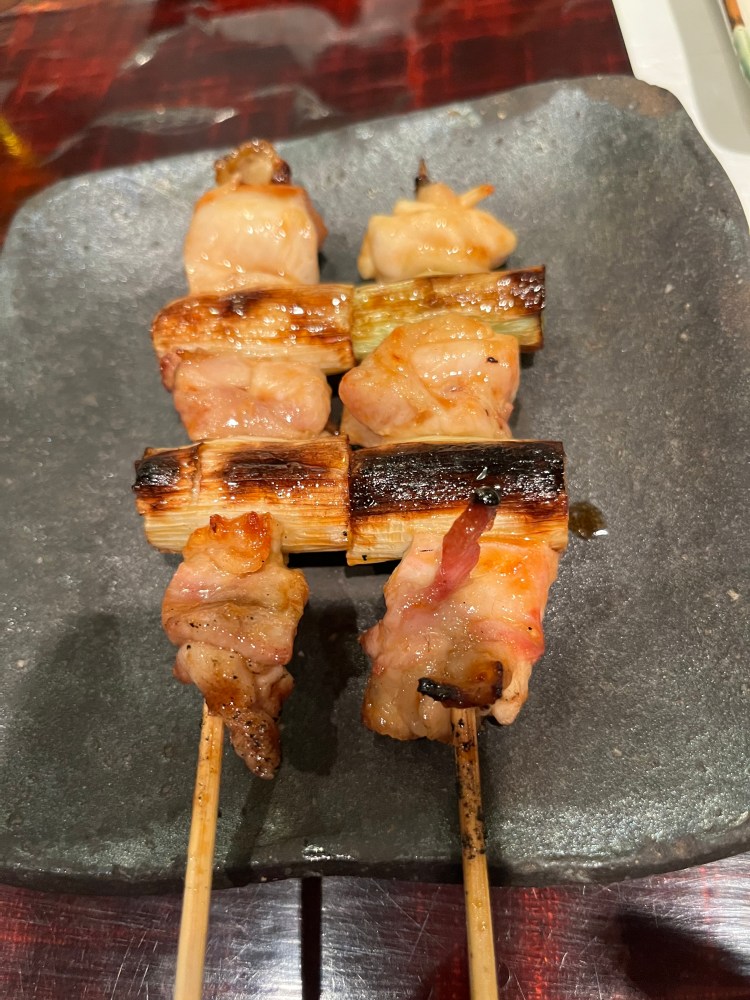
Skewer 1

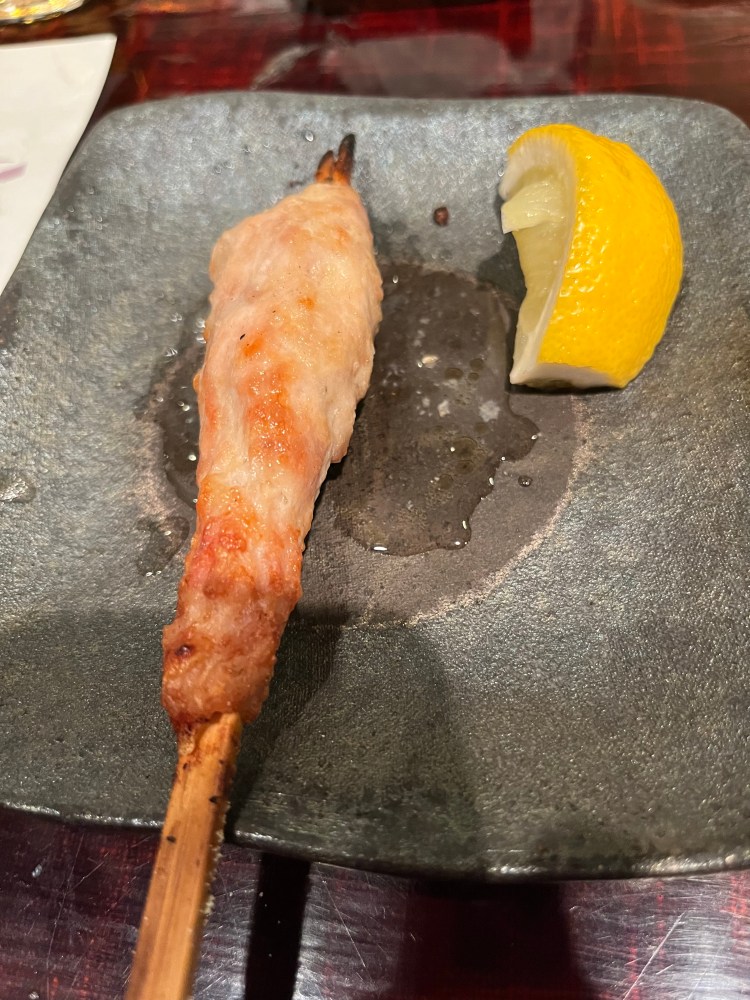
Another two plates followed before the waitress came to remove the plates and tell us that was the last of our chicken skewers.  This left us slightly confused, because we hadn’t had all the other things on the menu before the chicken.
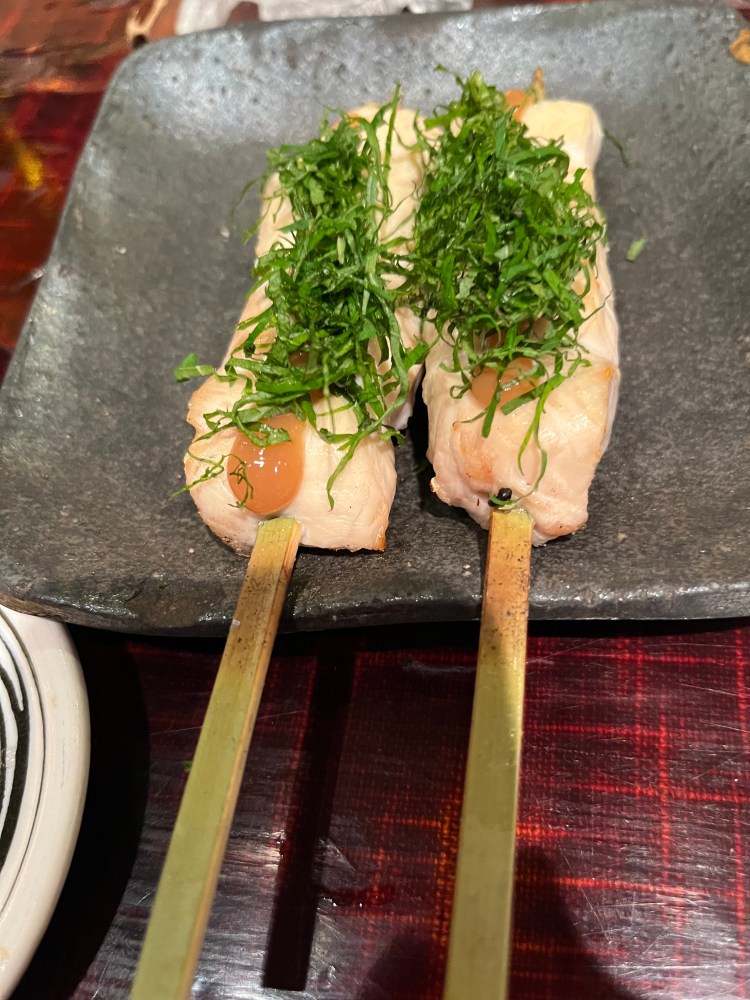
Skewer 2
Skewer 3

Eventually, dishes started flowing again.  Nishin Nazu, simmered herring and aubergine, followed by assorted tempura, which I didn’t manage to take a photo of.

The main event, or finishing dish as they called it, was Tori Hitsumabushi, chicken piled on a bowl of rice with pickles, soup and wasabi.

We left feeling quite replete and pleased with our choices. And through it all, the three chefs just kept skewering and grilling with not a cross word in sight.

Next day, we had to say goodbye to our luggage.  They don’t have a lot of room for luggage on the trains, but they do have a very good forwarding service.  If it all goes according to plan, our luggage will be waiting in our room when we get to our next hotel.  I’ll let you know.

Next morning we again met Yumi in reception and we took the train to Nara.  We started off on our own green line subway train, but once we got to Kyoto station it turned into a limited express mainline train.  Very confusing, but Yumi seemed to know what she was doing.

At Nara we piled into a taxi to miss the crowds and get to the Kasuga Taisha shrine by the back door.  This whole area is inhabited by semi-wild deer, and we met some of them walking up to the shrine.  If you bow to them they will bow back and then you give them something to eat.  However, you can’t tease them, because they’re liable to bite if you don’t come up with the goods.

After walking through the sacred forest, we came to the shrine which has 2,000 stone lanterns and 1,000 hanging lanterns in and around it.  The Samuri used to donate them, but these days it’s mostly businessmen hoping that they’ll get their money back tenfold.
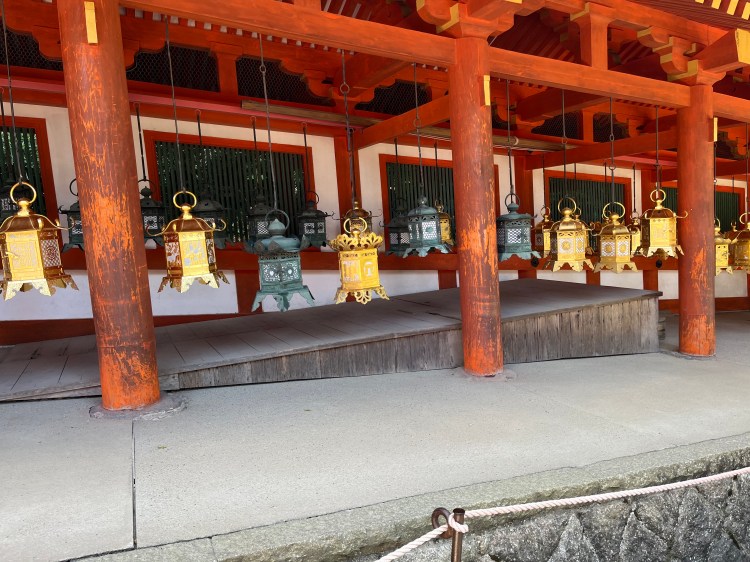
Lanterns

There are also a lot of sub-shrines around the main one, and a 1,000 year old camphor tree growing in the courtyard.
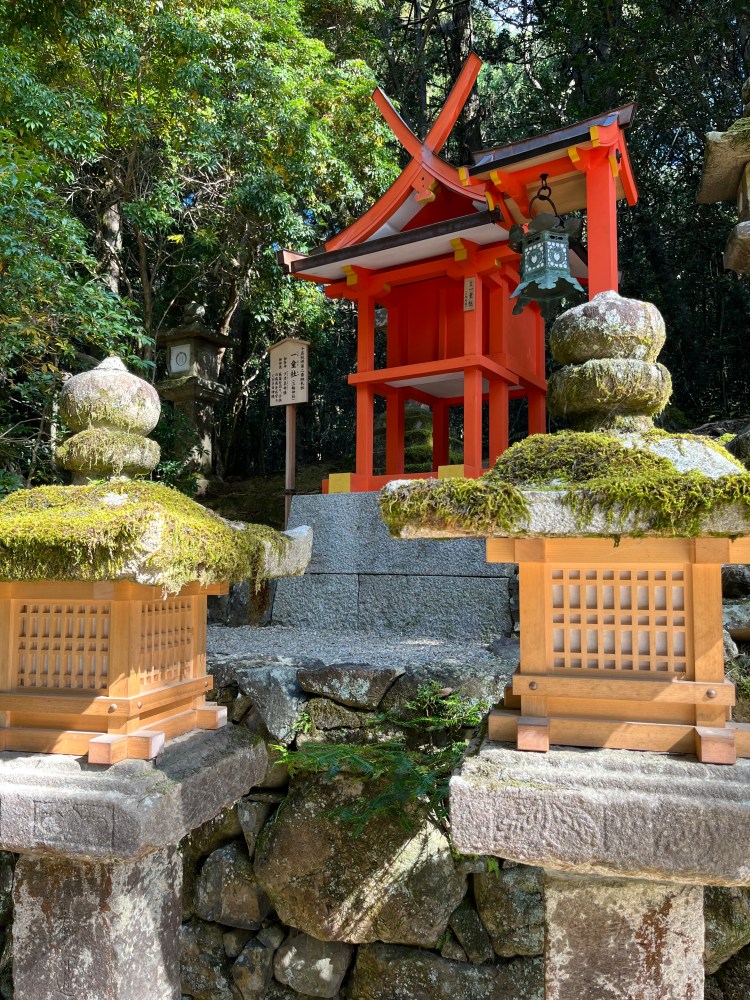
A shrinelet

From there we walked across to the Todaji Temple, which is absolutely huge.  It is said to have been built by the Shogun to impress the Chinese with his power.  At a time when the population was 5 million, 2.5 million were involved in building the temple.  It has burned down twice and when it was rebuilt in 1708 it was scaled down to two thirds of the original size.  Even so, it is the biggest wooden structure in the world.

Todaji temple

It houses Daibutsu, the Great Buddha, along with two other statues and four guardians.
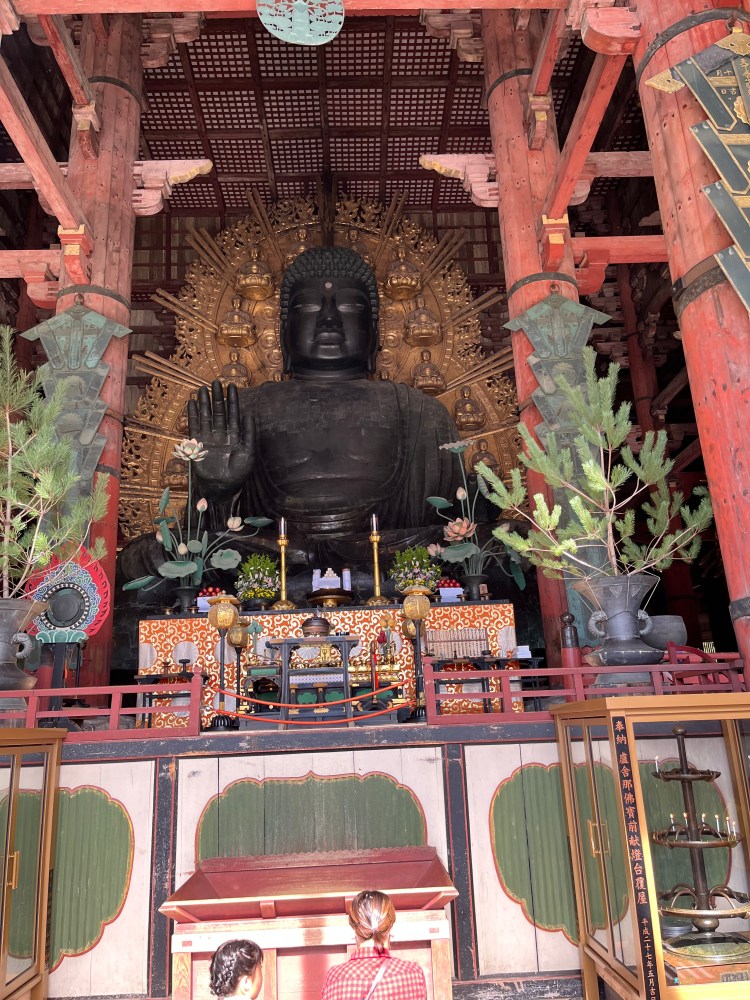
The great Buddha

Lunch was Tonkatsu, pork cutlets, rice, soup and assorted bits.  We had a long wait for a table, but it was worth it.

Lunch

Next was our tour of the sake brewery, but someone at the travel agents got it wrong because they don’t do tours at this time of year.  So we had to settle for a tasting of five different sakes.  It’s tough work, but someone has to do it.

Our final visit was to Fushimi Inari, a Shinto shrine that used to be dedicated to the god of harvest but is now dedicated to the god of business.  That’s progress for you.  It has 1,000 torii gates and about 1,000 tourists for every gate!  We started to walk through them, but it was impossible, so we cut our loses and came back to the hotel.

Some of the thousand gates

So that’s Kyoto.  Tomorrow is going to be a day of travelling.

Foodie Tour of Kyoto

Yes, it’s another food tour!  But there’s so much to try around here.

In our shopping bag full of vouchers from the travel agency, we had one for the Foodie Tour.  Because it’s a third party organisation, they don’t come to the hotel, we have to go to them.  And the meeting point was … outside McDonalds!  Did they get the wrong idea when we booked this?

Armed with our IC Card and knowledge gained from our orientation, we set off from the hotel with plenty of time to spare.  We were taking the subway from the hotel for two stops, changing to a different line for one stop and then walking about 250 yards to the meeting point.

The subway station is underneath the hotel, so we couldn’t fail to find that.  We sailed though the barrier and down the stairs and then had a debate about where to stand. In the end, we stayed where we were because the other end of the platform was busy.  The train came in, we travelled two stops and then we couldn’t see the exit for the other line.  In the end we headed towards the back and were rewarded with a sign that said Hankyu Railway. Yay!

Unlike the tube, where you can change as many times as you like, in Kyoto each line is run by a different company, so we had to tap out, go to the other part of the station and tap in again.  We got down to the platform, where there were two trains waiting, but then froze because they both seemed to be going in the same direction!  We tried to make out what the map said, but in the end a random guy asked where we wanted to go and told us which platform to use.

Arriving at Kyoto-kawaramachi station, our next decision point was which exit to use. We found a map next to exit 1 and decided we needed exit 8 (of 12).  We compromised on exit 5 and headed up to street level, where it was seething!  We used the phone to point us in the right direction and found ourselves going past exit 1!

In Japan, nobody crosses the road against a “Don’t Walk” sign, and with this number of people you end up in a large bunch of other people wanting to cross.  Then the light changes to green and both sides go charging towards each other like some form of British Bulldog!  By now we were five minutes late and queueing to cross another road when we suddenly realised we were facing a big yellow M on the opposite side.  And there was someone in front of it holding up a board.

We introduced ourselves to “call me Sue” and then set off on our tour.  Which started with another game of British Bulldog.  We were right by the Kamo, Kyoto’s main river and Sue led us down onto the bank and then into a series of narrow alleyways to get out of the crowds.

Alleys full of eating places

Out first stop was Isomatsu, a traditional Japanese restaurant with a green streak.  They grow their own vegetables and use only sustainable produce.  We were in a little booth for four, and after we’d ordered they let down a blind to screen us from the rest of the world.

Sue gave us the drinks menu and I immediately spotted plum wine, whereas Diane fancied the sparkling mango wine.  Mine came with ice and soda.

Plum wine and mango champagne

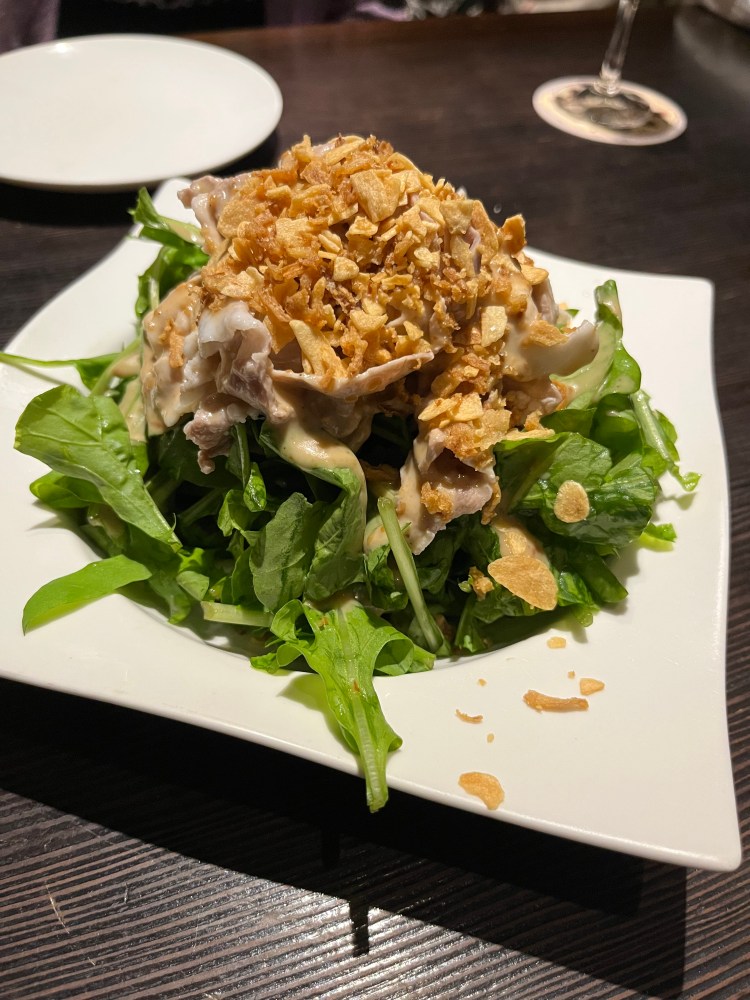
We started the meal with a simple pork salad, strips of very thinly sliced pork in a dressing on a mountain of leaves and what looked like corn flakes. 

Pork salad

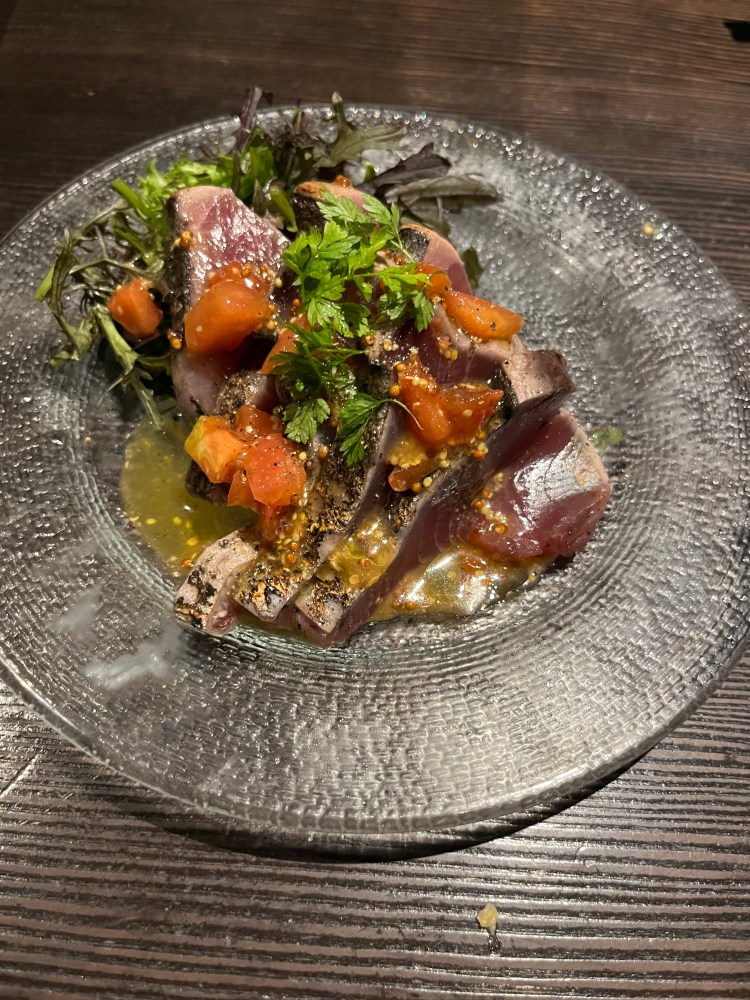
We then faced our fears and agreed to sample carpaccio of bonito, i.e. raw fish. 

Carpaccio of bonito

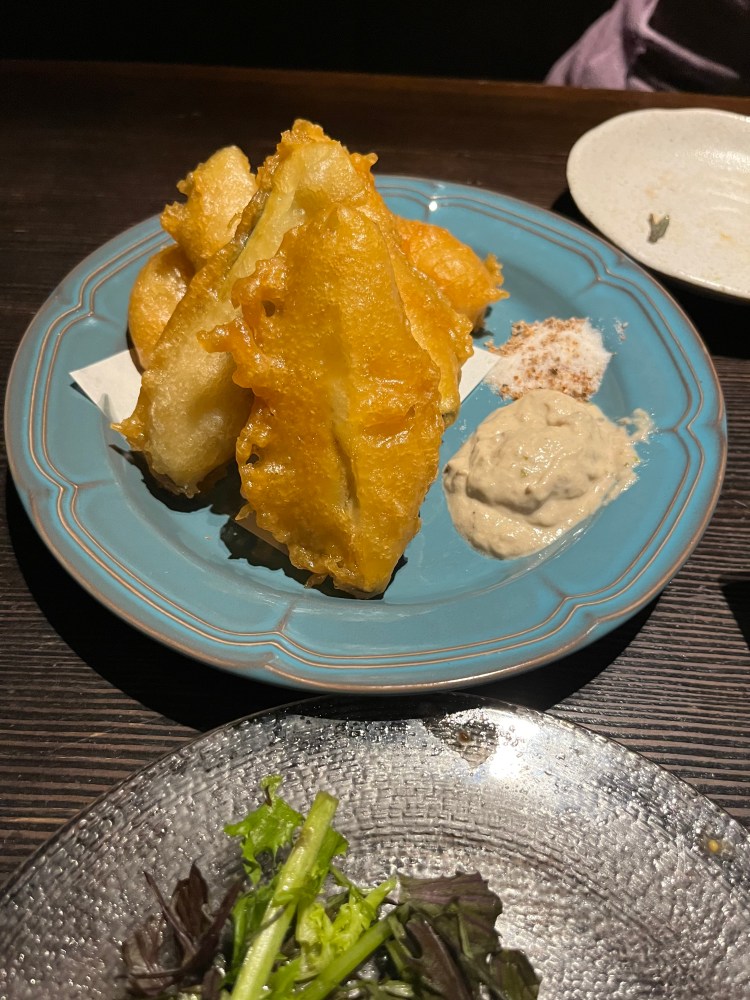
After that we had deep fried aubergine and shrimp.

Battered aubergine and shrimp

It was all excellent, including the raw fish. When we left there, there was a queue of about 15 people waiting to get in.  Insider knowledge again!

From there we walked along Pontocho street – more like an alley – and then through Nishiku market, where you find shrines among the shops. 

Shinto shrine

Our destination was Joyo Fair, a new and trendy sake bar.  We had reserved at table, but it didn’t come with chairs, that’s how trendy it is!  We left the ordering to Sue because we hadn’t a clue about sake.  They do tasting sets, so we tried a set of three.  One of the labels was prettier than the rest, but other than that I can’t tell you much about the sake.  But we had a pleasant time chatting with Sue about her family and places we’ve all been to.

Sake everywhere

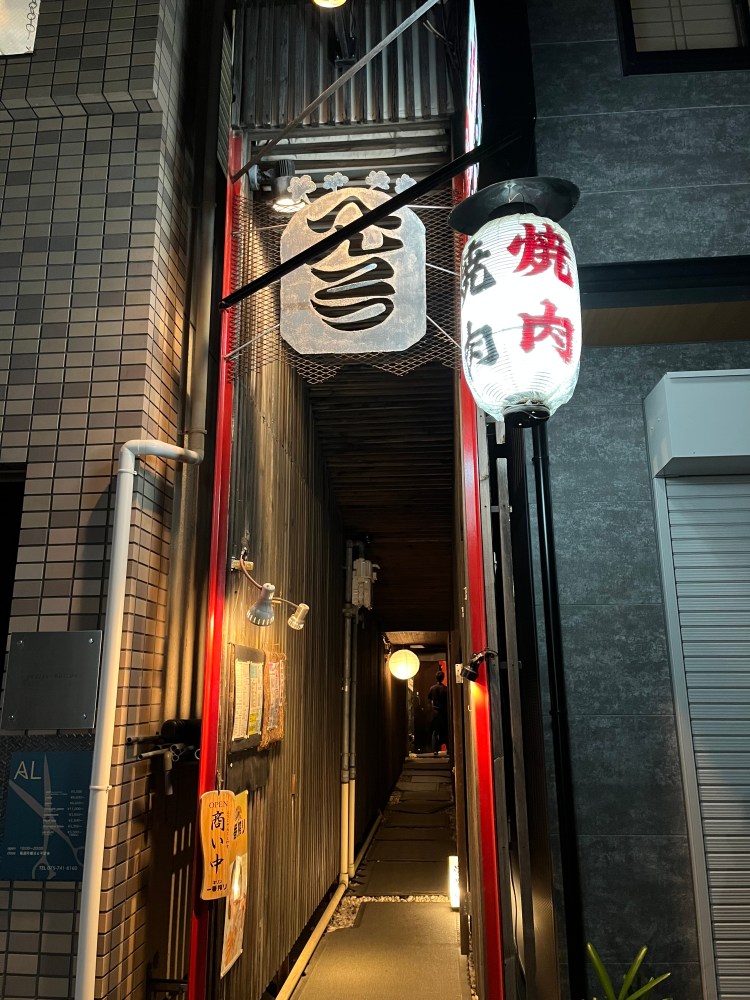
Our final restaurant was Henkotsu, a barbecue restaurant.  It didn’t look like much from the outside, but it was nice and cosy on the inside. 

Henkotsu entrance

The benches we sat on doubled as storage; you lift the seat and put your coats and bags inside for safe keeping.  There’s a gas heated barbecue in the middle of the table, and you cook your own meat.  Again, once we’d ordered a screen came down to separate us from everyone else.  I was starting to get paranoid until I noticed that everyone else was screened off too.
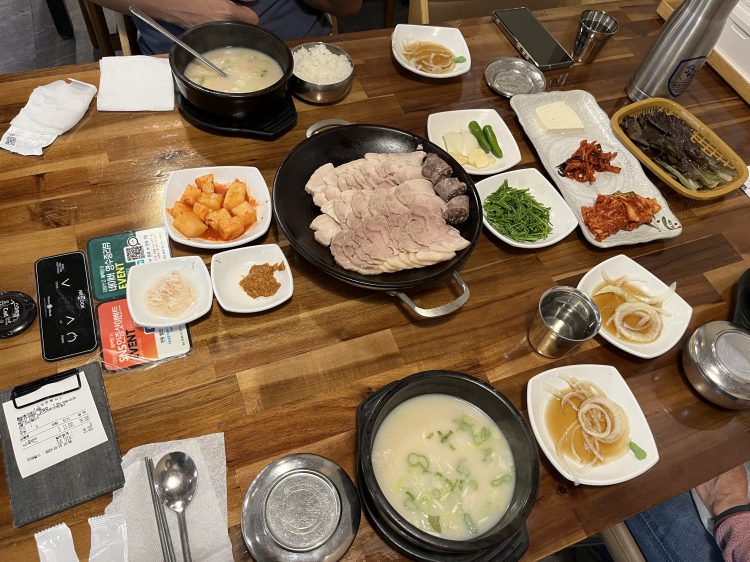
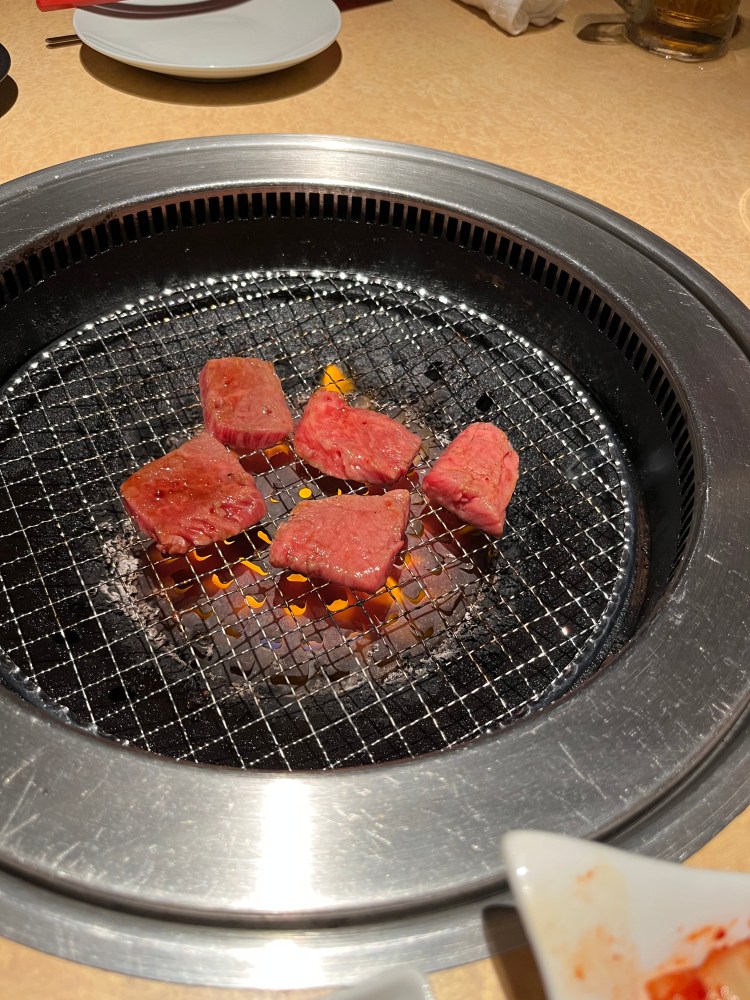
Sue secretly ordered kimchi because we’d said we’d enjoyed it in Korea.  It wasn’t as spicy, but nothing in Japan seems to be very spicy.  So far!  We then received our bowls of rice and soup, frozen mugs of beer and our first plate of meat.  Sue had a picture of a cow and pointed out which cut we were cooking, but I was too busy trying to stop it burning to look!

Beef barbecue

As we finished the meat, the next cut appeared; I’m not sure whether we had three or four cuts, but it was all excellent.  The odd thing was that there were five pieces of meat each time for three of us.

And that was the end of our tour.  Sue walked us back to our station, we said our goodbyes and we returned to our hotel.

And the driver wore white gloves

After breakfast, we were picked up by a new driver and deposited at Busan airport.  There was a huge queue to check in, but there were plenty of desks open and we were soon checked in,  through security and sitting with a couple of lattes people watching.
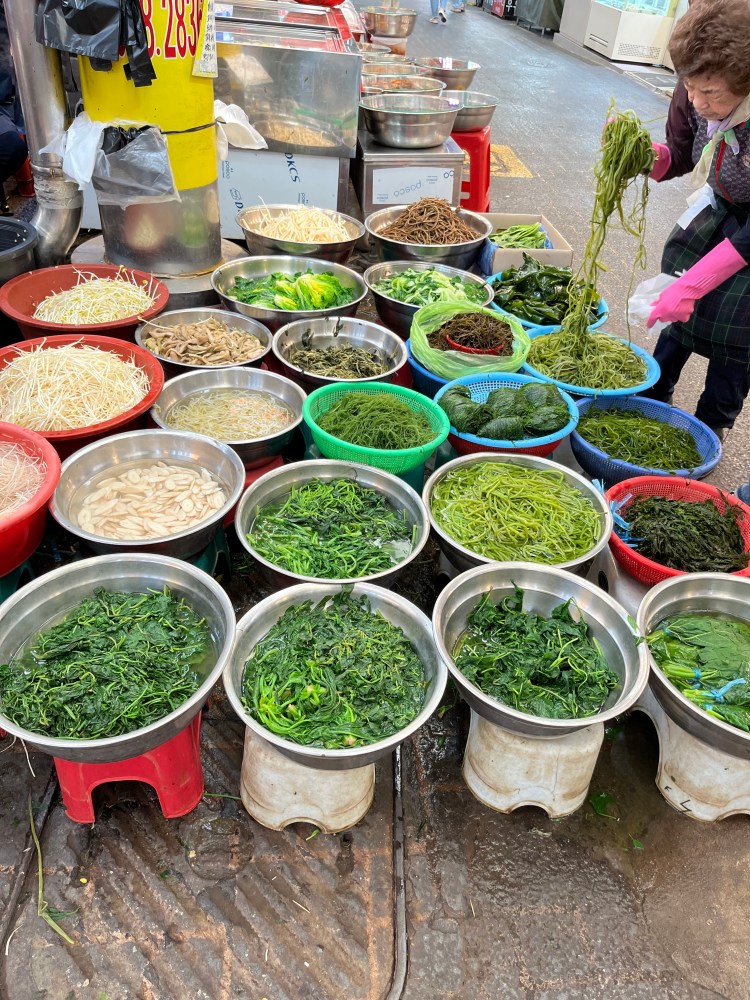
We might have been a bit complacent, because as we walked towards our gate we decided to buy a sandwich.  We came out of the shop with 5 minutes to spare!  There was a guy near the gate asking everyone of they were on the Osaka flight; it made his day when we said yes!  He hurried us on and they closed the door behind us!

The flight landed early at Osaka, but the place was heaving.  We had to be fingerprinted and get a mug shot before immigration. I was processed in a couple of minutes, but Diane couldn’t get her fingers to work!  The operator got her to wipe her fingers, and she was eventually able to donate her unique pattern to Japan.
At immigration, I was straight through, but Diane gave them a hard time.  In the end the immigration guy asked to see her fingers.  He took one look at them and let her through.  All this technology and he can decode her fingers with just a glance!

Eventually, we got our bags, completed all the formalities and entered Japan.

We eventually found the guy who was meeting us – he was at the other exit!  He gave us a shopping bag full of tickets and vouchers then led us out to our car and driver.  The driver wore white gloves!  However, he was quite charming, apologising in his limited English that the drive was going to be about an hour and a half and saying he’d do his best for us.  

It was quite obvious that we were in a different country.  There were no high rise buildings, the countryside was green and wooded and what houses we could see were quite utilitarian.  And we were driving on the left! 

After about an hour the driver again apologised because we were still 20 minutes from our hotel!  We arrived about ten minutes later.  The driver took us inside, spoke to reception, waved his white-gloved hand and left us to it.

The equally charming receptionist took our details and then told us we didn’t have a reservation!  They called the agency and after about 20 minutes on the phone, told us we could stay there after all.

Our room

By this time it was about 5pm and all we’d had to eat since breakfast was half a sandwich each, so we went down to find the restaurant.  The hotel doesn’t have a restaurant!  We went outside looking for pictures of food.  We found some on the opposite side of the road from the hotel, found a couple that we liked and went in.

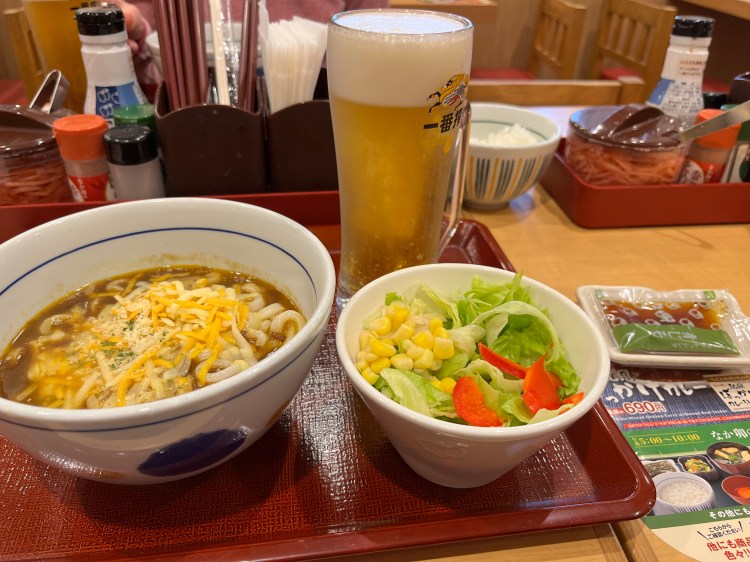
It was a bit like a canteen inside, with a serving hatch.  We had to order on a monitor, which, fortunately, had English descriptions to go with the pictures. We ordered Udon noodles with chicken, rice and some salad to make it healthy.  And a beer to make up for the salad.

Dinner

Back at the hotel, we tried out their self-service Nespresso machines and then went up to our room to try and work out what was in our shopping bag from the agency.

Next morning we had a half day “Orientation” scheduled.  We met Miwa (which in Chinese characters means beautiful and peace) armed with our shopping bag and got orientated in record time, thanks to our study the night before.

Our next task was to learn how to use our IC cards on the subway.  Miwa showed us how to load money onto them and then how to use them to go through the barrier.  Which is pretty much the same as using contactless on the tube!  The difference is that there is no barrier on the gate.  I asked what would happen if someone didn’t tap in or out.  She said it doesn’t happen!

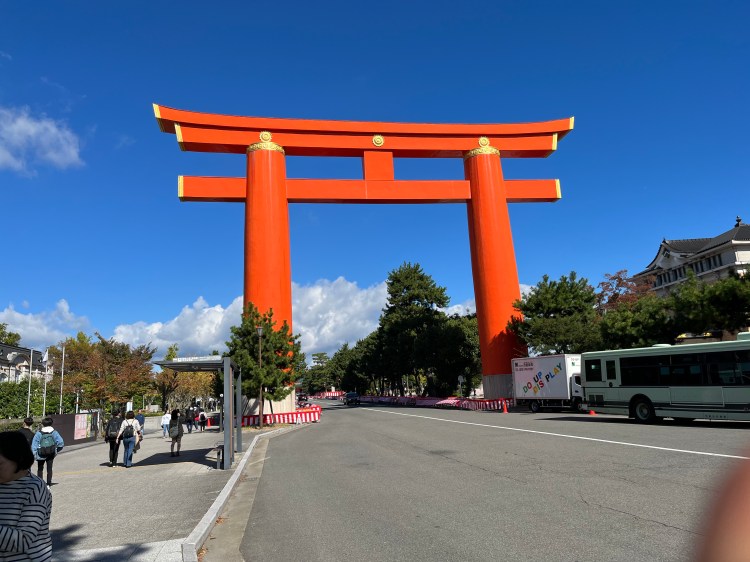
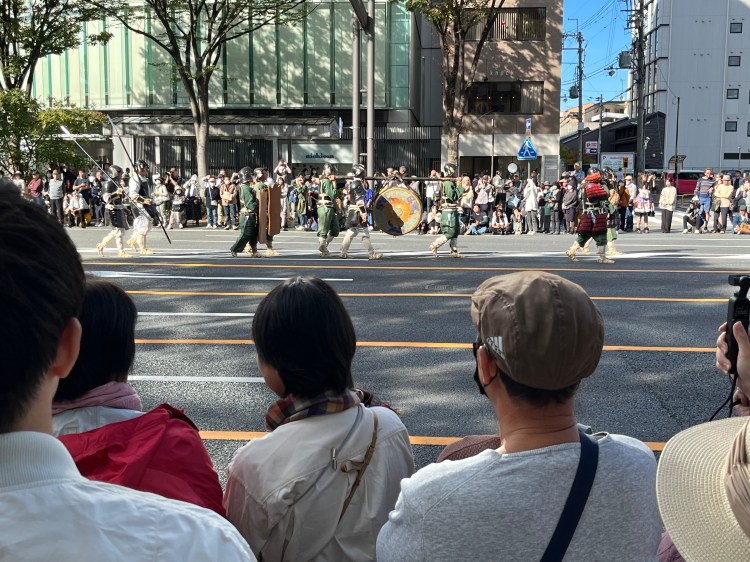
Our first port of call was Heian Jingu, a Shinto shrine.  We happened to be here on the same day as Jidai  Matsuri, one of three festivals in Kyoto that celebrate Japan’s emperors.  It involves a procession from the Imperial Palace to Heian Jingu, which is why we got here early.

Heian Jingu Gate

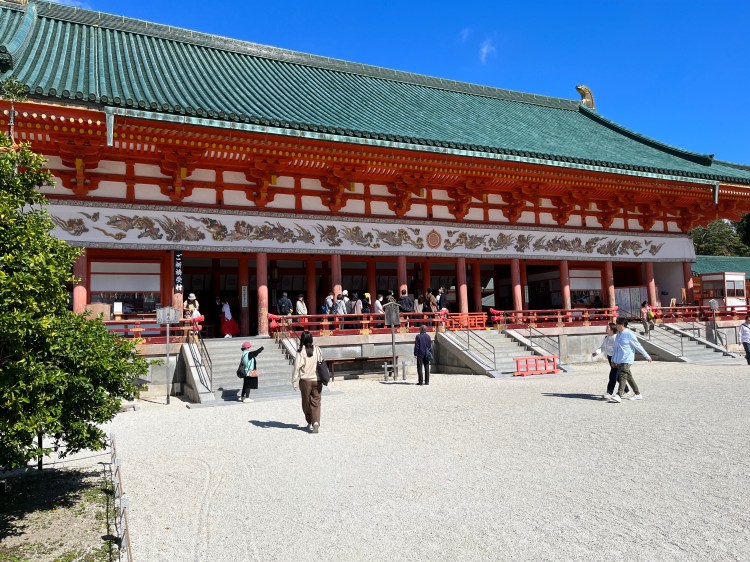
While not particularly old, the shrine is listed as a top ranking shrine and an important cultural property.  Unfortunately, you aren’t allowed to take photos of the inside of the main building, something that we found is common in temples and shrines.

Heian Jingu Shrine

From there we walked up to the Shoren-in, or Blue Lotus, temple, via the museum of photography.

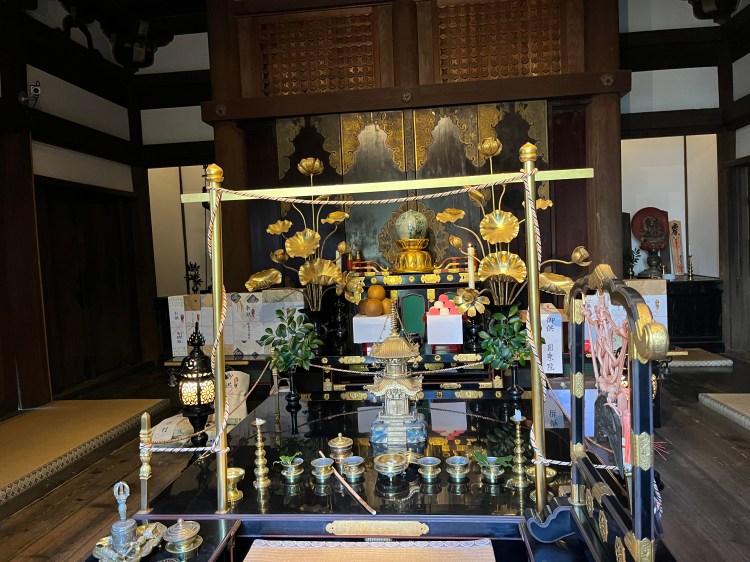
Altar at Shoren-In

The temple dates back to the 12th century and is known for it’s beautiful gardens.  It was built by the imperial family as a place of study and was also the Emperor’s residence for a while in the 18th century.  Although it was a fairly hot day, it was very cool inside the temple.  Among the artefacts inside are the Emperor’s personal palanquin and travelling luggage, all hand carried.  There’s also a shrine to the fire deity, where they light a huge fire, somewhat dangerous in a wooden building.

The Emperor’s palanquin

You have to take your shoes off to enter, but then collect them again to go into the garden, which is noted for it’s camphor trees and moss lawns.  There’s also a Buddhist dharma bell, which I got to ring.  

While walking around the gardens we saw a group of well dressed women leaving one of the buildings after having had a tea ceremony.  Miwa told us that this isn’t the everyday occurrence that we think it is.  The tea ceremony was originally for Emperors and the nobility, rather than the common people, and is reserved for special occasions.  And tourists!

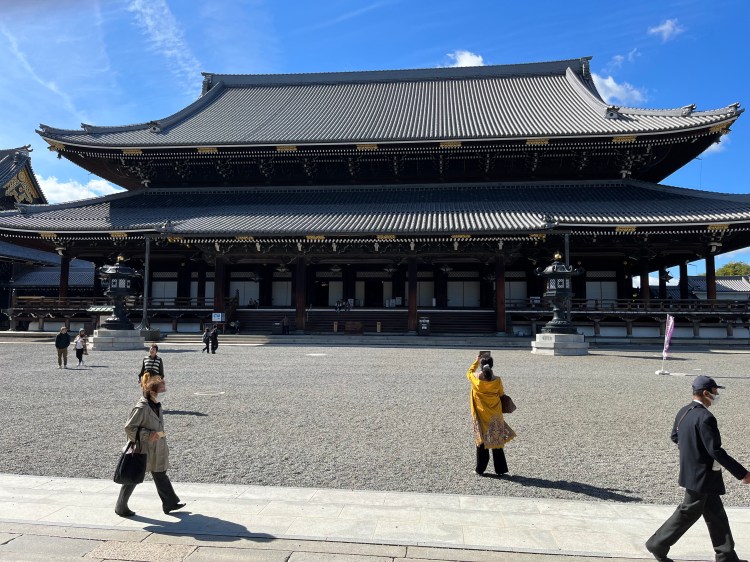
After that, back to the subway to visit the Higashi Honganji temple or Eastern Temple of the First Vow.  This and the western one are the head temples of Pure Land Buddhism, the most popular version of Buddhism in Japan.  (Esoteric Buddhism was for the emperor and nobility and Zen for the Samurai!)

Higashi Honganji Founders Hall

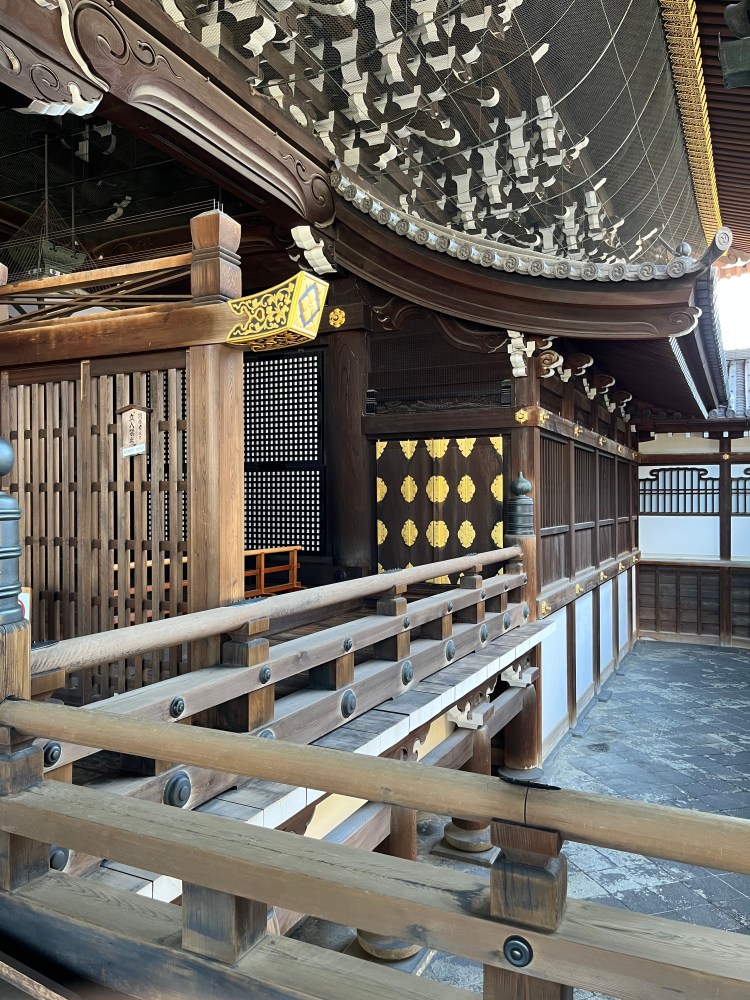
The temple dates from 1602, although it contains a mausoleum dating from 1270.  The two main buildings, Founders Hall and Amida hall are off limits to cameras, but they are very ornate and feature a lot of gilded statues and woodwork.  It is one of the largest wooden buildings in the world and has burned down and been restored four times.

Small part of the temple

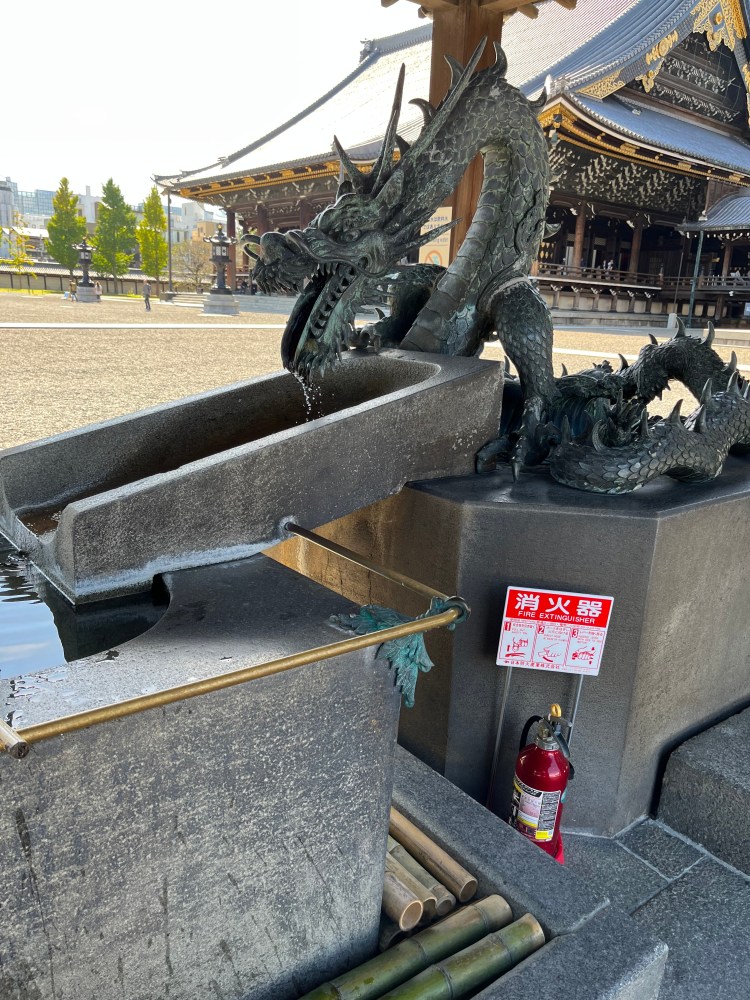
Unlike dragons elsewhere that breath fire, the one in this temple breathes water.  Which hasn’t prevented the fires.

Guardian (water) dragon

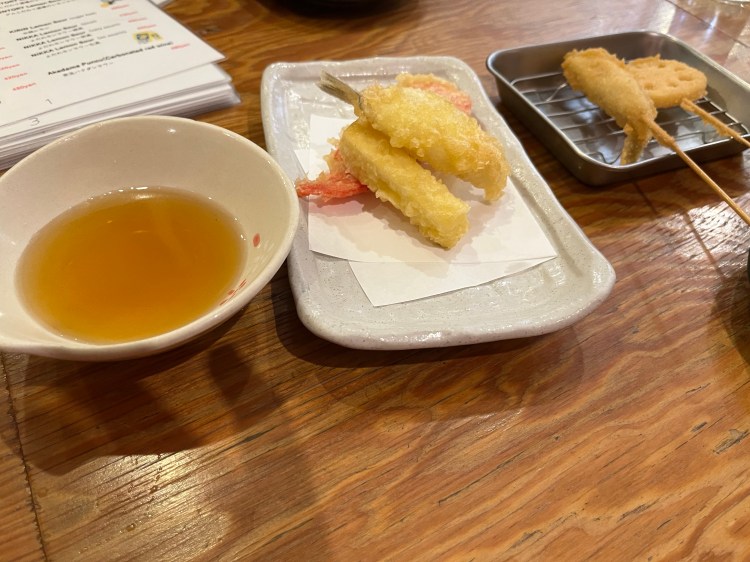
By now it was half past lunchtime, so Miwa took us to a “non tourist” restaurant to try some local specialities.  We tried tempura, kushi katsu, omelette and dumplings.

Lunch

Walking back to the hotel, we discovered that the festival parade was still in progress.  There were people in traditional costumes from all the different periods of Kyoto.  When I say in progress, they were standing still more than they were walking.  It was a long parade and it would be a long time before they made it to the end.

Festival procession

Tiny Train and Huge Tower

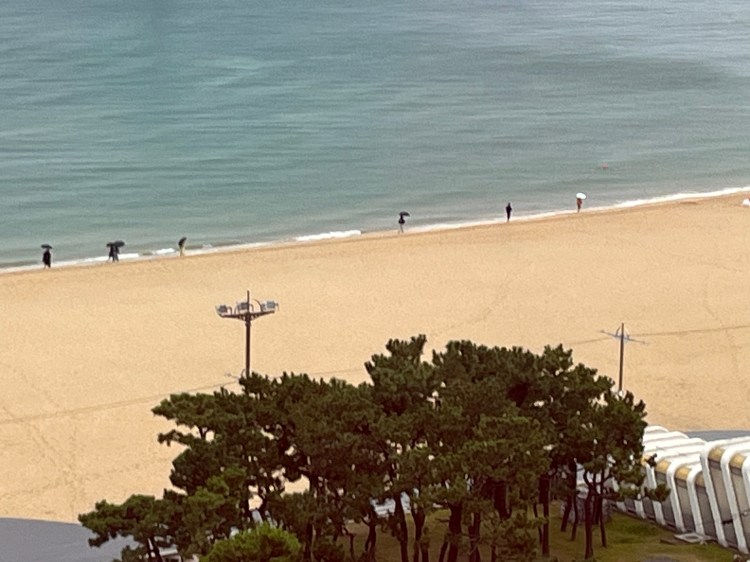
Looking out of our window first thing this morning, we could see a line of people with umbrellas walking along the shoreline.  It looked like the inspiration for a Jack Vettriano painting!

Early morning stroll

We had a text this morning to say that BK wasn’t well, so our guide would be Linda.  There has to be a joke about an assignation with a strange woman outside a brewery …

Anyway, she was there before us along with a written plan of what we were going to do today.  But she doesn’t drive, so we trotted off to find our driver, who was in a very fancy Kia.  It looked new and I’m not sure he knew what all the controls were for yet.

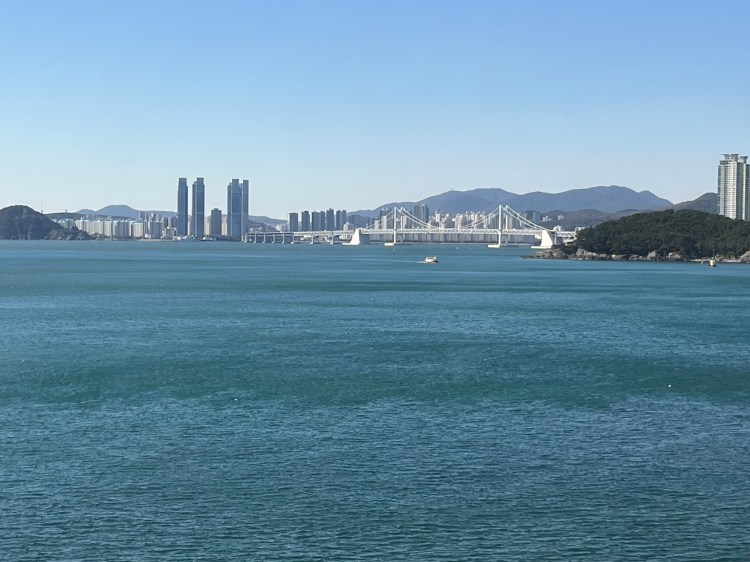
Our first port of call was over the diamond bridge again, and we found out why they call it that.  At night, it is all lit up with white lights and it sparkles like a diamond.

Diamond bridge from Oryukdo

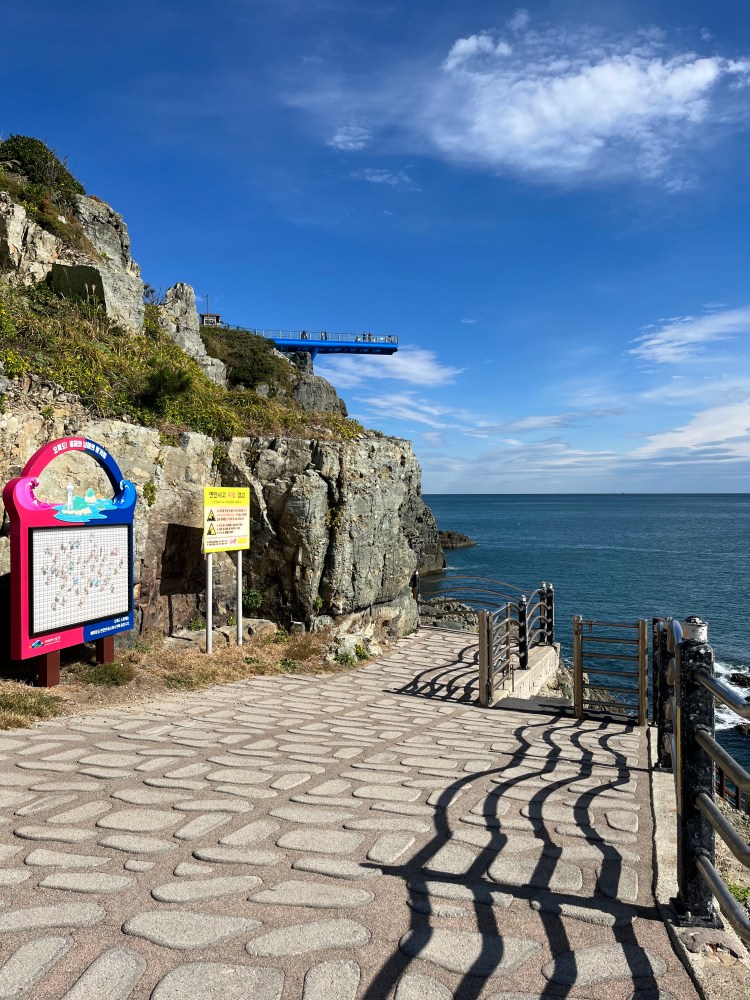
We stopped off at Oryukdo Island, which means five or six. Depending on which side you look at them from, you can see either five islands or six.  I could only see two! This is the point where the East Sea meets the South sea, and the start of walking trails that follow the coast all the way to the border.

Damned if I can make out six islands

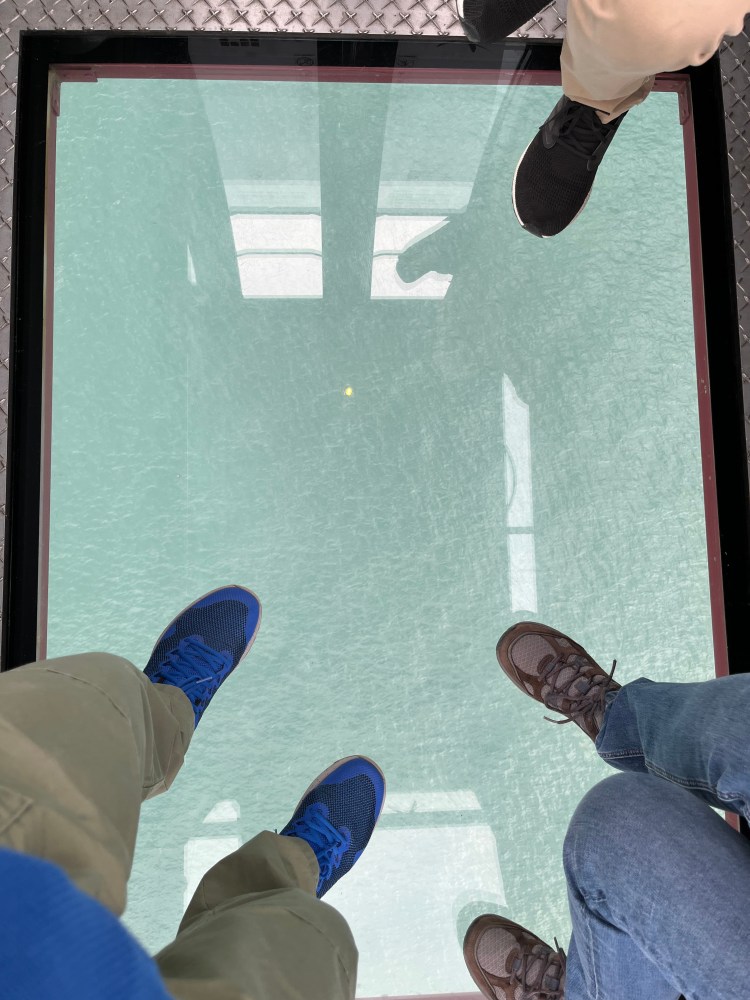
There’s a platform that allows you to walk out over the ocean, with a floor made of bulletproof glass.  They make you put on soft overshoes so that you don’t damage the bulletproof glass!  It was really quite disconcerting standing 35 metres over the waves; you can’t do it for long.  On a sunny day, you can see Japan, assuming you’re not looking down.

Scary platform

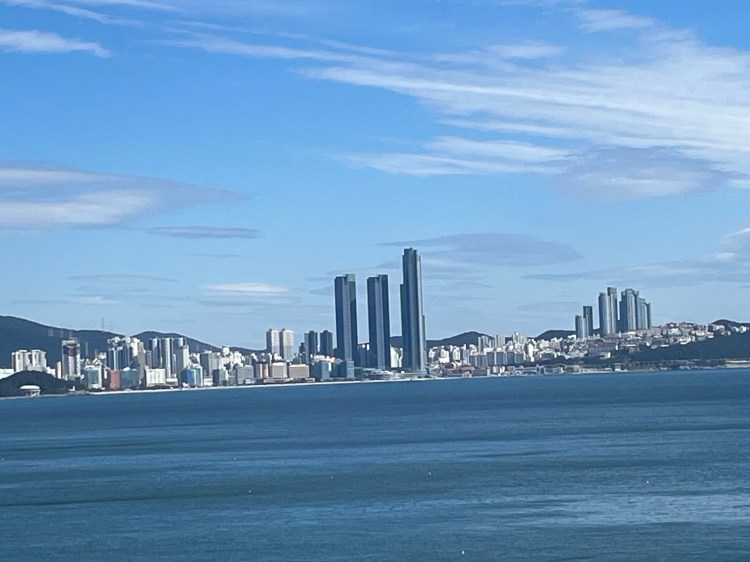
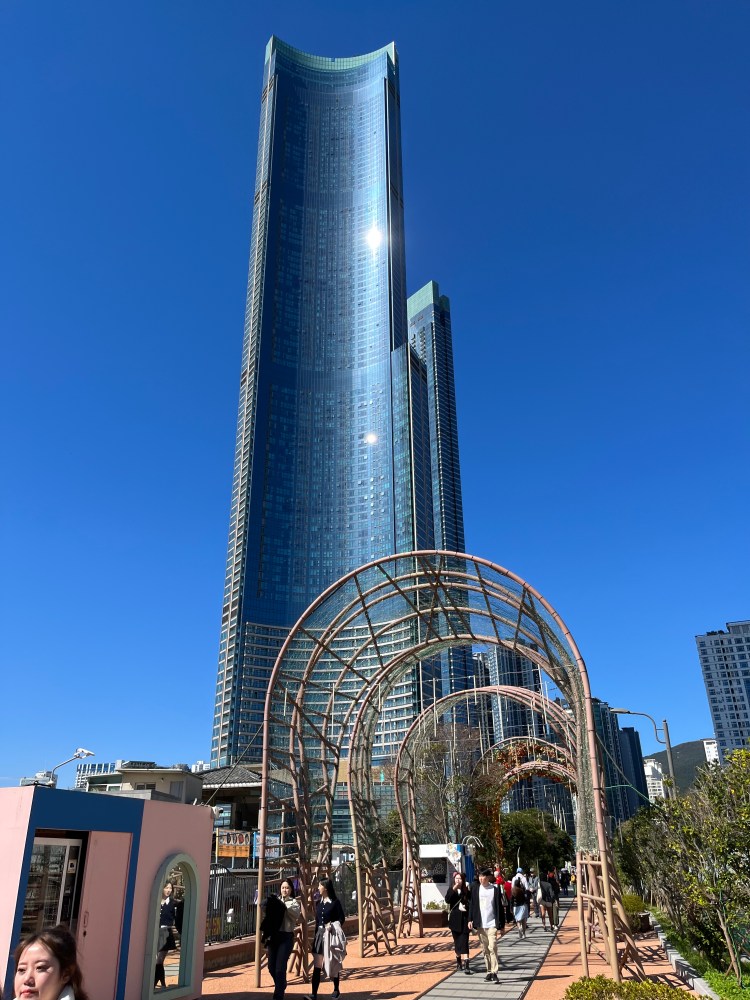
Looking back towards Busan, we could also see the area that our hotel is in.  It is near the X the SKY, the second tallest tower block in Korea at 411.6 metres.  There’s an observatory on the 100th floor and a Starbucks on the 98th, making it the highest Starbucks in the world.

Our hotel is over there

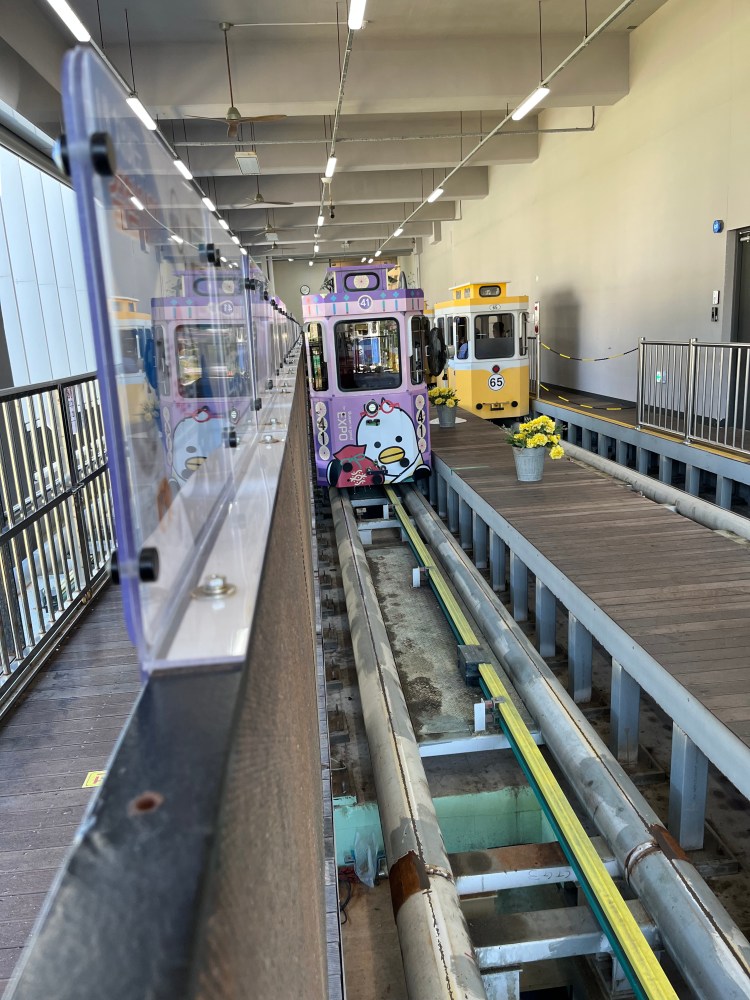
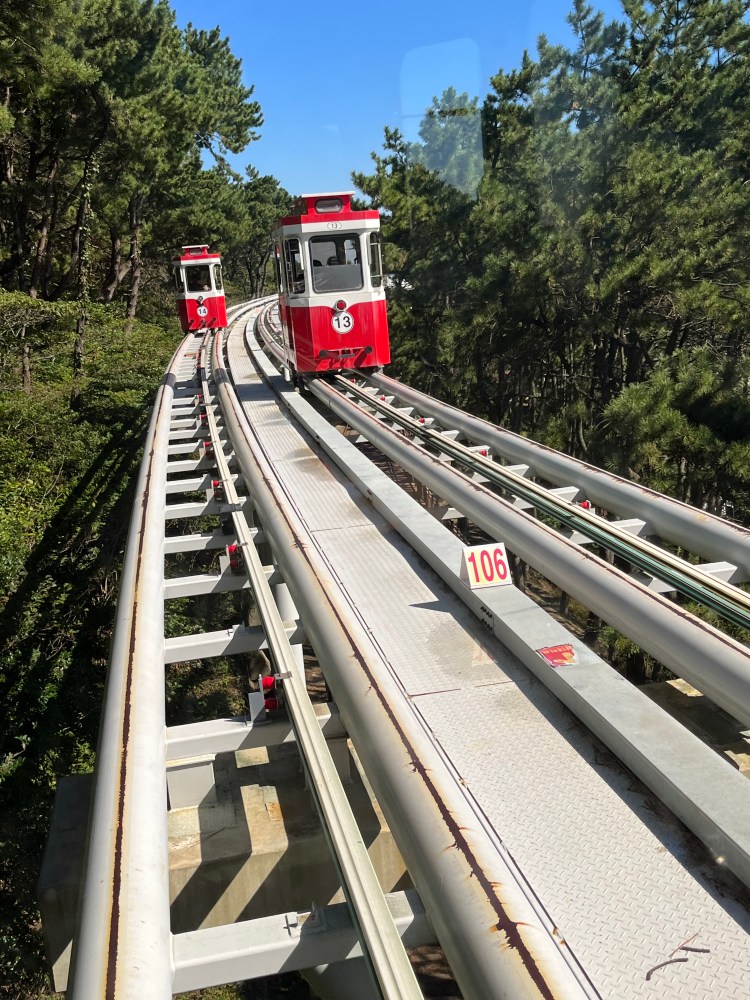
From there we came back over the Diamond bridge, around X the SKY and ended up at Cheongsapo station.  This is where one end of the Sky Capsule is located, the other end being Mipo station at Blue Line Park.  The sky capsule is a little elevated track that follows the path of the Blue Line Railway but 10 metres above it.  You ride in cute little cars that look a bit like ancient cable cars.  It is quite a peaceful way to spend half an hour.

Our car approaching
Sky Capsule

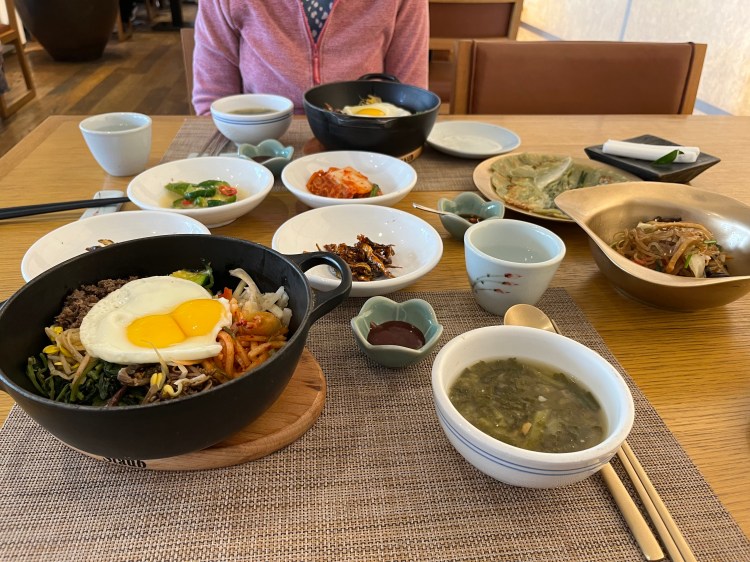
And that was it as far as our tour was concerned.  We spent some time wandering around the Haeundae beach area, dined on bibimbap and got ourselves packed.  Tomorrow we’re off to Japan!

Bibimbap
X the SKY

Things we’ve learned about Korea.

  • There is no fourth floor in most hotels, public building and – especially – hospitals.  Four is considered to be an unlucky number.
  • All restaurant tables have either a drawer or box containing napkins, chopsticks and spoons.
  • Even Bicester can’t compete with the number of coffee shops per square metre.  Korea is the third largest coffee market in the world.
  • All the hotels we’ve been to and a number of other places have toilets that will wash and dry you.  If you can understand the controls, they are very effective.
  • Most public car parks have a pink zone exclusively for women.
  • Just about everywhere we’ve been to has been destroyed by the Chinese, Japanese, Manchus or other Koreans.  They’ve all been restored.
  • The country is generally much cleaner and safer than anywhere we’ve been to, and there are no (visible) homeless.
  • I’ve never seen so many selfie sticks!

A tour of Busan

We met BK outside the micro-brewery and set off for Songdo, Korea’s first official public beach, to ride the cable car up to Amnan park.  To get there, we had to cross several bridges, including the Gwangdamdaegyo or diamond bridge.  This is a two level suspension bridge connecting Haeundae to Namcheon, and the second longest in Korea.  Unfortunately, as spectacular as it is, it isn’t possible to get a decent photo while you’re driving along it.

Diamond Bridge approach

As we were driving along, BK told us that tomorrow there would be a group of 2,000 students visiting the cable car.  When we got there it looked as if they’d come a day early, as there was a huge queue.  However, BK had a plan!  Some of the cars – the red ones – have a glass floor, but it costs more to ride them.  He got us red car tickets and we walked straight to the front of the queue.  One point for insider knowledge.

Looking up
Looking down

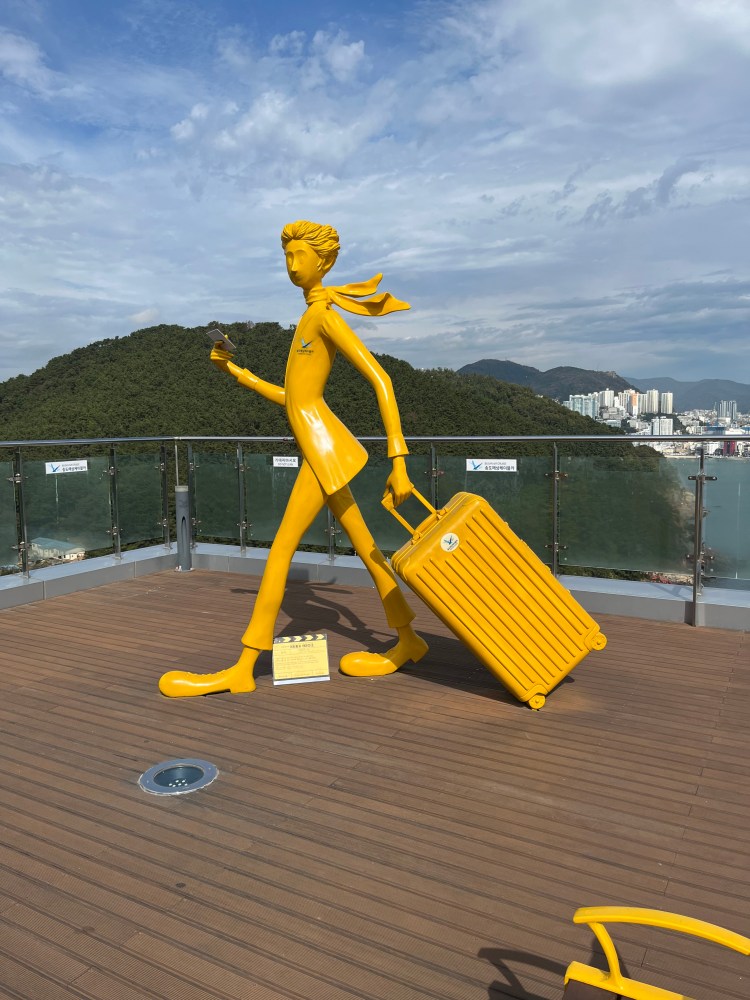
The destination is Amnan Park, 1.6km away across the sea, which you can view between your feet.  Once up there, it is all a bit tacky, as if they had to find a reason to attract visitors.  On the roof of the station there are lots of characters from Le Petit Prince, for some reason.  

Why?

In the area immediately outside, there are dinosaurs hiding in the bushes. Beyond that, there are trails through the woodland, one of which leads to yet another suspension bridge that allows you to walk to a small island.

Then we took the cable car down again.  Interestingly, when we got there I noticed that there was a huge queue for the red cars but normal tickets were walking straight on.

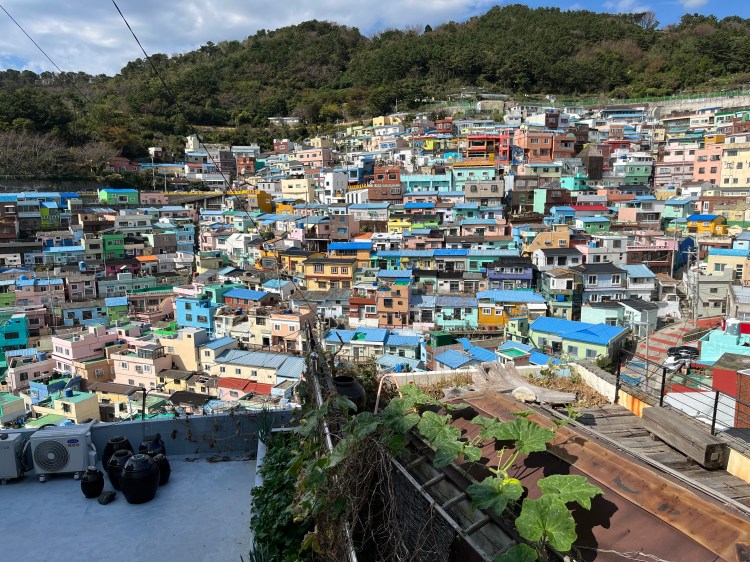
Next we drove up to Gamcheon Culture Village.  One of the oldest parts of Busan, it was also one of the poorest.  It was first settled by the Japanese in the 20s, other families were moved in to provide a workforce for the docks in the 50s and refugees from the north added to the population.  Development was uncontrolled and living conditions were poor.

Gamcheon Culture Village

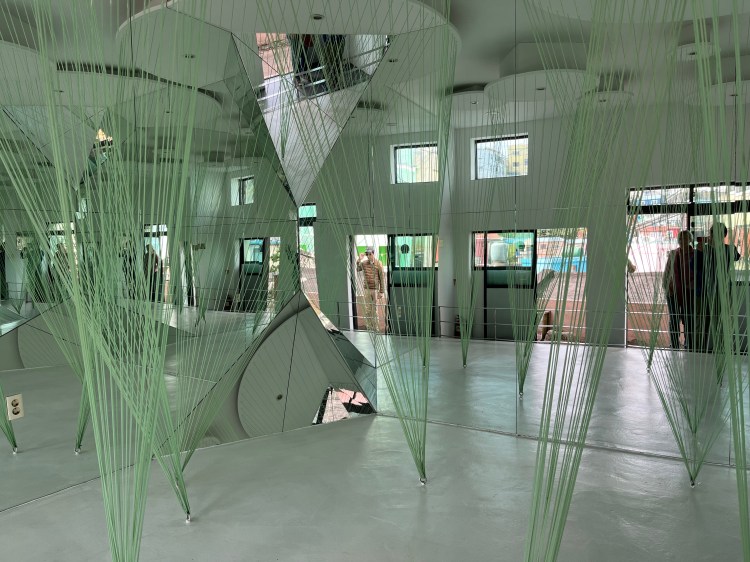
In 2009, an art-themed renovation project was started to convert the village into a cultural hub.  This is most obvious in the variety of colours, but there are also now retail spaces, galleries and, inexplicably, more Petit Prince themes.  It was interesting to see, but, again, rather tacky.

Art installation

Lunch today was dweji gukbap, which means pork soup rice.  A Busan speciality it is a soup made with … pork and rice.  And sides.  Today we had salty shrimp, two types of radish,  onion soaked in soy sauce and wasabi, chives, garlic, soy bean paste and deep fried stuffed chilli.

Dweji Gukbak

You are supposed to take a lettuce leaf, add a piece of pork, some rice and any of the other sides your feel like, roll it all up and pop it into your mouth.  My mouth wasn’t big enough.  Diane’s was!

After a quick coffee, we headed back across town to visit the market area.  We started with the Bupyeong market, the largest and oldest market. The indoor part mainly sells food from three main avenues.  It’s all a big jumble and I’ve no idea how you choose between two competing stalls selling the same things.  There’s also an outdoor element, selling mainly souvenirs, leather goods and knock-off designer stuff.

Pick your own

Secondly there is the Gukje or International market.  It started by selling goods discarded by Japanese at the end of the colonial era.  Later refugees sold goods acquired from Americans or otherwise smuggled into the country.  Nowadays it sells all sorts of things including, for some reason, catering-style kitchenware.

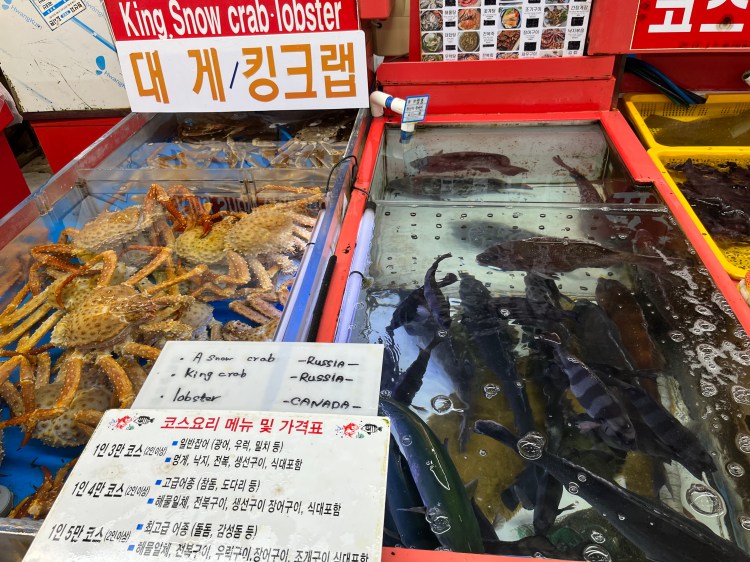
Thirdly, we went to Jagalchi fish market.  Here you can buy any kind of fish or shellfish you like, be it local or imported. Delicacies include raw crab, imported from Italy and live octopus, which is bought to the table still moving.  

Fish market

If you’re feeling hungry, you can pick what you want and take it upstairs where one of the stalls will cook (if necessary) and serve it up to you.

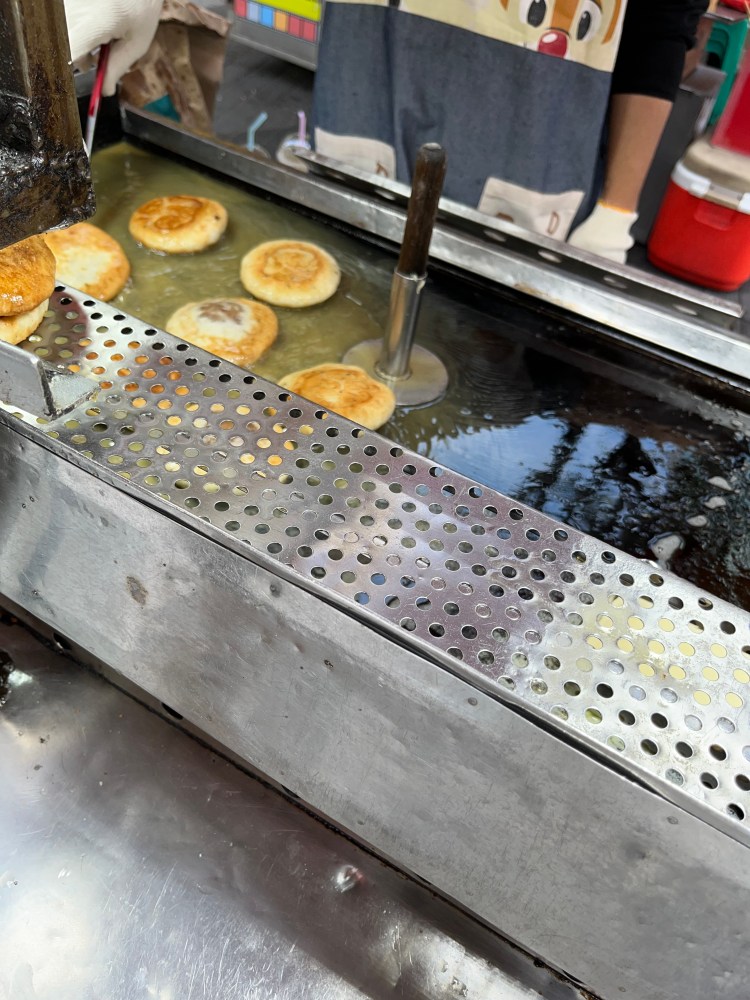
We declined, but we did pick up a freshly cooked hotteok.

Hotteok cooking

Apart from a detour to a fish cake shop, so that BK could spend a 15% off voucher, that was our day.

Hyundai City and Seaweed Soup

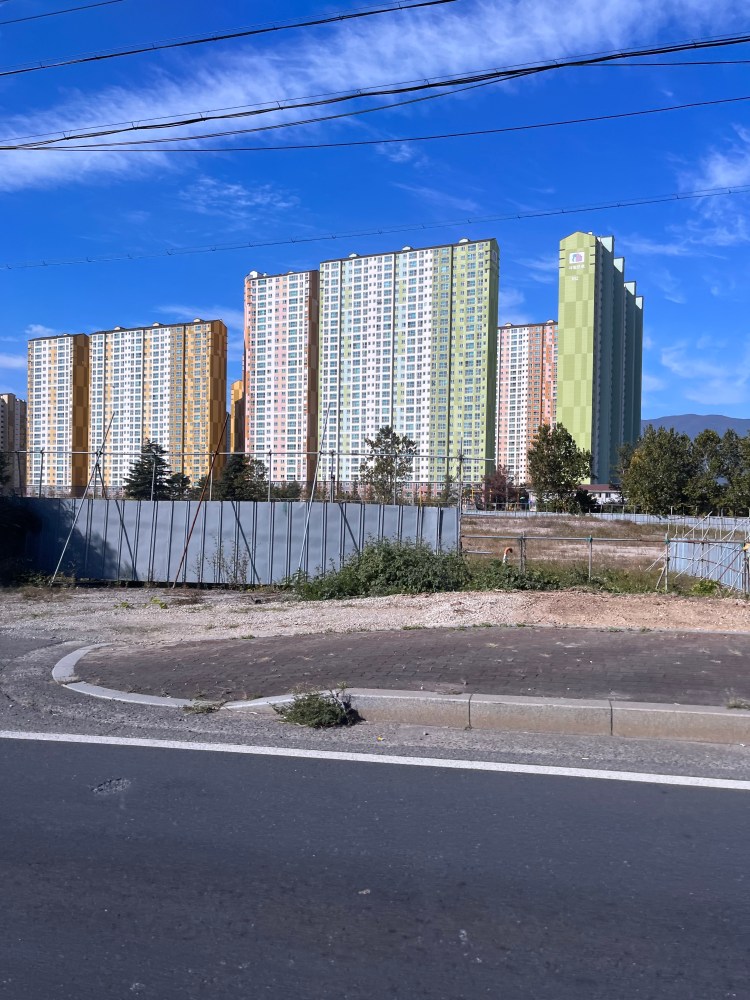
BK picked us up in the morning and we travelled south to Ulsan.  As you approach the city, there are huge blocks of apartments lining the roads. 

Outskirts of Ulsan

Further in you come to the world’s largest car assembly line, owned by Hyundai Motor Company; it seems to go on forever and there are completed vehicles everywhere waiting to be shipped out.

We drove past the docks, again on a gigantic scale, where three vast ships were sucking in cars.  (On our return journey, one had already set sail.) Hyundai also operate the world’s largest shipyard, make steel and have their own oil refinery so they can control the entire supply chain.

Our destination was Daewangam Park, built on land donated by … Hyundai.  Daewangam means Rock of the Great King, after King Munmu who became a dragon on his death so he could protect his people.

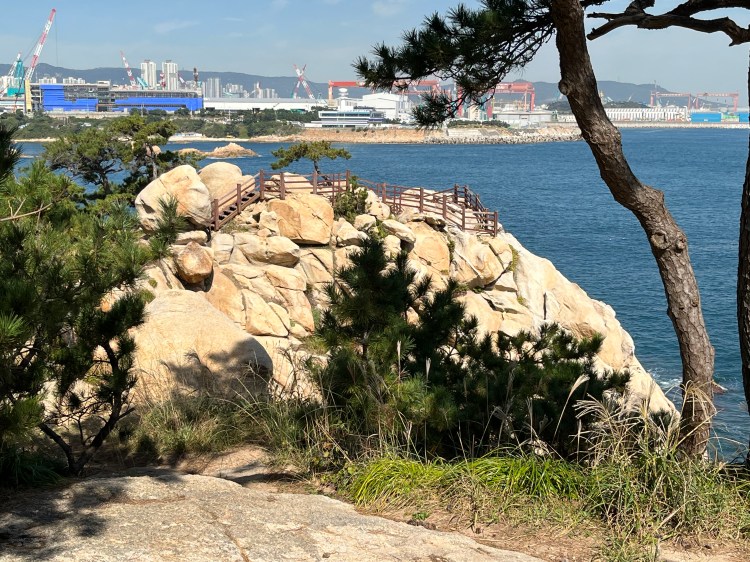
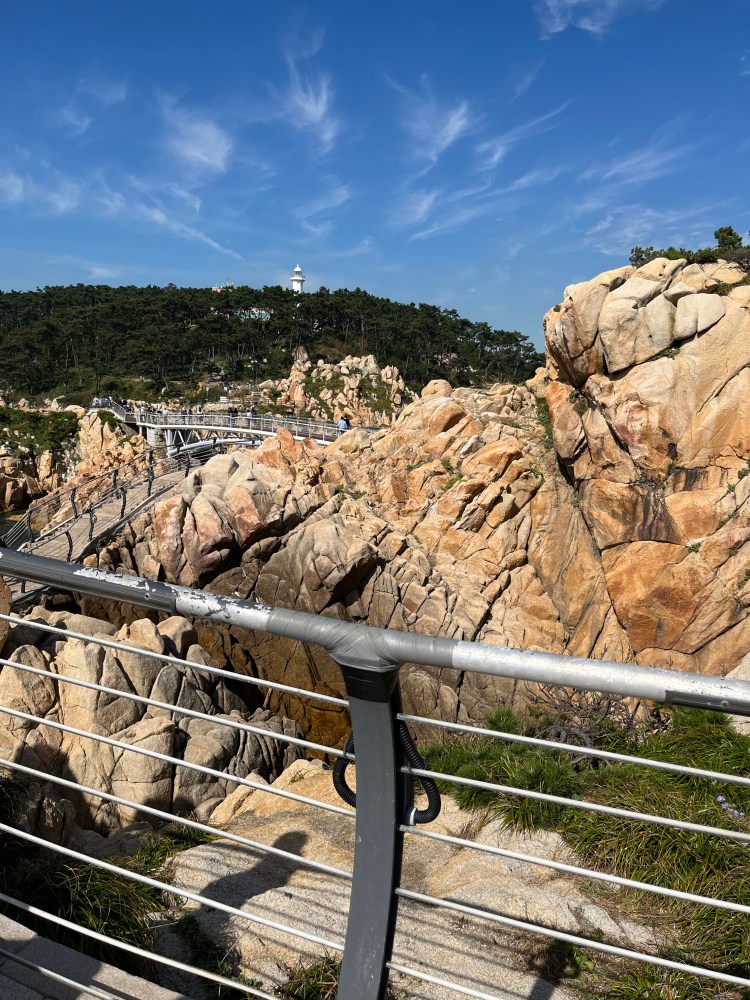
The area is surrounded by pine woods, apparently planted by Japan to hide the weapons they had cached there.  Emerging from the woods you arrive at the top of a cliff overlooking the bay, with the industrial part of Ulsan opposite.

Industry everywhere

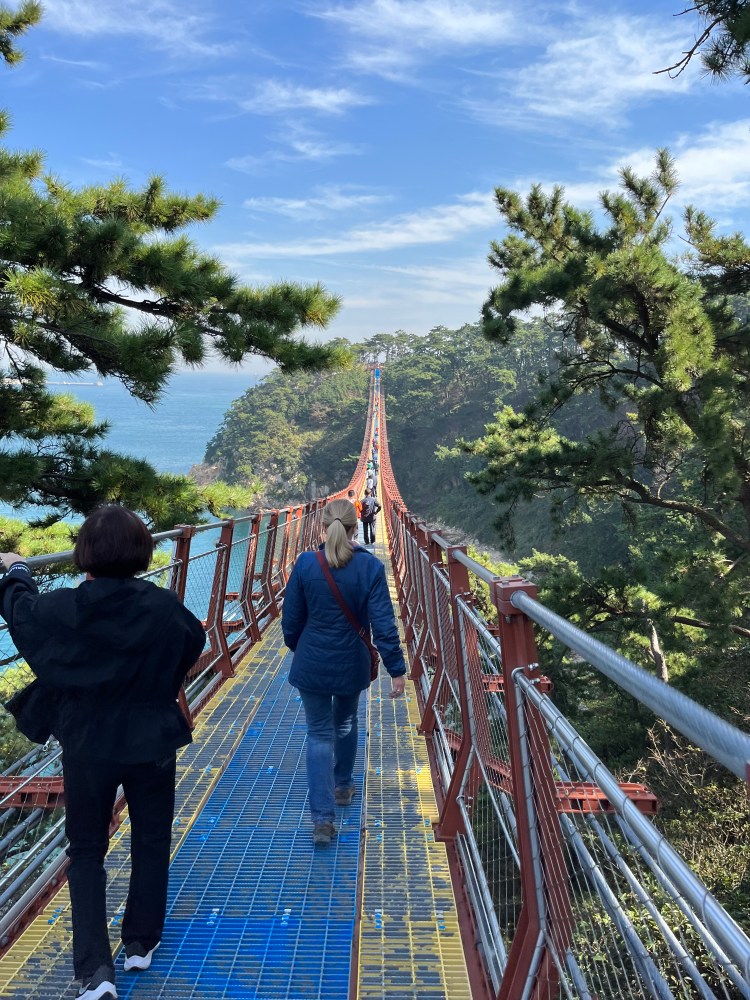
The only way on from here is over a suspension bridge, fortunately one way only, given the number of people stopping for selfies.  It sways about more than the Millennium Bridge and the sea below is so clear you can see the lost smartphones.

Daewangam Park suspension bridge

On the other side, there’s a trail that leads up to a tiny rock with even more photo opportunities.  We were accompanied by a school party, a football team and a group of civil servants on a training course.

Path out to the photo opportunity

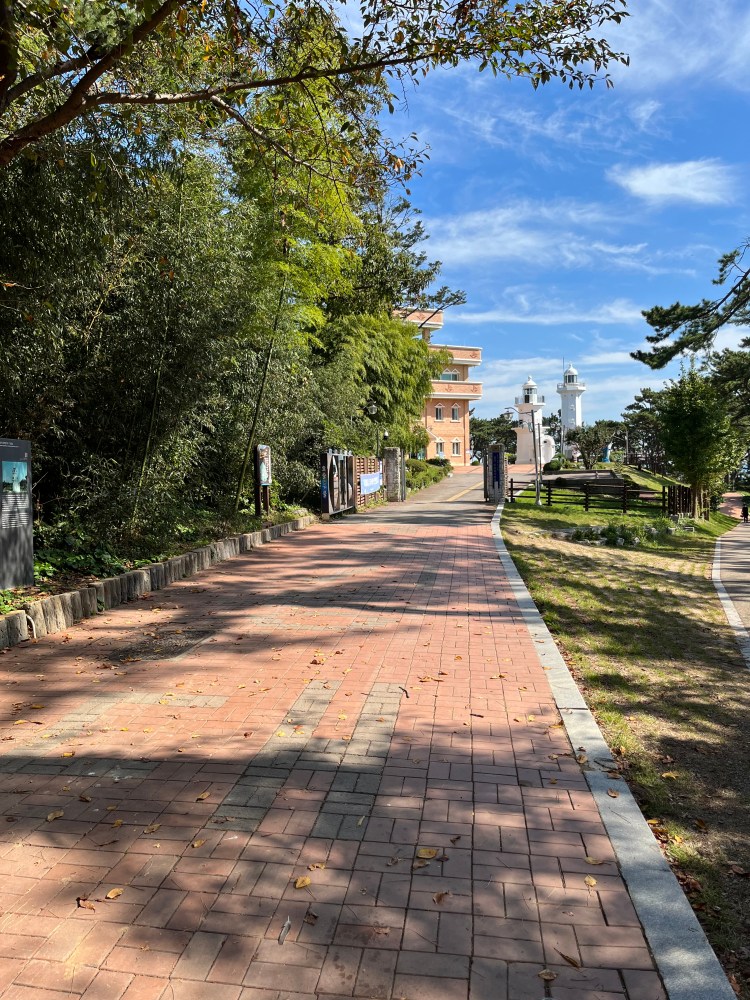
Coming back from there you pass the Ulgi lighthouse.  To be more precise, the two Ulgi lighthouses.  Trees grew in front of the first one, obscuring its light.  Rather than cut down the trees, they built a new lighthouse.

Ulgi lighthouses

Looking to sea from there you can see why they need a lighthouse.  There were dozens of ships in the distance, all waiting their turn to enter the port.

Ships waiting to dock

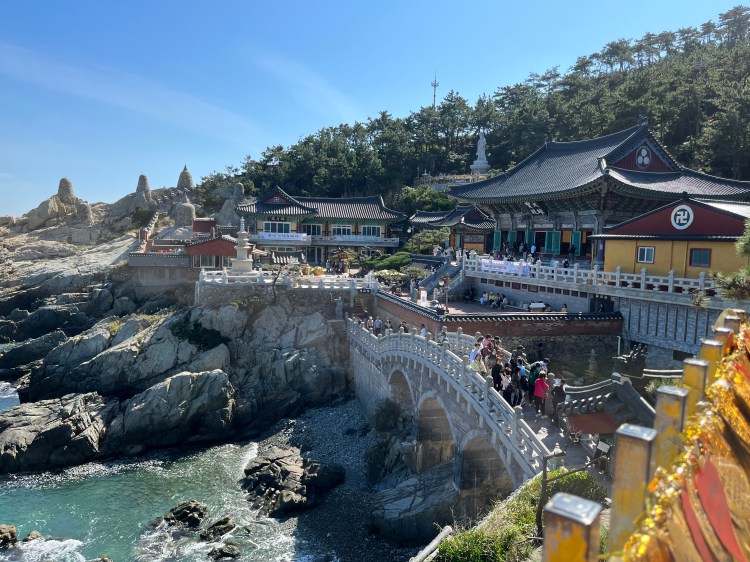
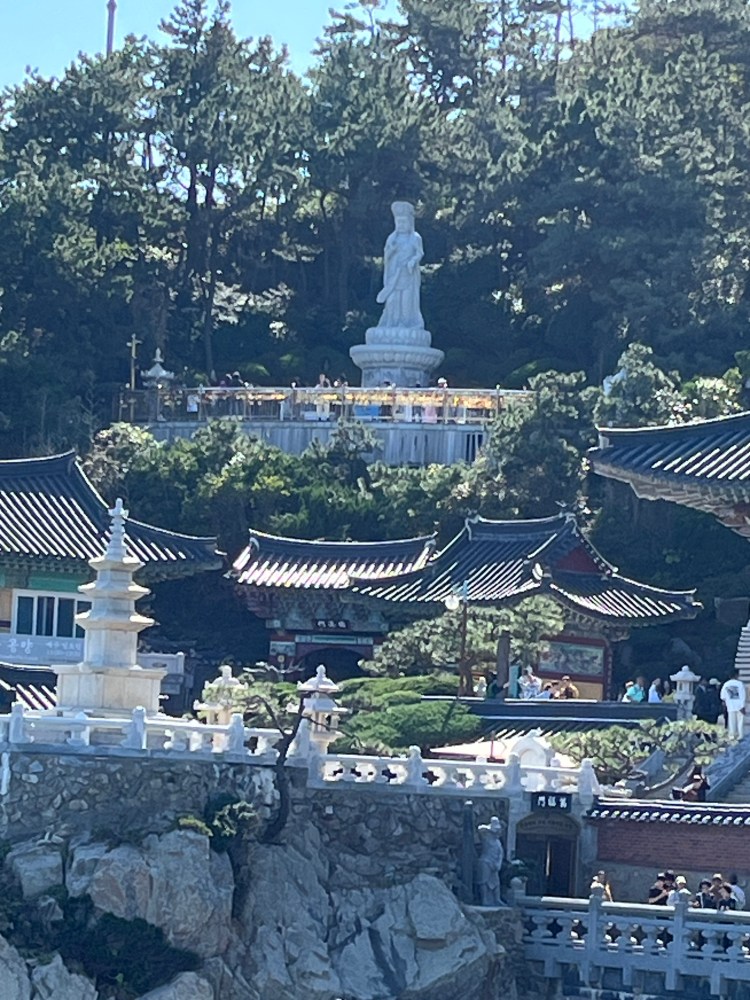
We had to make one more stop before BK would let us have lunch.  This was Haedong Yonggungsa, the temple of the dragon palace, a Buddhist temple notable for being built on the beach.  It sprawls across the rocks with some very steep and narrow tracks between different parts.

It goes on and on

You enter along an avenue of food and souvenir stalls, then a line of statues representing the zodiac signs.

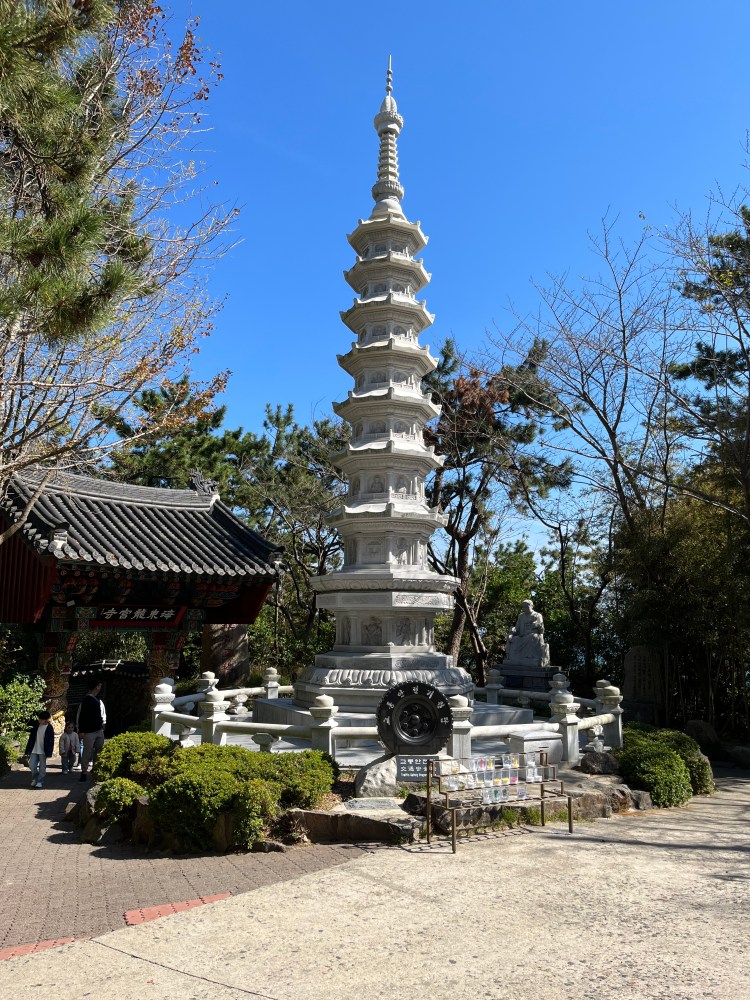
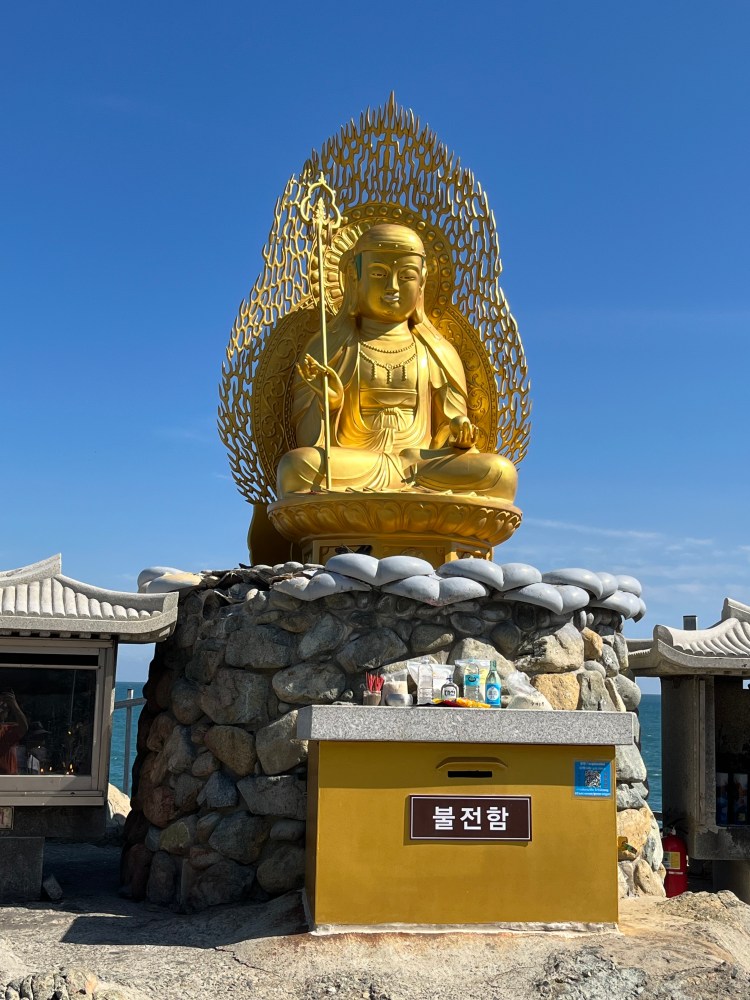
Inside, there are various Buddha statues, including one for making sure you have a son, along with some shamanic icons as well.  There’s also a traffic safety pagoda, donated by the local cabbies!

Traffic Pagoda
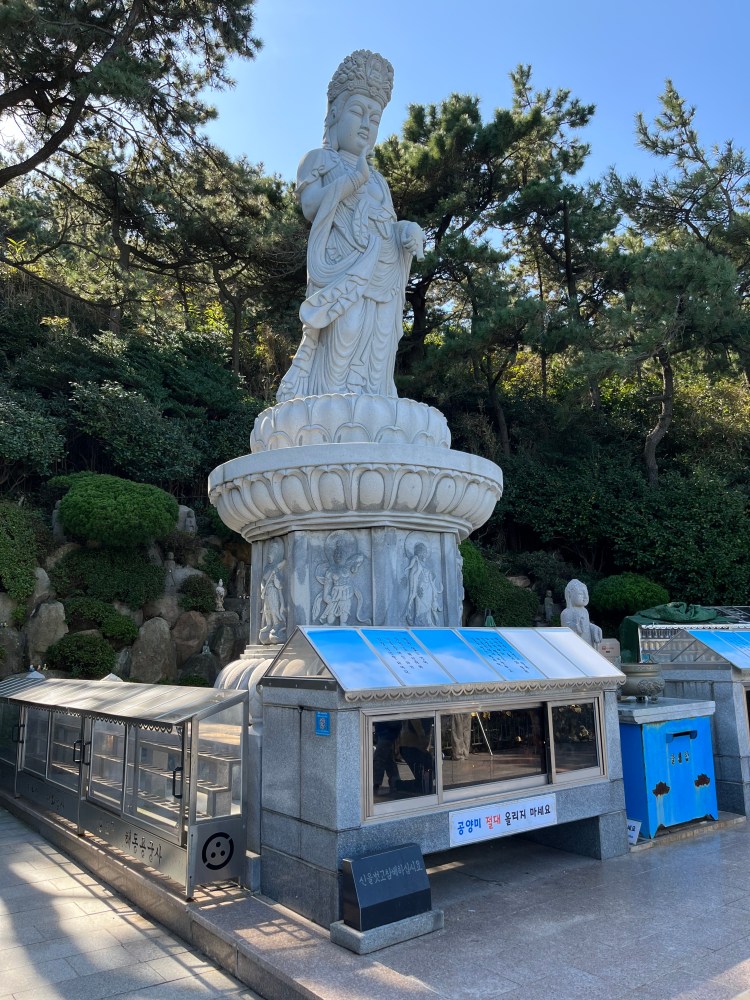
Goddess of Mercy
Buddhas watching tourists throwing coins
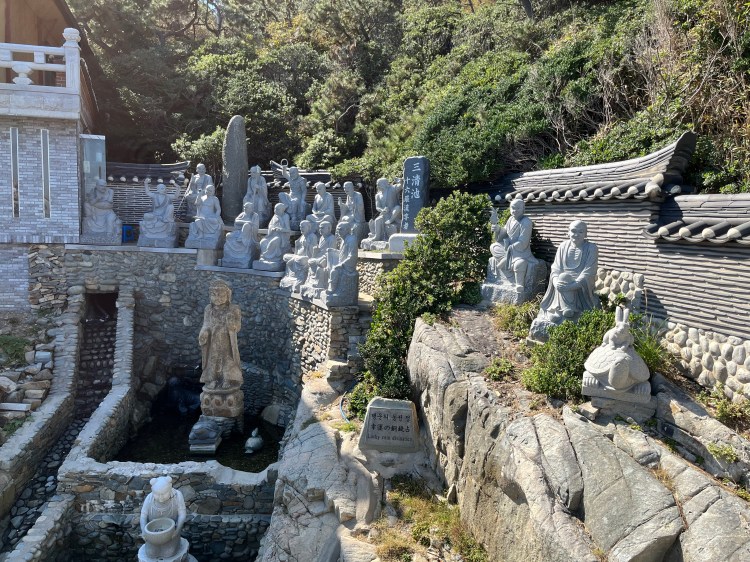
More Buddhas
Managed to get a shot with no tourists

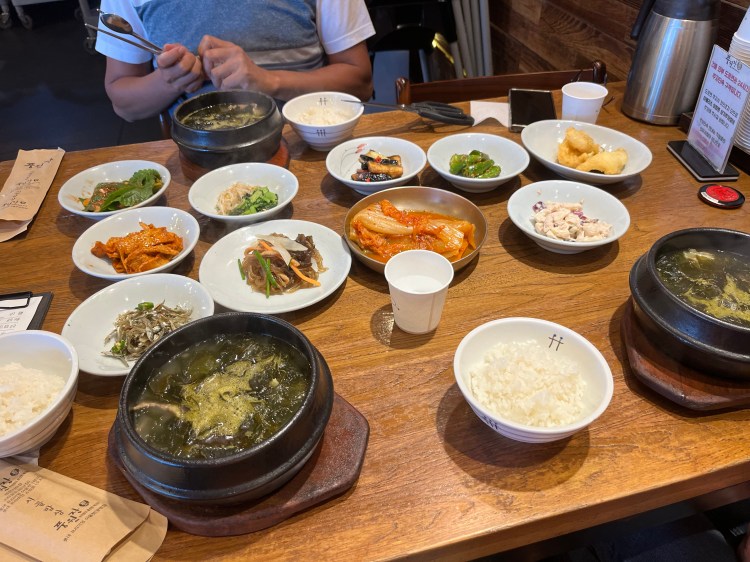
Our final destination was Busan, South Korea’s second city.  Lunch today was Miyeok-guk, a seaweed soup traditionally eaten on your birthday.  As always, it came with side dishes; whitebait, fish cake, battered fish, kimchi, pasta salad!, green chillies, aubergine, glass noodles and rice.

Seaweed Soup

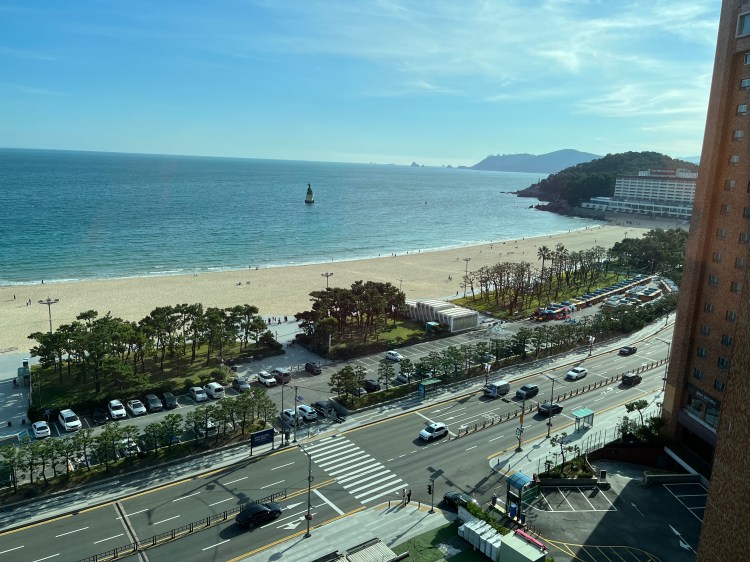
The restaurant was just down from our hotel, where BK deposited us for the evening. Here’s the view from our room on the 11th floor.

The view from our room on the 11th floor

Unfortunately, they have their own micro-brewery at street level so we had to go and try the Gorilla ale and Busan pale. Cheers!

Temples, grottos and raspberry wine

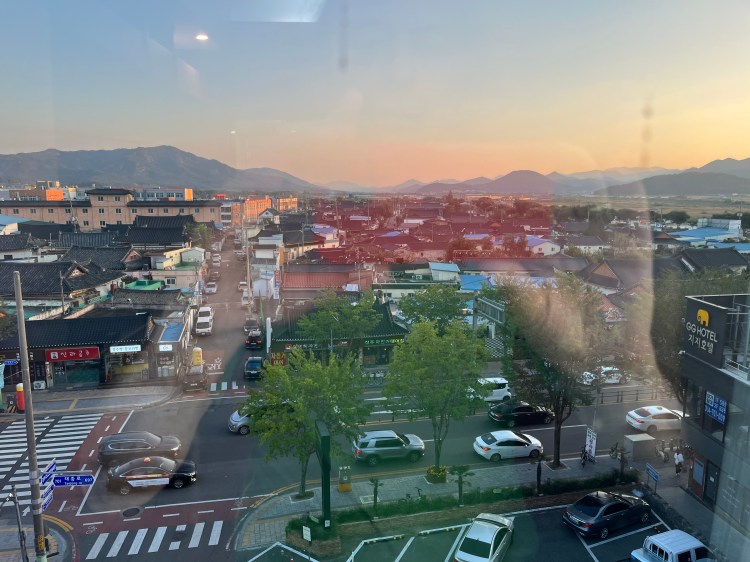
Looking out from our hotel window is a complete contrast to Seoul. The city is ringed by mountains and contains mostly traditional buildings with tiled roofs, with just the odd block that rises to three stories.

View from our hotel

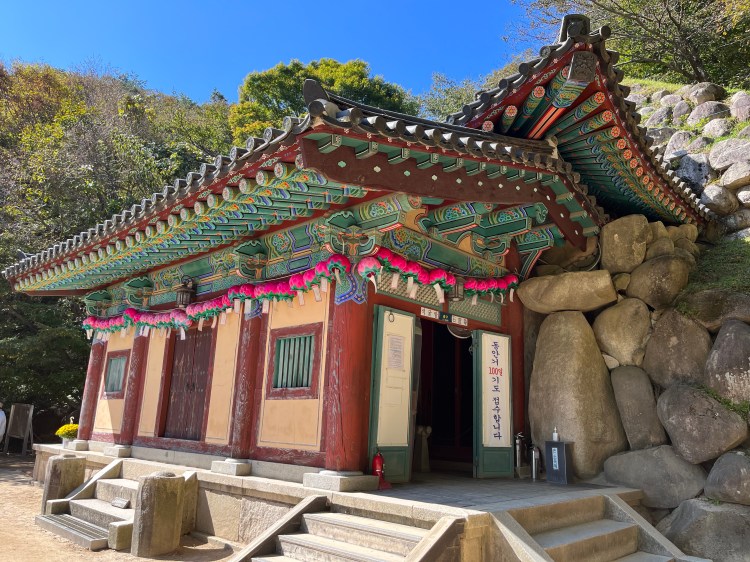
For our second day here we were exploring some of the history of the area.  BK met us at the hotel and we drove up to Bulguksa, an ancient Buddhist temple in the mountains.  Originally built in 774, but destroyed and rebuilt several times, it contains six national treasures, including two statues of Buddha that we weren’t allowed to photograph.  It also houses the earliest woodblock prints in the world.

A peaceful place

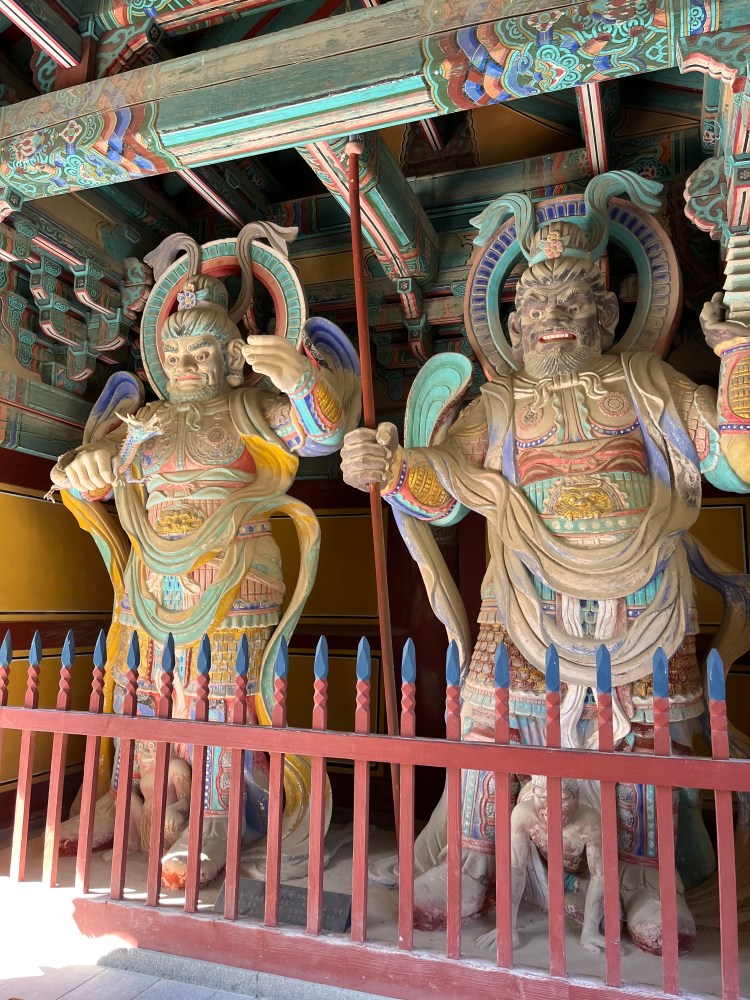
As always, there are five gates, guardians and a lake.  And people in your photos!

Two of the guardians
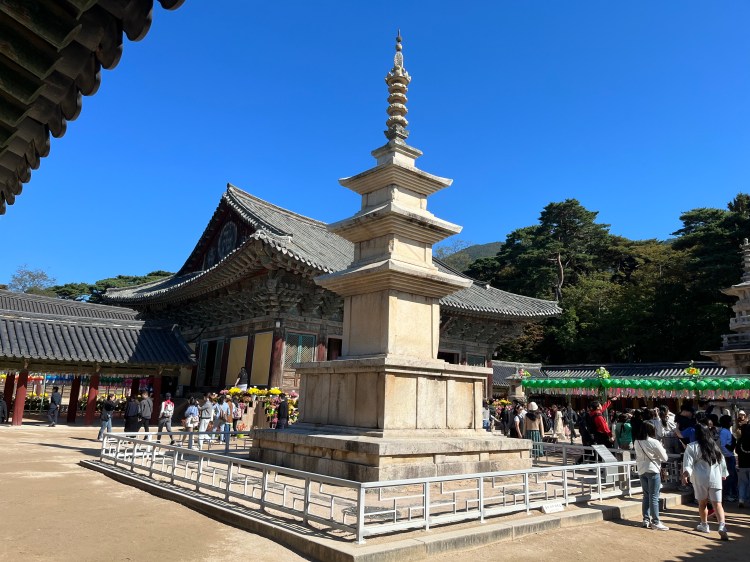
National treasure pagoda

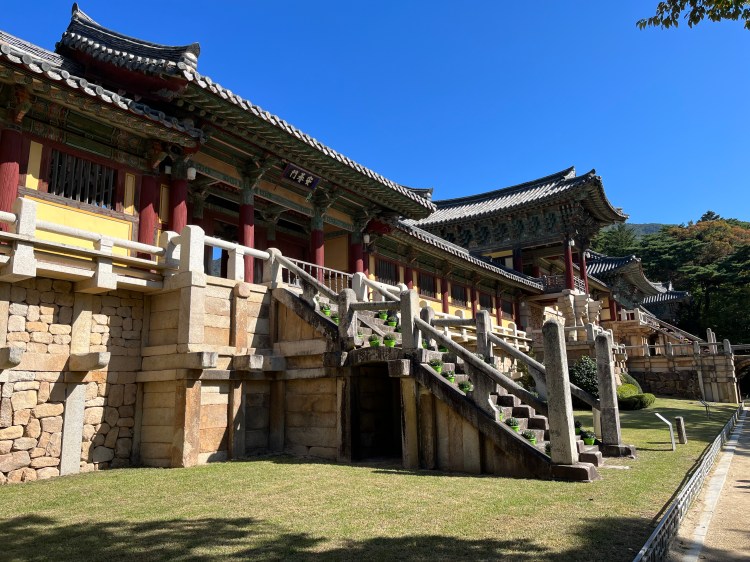
The foundation of the last gate is made of granite blocks, the top layer of which have been carved to fit the irregular stones below them.  That way, the floor is flat.  A massive undertaking in the days before power tools.

Last gate to the temple

From there, we continued up the mountain the Seokguran Grotto, a place of meditation.  Normally, an existing cave would be used, but there aren’t any in the area so they had to make one!  When originally built, the dome comprised 365 granite blocks perfectly fitted together.  Water would seep through the roof, which provided a natural cooling mechanism.  During a restoration project by the Japanese in the early 1900s, the dome was encased in concrete to stabilise it.  This led to humidity and erosion of the statues.  Today, the front of the dome is sealed with a glass panel and they have a dehumidifier permanently on inside.

Seokguran grotto

At sunrise, the sun lights up the statue of the Buddha inside the grotto, and it is a very popular time to visit.  We came later!

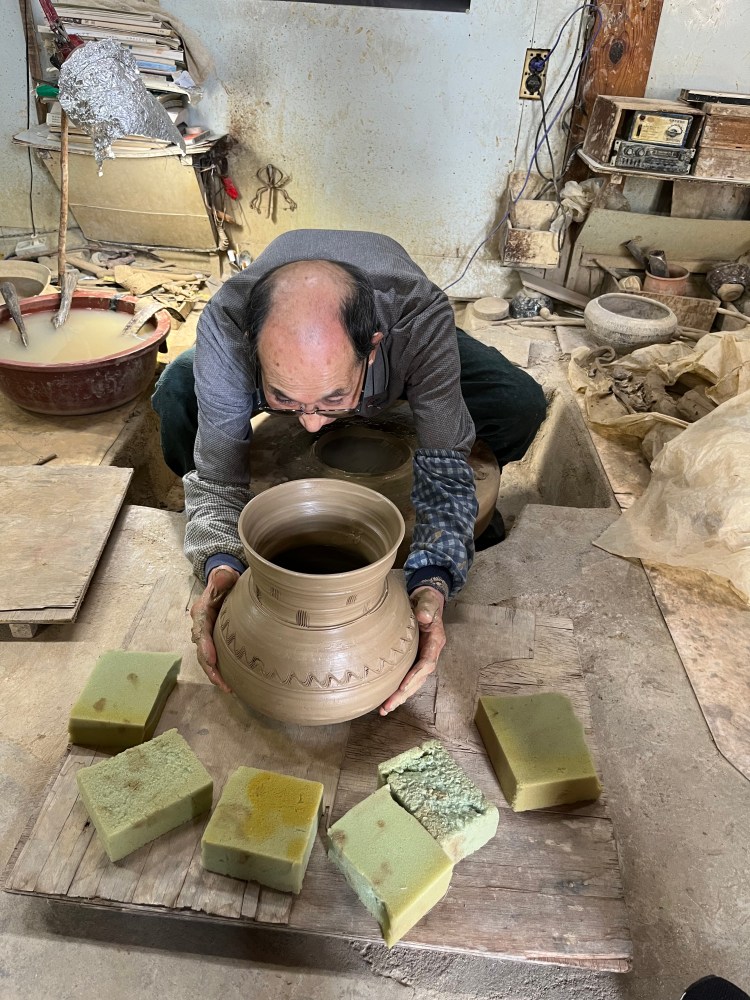
From there we descended down into Gyeongju to visit the folk craft village.  This was started in the 80s by a potter who had revived the ancient Silla method of making unglazed waterproof pottery.  He gave us a demonstration, working at a foot-driven wheel to make a traditional pot.  We also viewed his wood-fired kiln, which is built on a slope for better control of the temperature.  His exhibition room contained hundreds of items at remarkably low prices considering the amount of work that goes into them.

The finished article

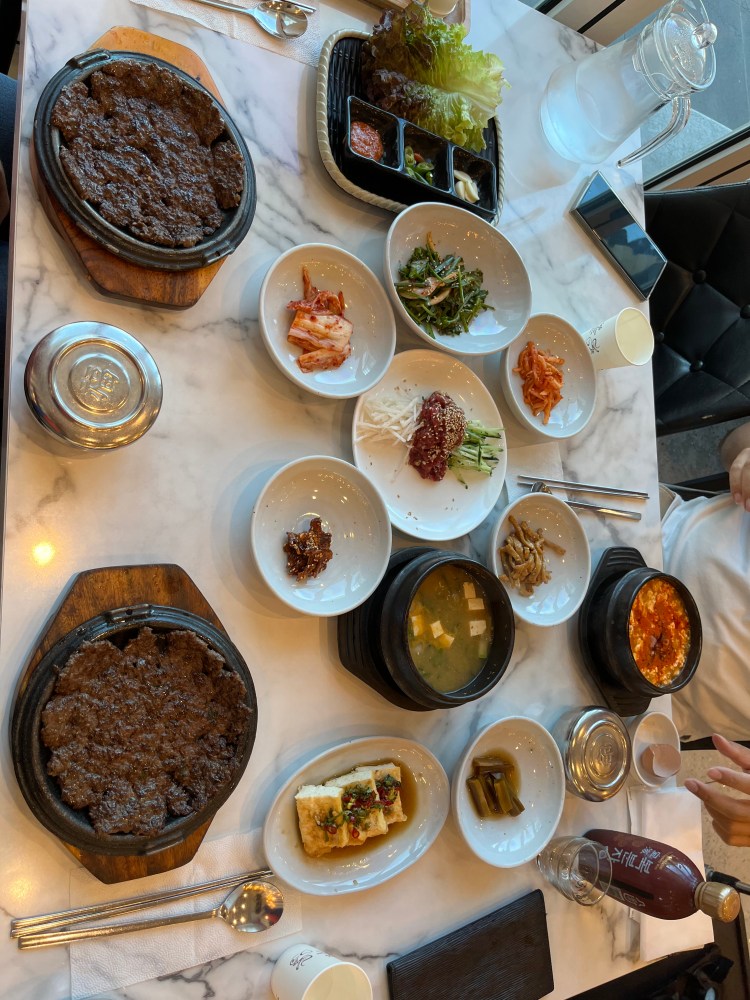
Next we made a lunch stop at another one of those Korean restaurants that specialises in one type of dish.  This time it was ddudukgalbi, a local speciality of minced short-rib beef.  Plus accompaniments including, tofu, soup, pickled raw fish, kimchi, leek, orange radish, pickled lettuce stalks, various dips and a plaice, that BK dissected with chopsticks.

Ddudukgalbi

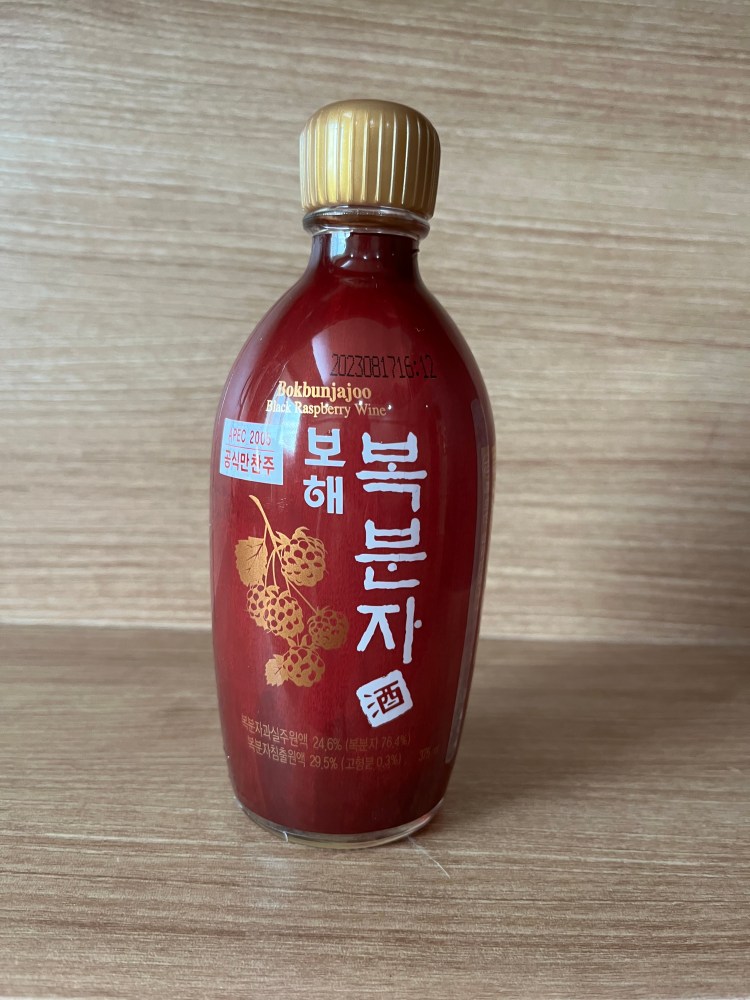
The house also threw in a “gift” for BK as he hadn’t been there for a while, the Korean version of steak tartare.  We also spotted raspberry wine on the menu, so thought we’d try a glass.  We got a bottle!  As it was 15% alcohol, we took some back to the hotel with us.

Raspberry wine

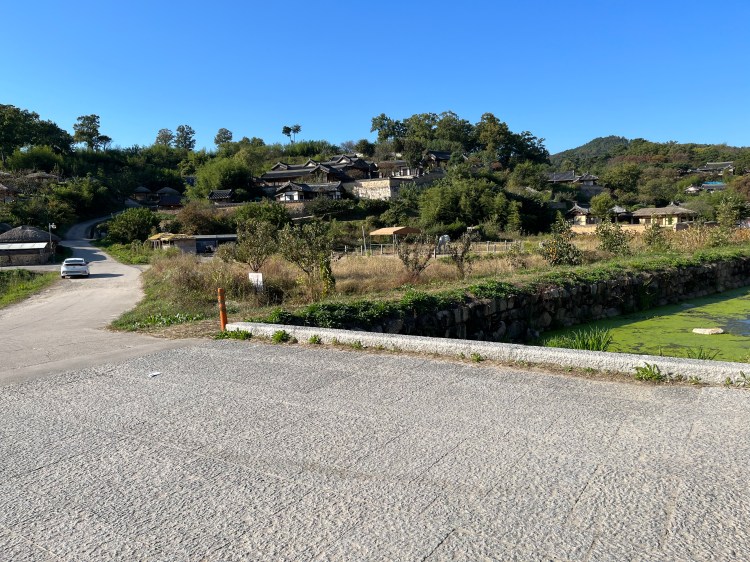
Our final destination for the day was Yangon Village, a UNESCO heritage site.  Founded in 14th century, it was a clan village, based on Confucian culture and laid out according to Feng Shui principles.

It is somewhat unusual for a Heritage site in that the houses are still occupied, mainly by the original two clans that started the place. We went into one house and BK told us that the owner must be at home, because he plays classical music to drown out the noise of the tourists!

Yangon village

Despite that, the whole village exudes an air of peace.  It must be a lovely place to live if you can handle all the visitors.

Into the Silla Kingdom

Next morning we were picked up by taxi and deposited at the latest incarnation of Seoul railway station.  The original station is next door, a lovely red and white stone affair that looks just like a station and was built by the Japanese.  It was restored to the way it looked in 1925 and is now a cultural centre.

The new station is a big glass and steel building designed to handle today’s travellers.  There are masses of manned ticket desks as well as self service machines.  The departure and arrivals boards are huge, colourful and switch between Korean and English, so no problem there.

We were a bit concerned about our ticket, which we’d received with our itinerary back in the UK – train KTX 021, carriage 5, seats 8A and B.  It was a poorly photocopied A4 page with one ticket on either side.  As a backup we also had it electronically on both our phones.

Eventually, our train came up at the bottom of the board, so clutching our ticket we went off through the departure gate.  And didn’t have to show our ticket!  Then down to the platform to the train, which had the destination and 021 in Korean and English alternating on a sign by each door.  Carriage 5 was just where it was supposed to be and our seats were next to a window so we could see out.

But we still hadn’t shown our tickets!  Well, maybe they’ll check them on the train.  Two and a half hours later, we arrived at Gyeongju with our tickets still unchecked.  As I got off the train this guy says “Are you Steve?”  It was BK, our new guide, who knew exactly where we were going to get off.

I’m quite liking Korean trains.

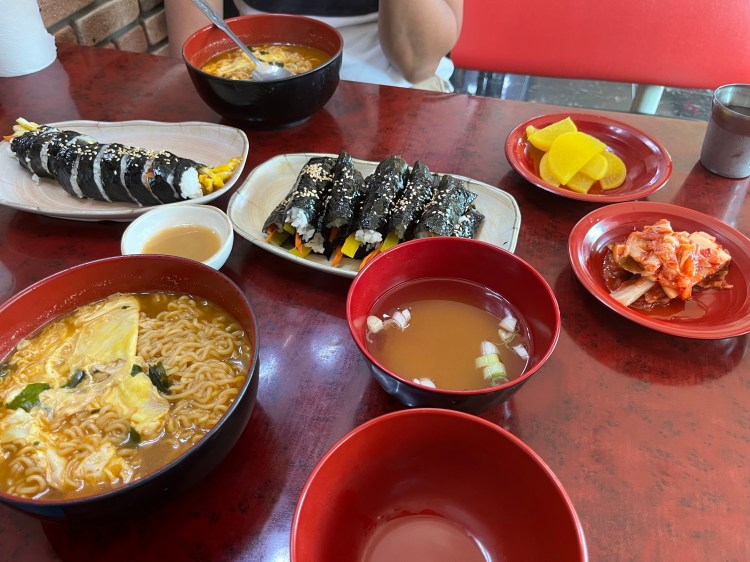
Lunch was our first priority – I’d bought a Toblerone at the station but it wasn’t enough.  BK drove us downtown to one of his favourite eating places and we tried our first kimbap, rice and vegetables wrapped in seaweed, along with noodles and sides.

Kimbap

Gyeongju was the capital of the Silla kingdom, which unified the three kingdoms of Korea in 57BC despite being the smallest of the three.  For unified, read conquered.  The kingdom lasted nearly 1,000 years before collapsing.

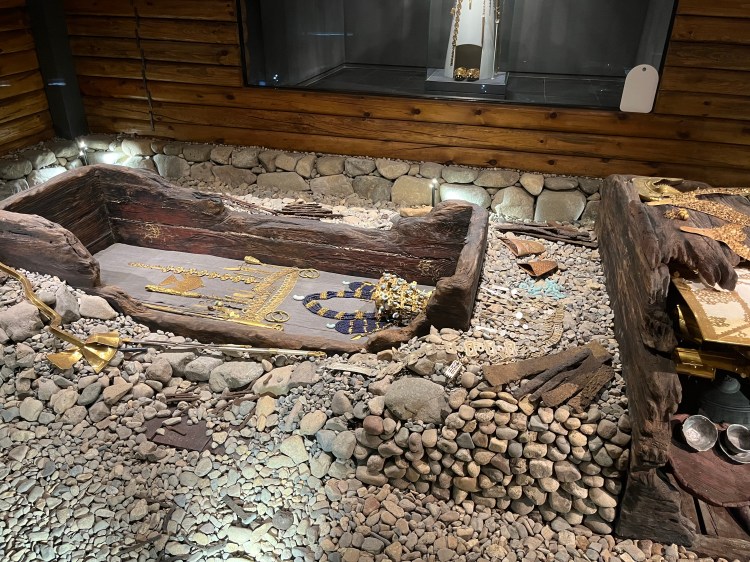
Wherever you look in Gyeongju there are burial mounds, 155 of them in total, most of which haven’t been uncovered.  The body was laid in a wooden coffin, fully dressed and with all the possessions needed in the afterlife, and then covered over.  After that, a wooden framework was added and filled with stones to make a great mound.  In some cases, a mound would be breached and a second body added next to it, making it look like a camel’s back.

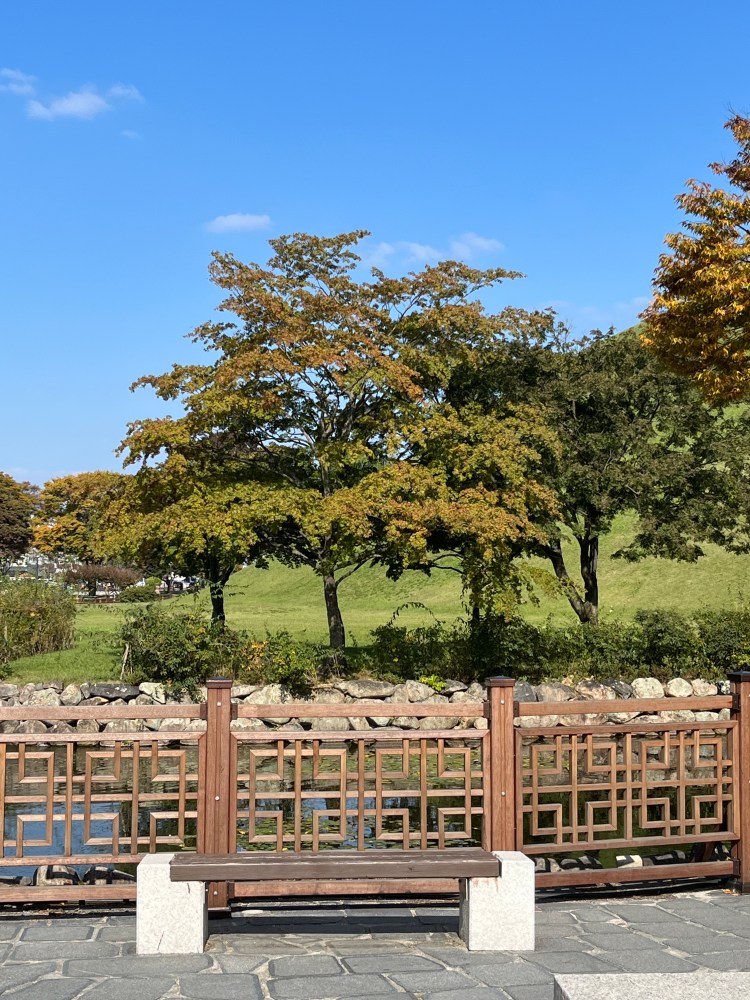
Autumn colours

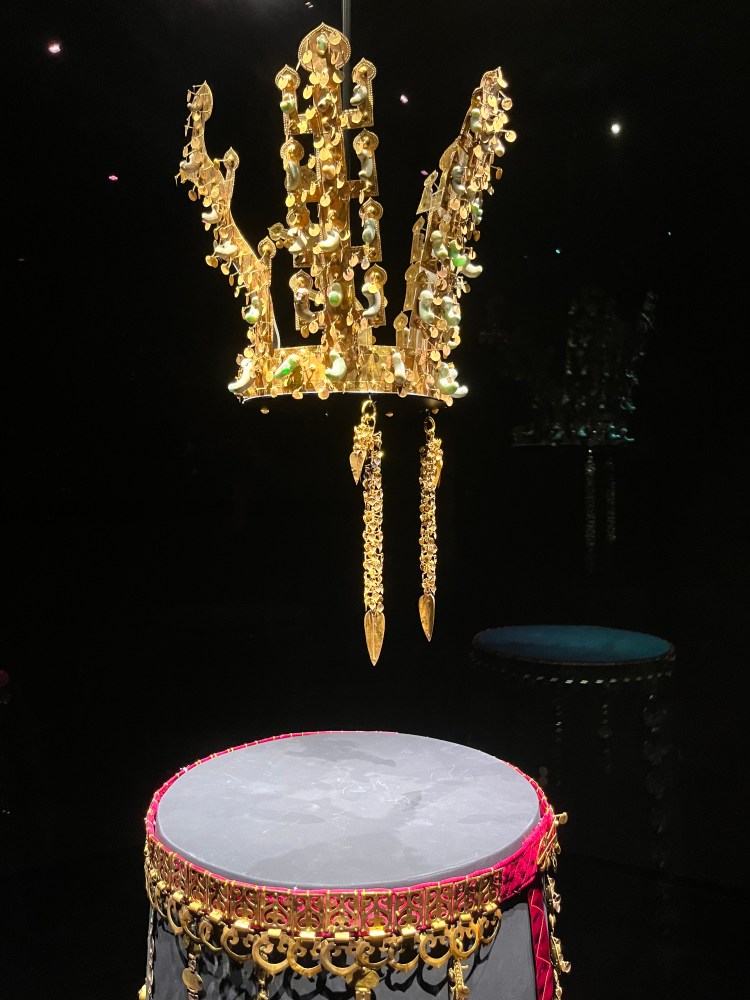
Only one tomb is open to the public and that was our next stop.  It is called the Flying Horse tomb because, among the artefacts found, was a “mud guard” decorated with a flying horse.  When the tomb was opened, they found all the artefacts laid out, but the body had disintegrated.  One of the key items was a crown, indicating that this was a king; to date six crowns have been discovered, one of them being a woman’s.

Flying Horse Tomb

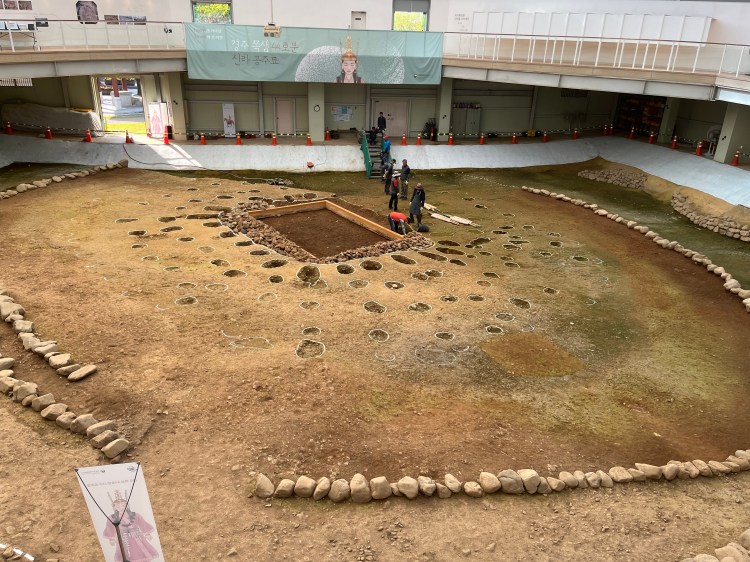
We then walked over to tomb 44, which is in the final stages of excavation.  This is thought to have been the tomb of a teenaged princess, and there’s evidence that mourning rituals were held on the anniversary of her death for nine years.

Tomb of a princess

Walking back to the car, BK introduced us to Hwangnam-ppang, a local speciality.  It is a small bread roll filled with red bean paste, straight from the oven.  We ate them so quickly that I forgot to take a photo!

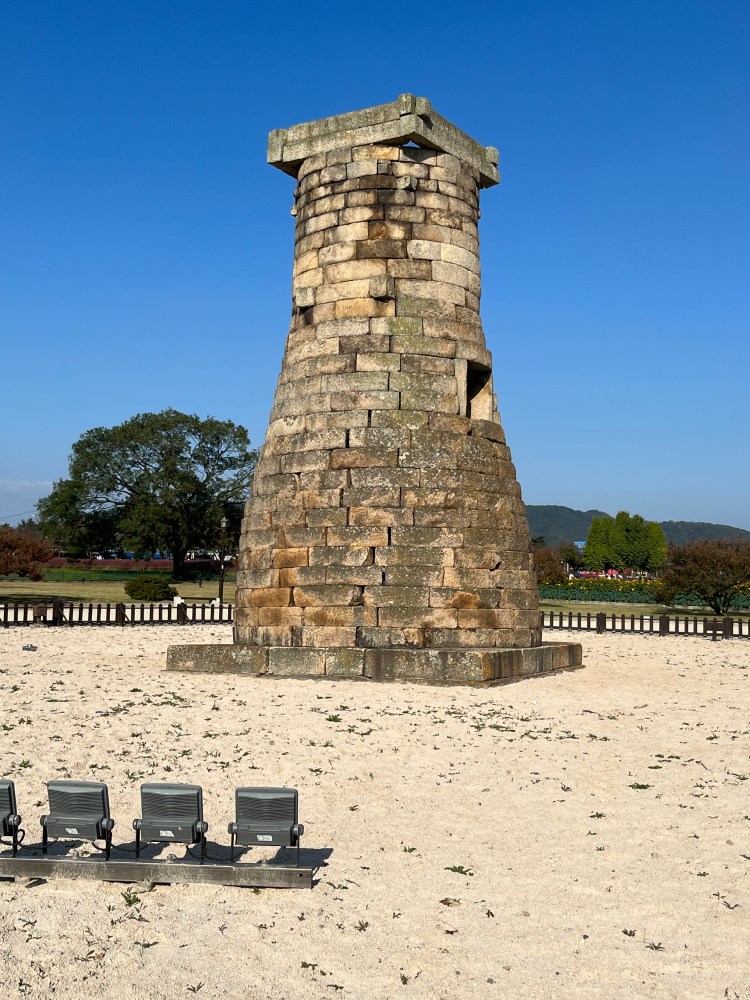
Next, we were off to see the Cheomseongdae tower, said to be the oldest astronomical observatory in Asia.  It is sited opposite the old royal palace, which has since disappeared. 

Cheomseongdae Tower

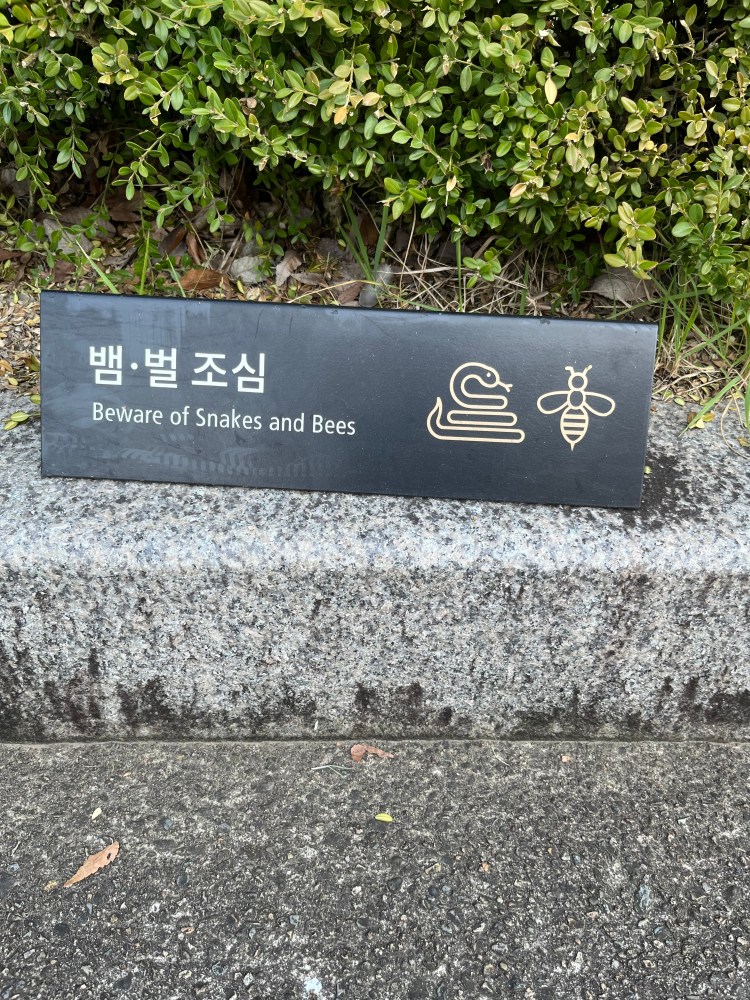
And it is in a park which features pink grass and a variety of other flowering plants. A lot of which have been trampled on by people who ignore the multilingual “Keep out” signs.

Pink grass

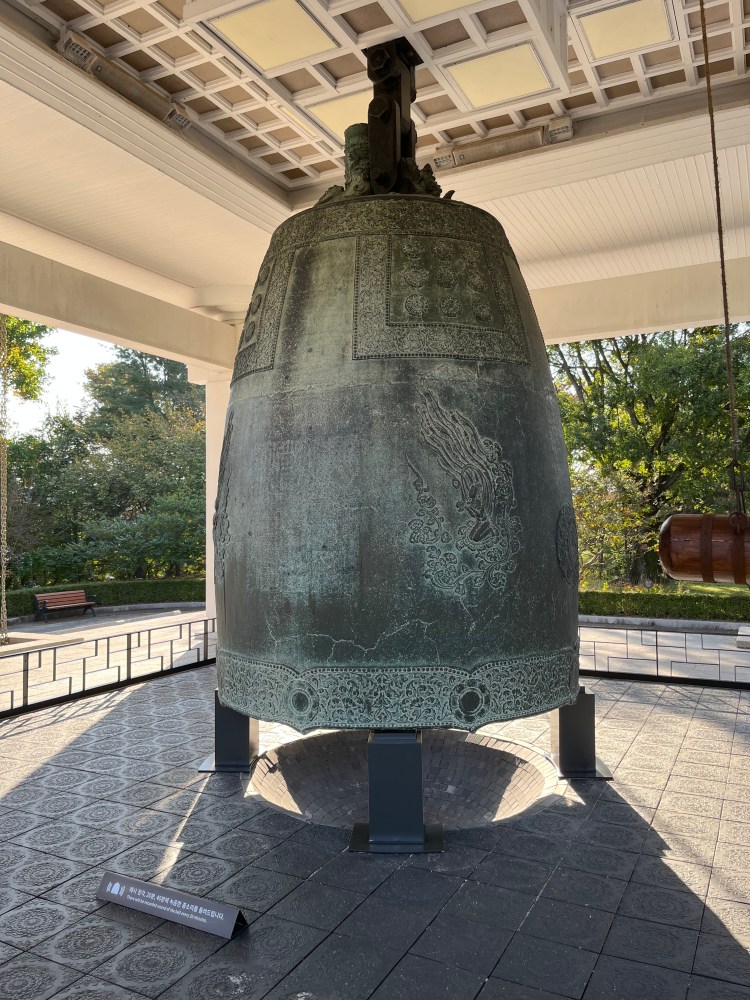
Back in the car, we drove to the national museum, in the grounds of which is the Sungdo dharma bell.  Created in 1771, it is the largest bell in Korea.  It sounds every 20 minutes, but only though a set of speakers!

Sungdo Dharma bell
Fortunately we didn’t see any

Inside, we had a quick history lesson on the Silla kingdom and then saw many of the original artefacts recovered from the various tombs, including the Flying Horse tomb.

Flying Horse artefacts
Female crown

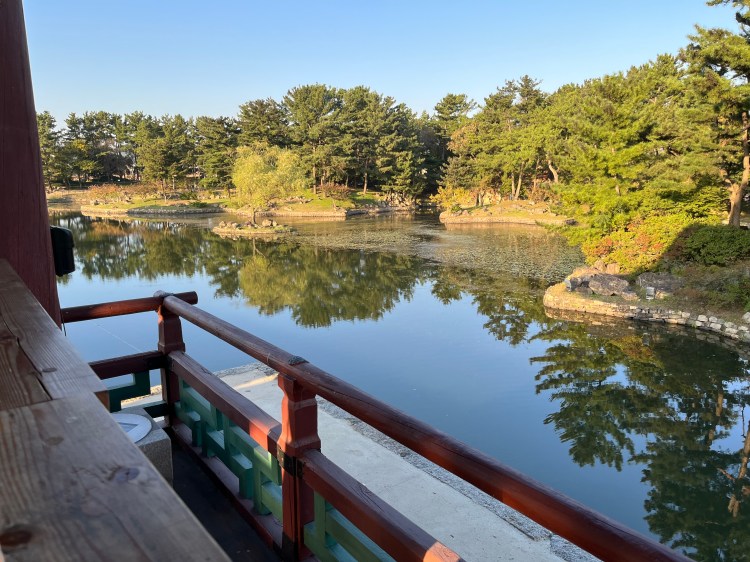
Also in the museum is a model of the Donggung Palace and Woji pond, built by King Munmu, the first Silla king.  Only three buildings remain of the palace, around the Woji pond.  Looking at the model from above, the pond and land around it look like the map of Korea, with Japan on one side and China on the other. The pond was dredged as part of the restoration in the 70s, and the museum contains several artefacts, including a boat.

We then went off to visit the Palace and pond themselves.

Woji Pond

It had been a very long day, so I didn’t get to finish writing about it.  Another post will be along soon!

Sightseeing Gangnam Style

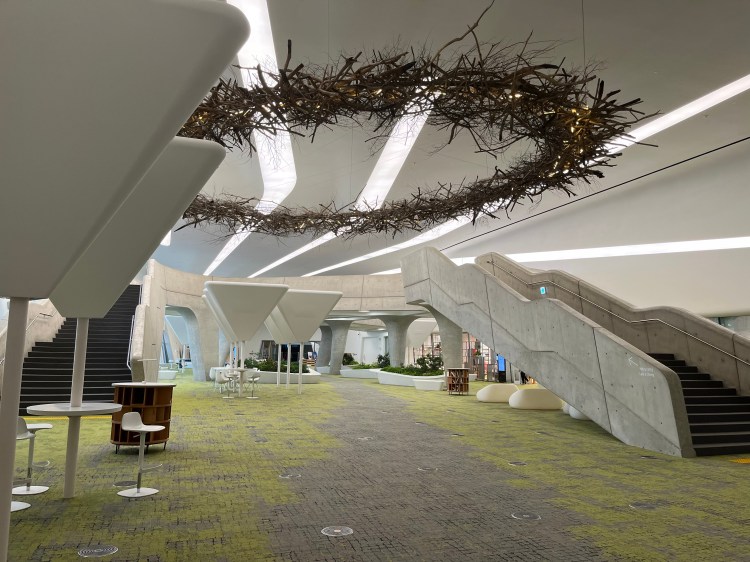
After yesterday’s miserable weather, the sun came out again today.  Henry picked us up and we set off for  the DDP, the Dongdaemun Design Plaza. There’s lot of information about the DDP on the internet, but it was designed by British-Iraqi architect Zaha Hadid and replaced a stadium built by the Japanese.  From the outside it looks like three gigantic mushrooms, but the inside is all swirls, angles and concrete.

DDP

Dongdaemun is the centre of Seoul’s fashion district and DDP contains all sorts of fashion and design exhibitions.  We particularly liked the twirling chairs in the rainforest.

Jungle room

From there we set out for Gangnam, which translates as South of the River.  As you cross the river Han, the first thing you notice is the huge 70s apartment blocks.  Then the ultra modern towers and malls and the road leading to the Olympic Park.

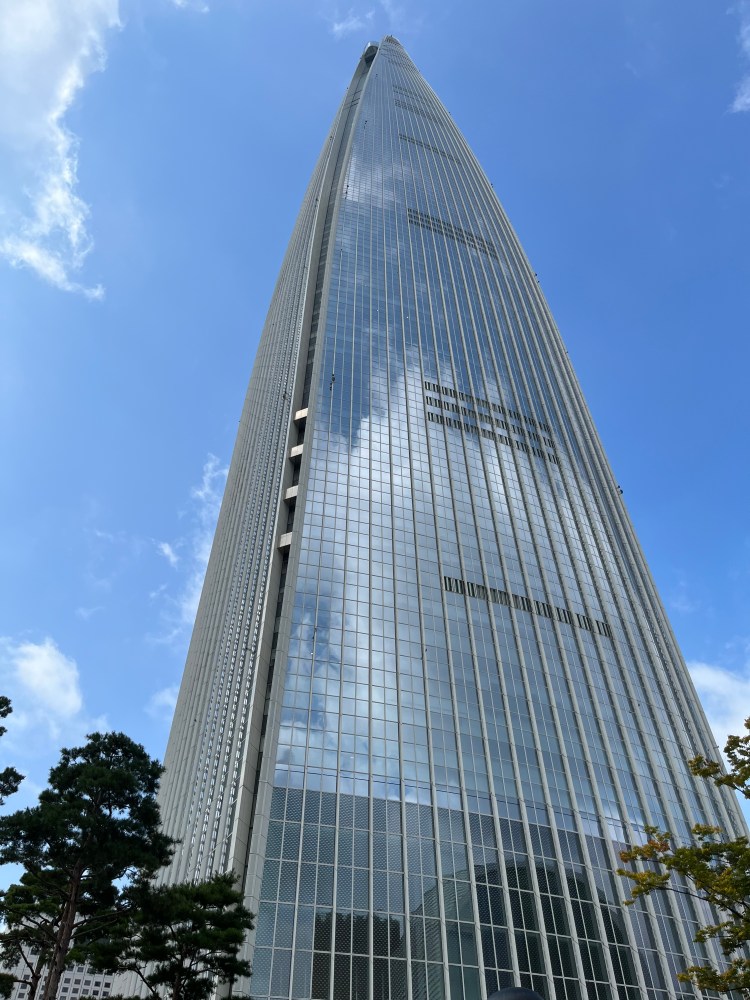
Our first stop was the Lotte World Tower, the tallest building in Seoul.  It looks like a cross between the Shard and the Gherkin, and at 555m is taller than both of them put together.  Below is the Lotte World Mall, and somewhere nearby the Lotteworld itself, Seoul’s answer to Disneyworld.

Lotte World Tower

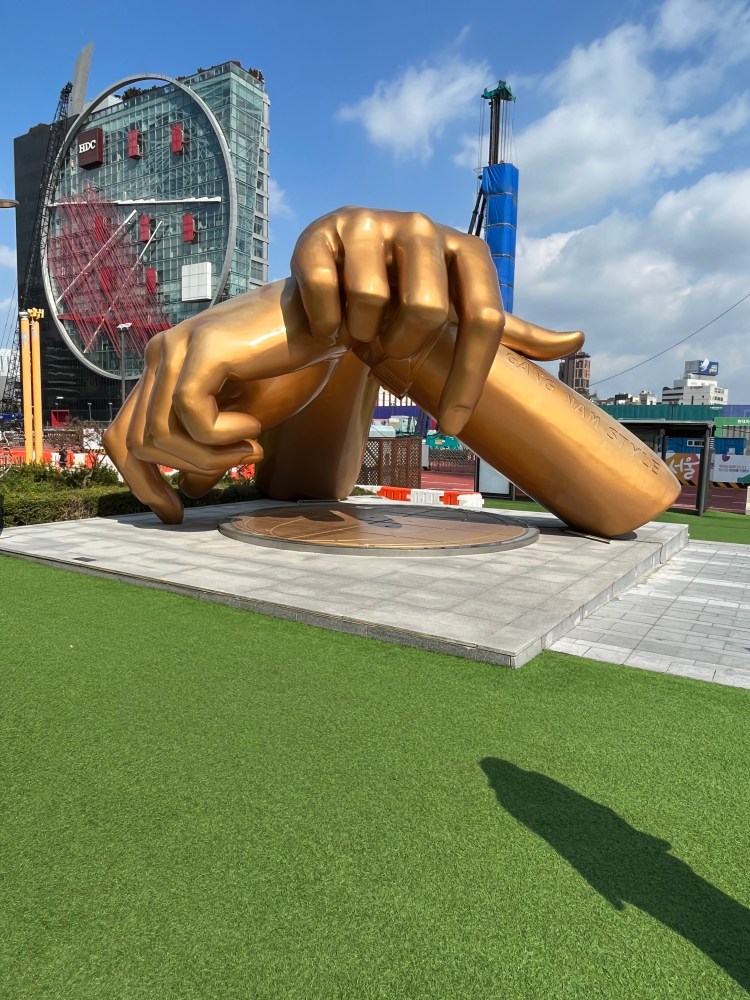
From there we went off to the Coex convention and exhibition centre and yet another huge mall.  We were here to see two shrines.  The first is a huge, golden Gangnam-style hand pose.  For some reason, it was surrounded by Italians.

Gangnam style

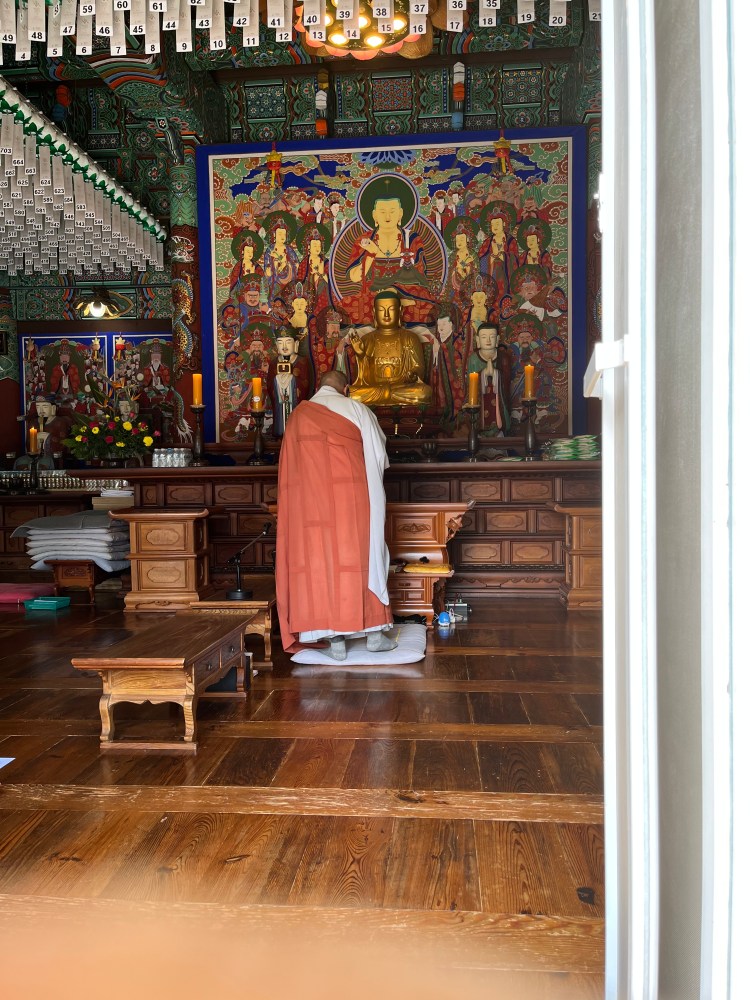
The second was Bonguensa, Korea’s oldest Buddhist temple, which dates back to 794.  It was totally packed with devotees.  As always, there are five gates leading up to the main temple building, behind which is a 75-foot tall statue of Buddha that looks out across the city.  I doubt if he thought he’d eventually be sited in one of the richest and materialistic places in the world.

Buddhist Temple

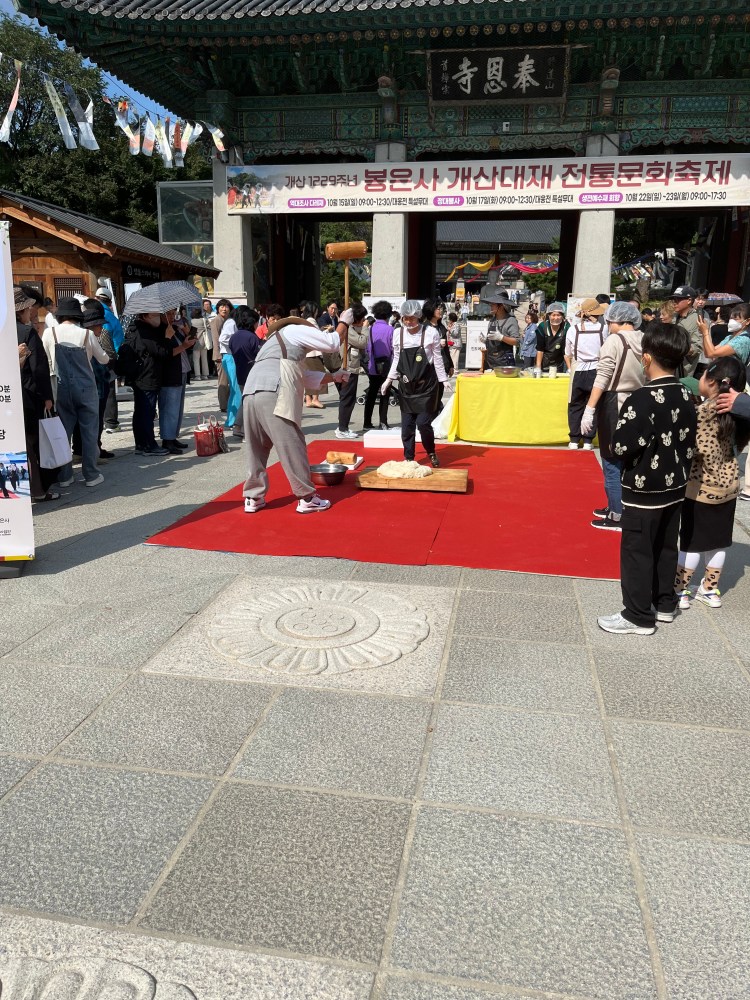
Just outside the first gate there was a huge queue of people waiting for rice cake which was being made right in front of them.  A guy with a rather large mallet was pounding the rice in front of the steps.

Pounding the rice

We went back to the mall and had  Bibimbap instead.

Bibimbap

Our final visit of the day was to Namsan, or Southern, mountain.  We had to leave the car parked at the foot of the mountain.  There is a path that winds up through a dense forest of maple and pine, which looks spectacular in the autumn.  We took the shuttle bus!

We were aiming to get there for three o’clock to see a cultural and martial arts exhibition.  As we arrived, a quartet of drummers were starting their performance.  This was followed by a bunch of tough-looking guys waving swords and pikes around in a way reminiscent of a bad Hollywood film.  I half expected Indiana Jones to turn up and shoot them!

Pretend warrior

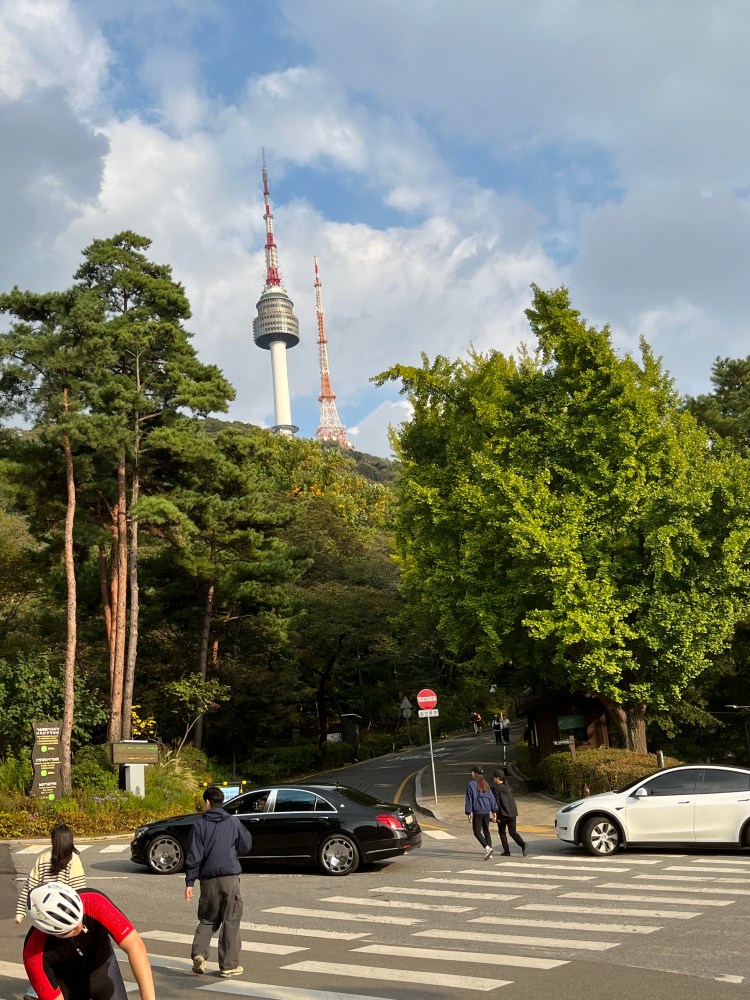
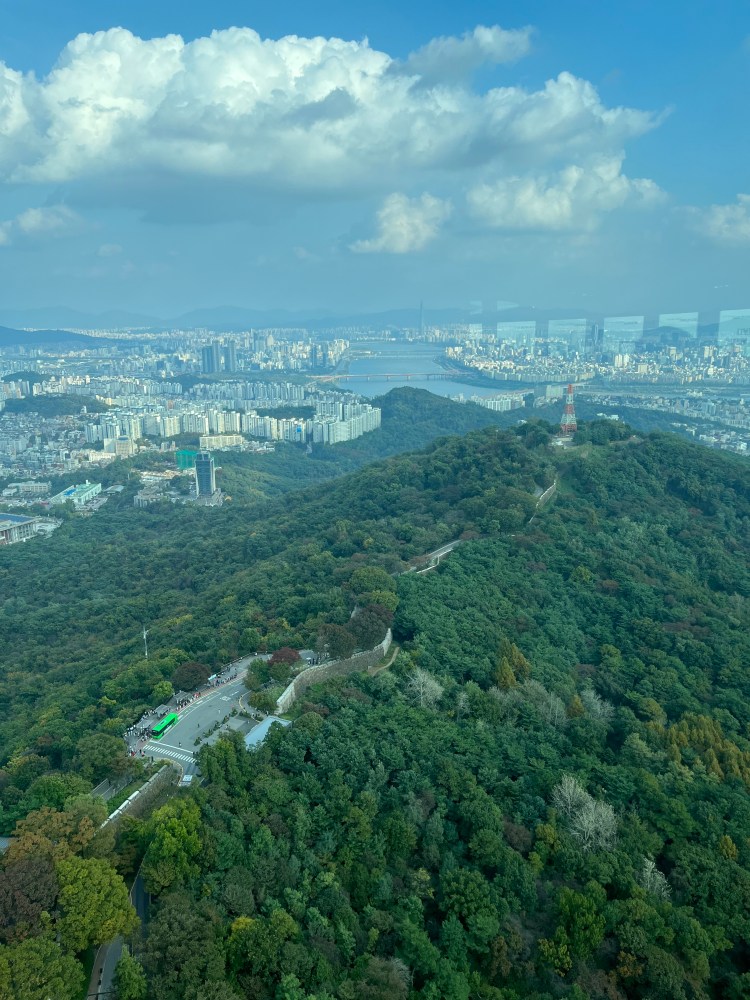
But the main event up here was the Seoul Tower, Seoul’s first radio tower and the second highest point in the city.  We’re were able – on payment of a small fee – to take a very disorienting lift up to the observation deck.  From there you get a great view of the city and some of the places we’d visited.

Seoul Tower and little brother
UK is that way

Then we discovered that the shuttle bus doesn’t go back to where we started!  It is a circular route with a start/end point where you have to change buses.  Diane and I went down on the bus, Henry walked back to the car and met us.

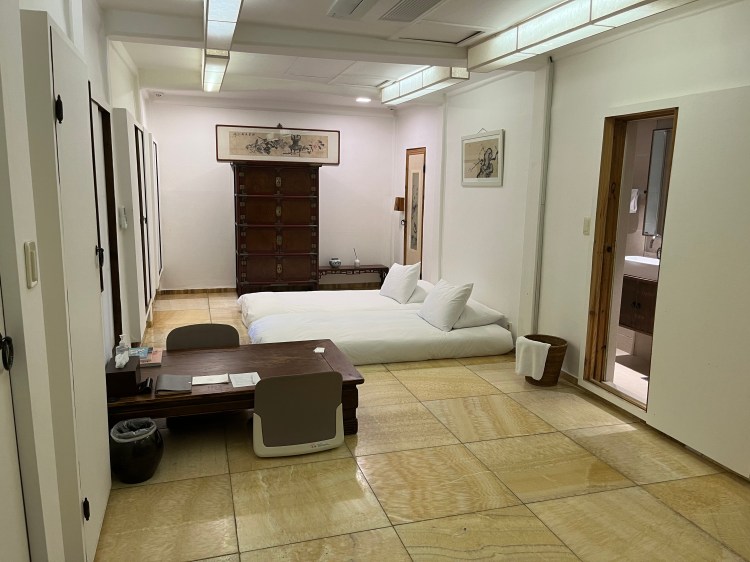
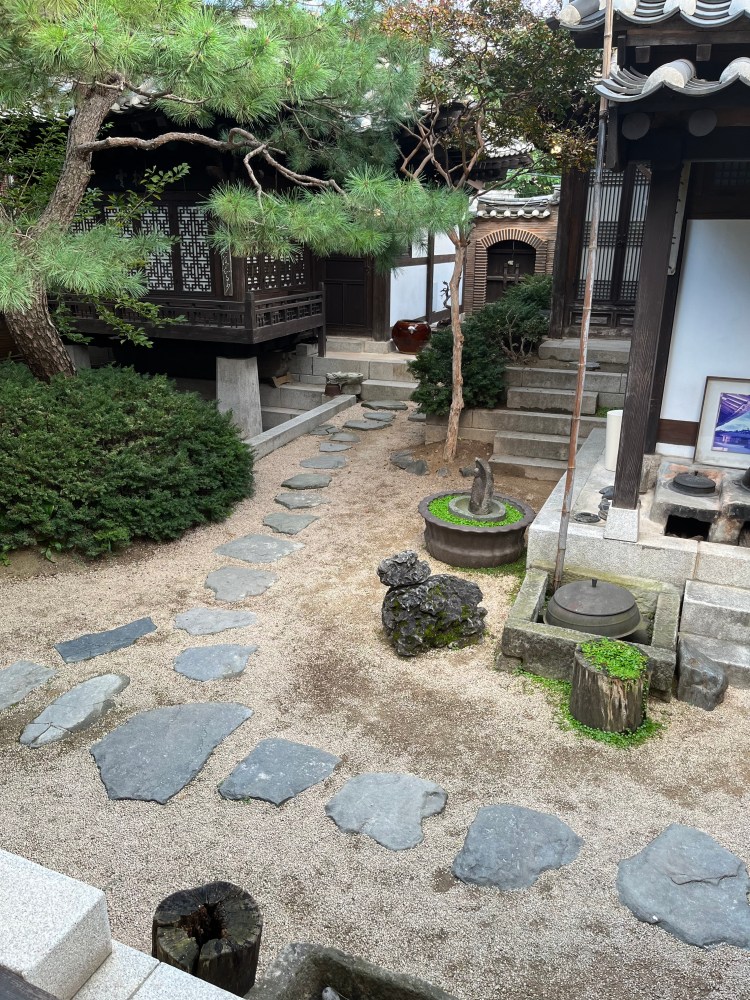
For our final night in Seoul, we were going to stay in a Hanok, one of Seoul’s traditional houses.  Henry drove us there and we said goodbye as we went through the gate and stepped back in time.  The Hanok is several small buildings grouped around a winding path.  As you can see from the photo, it is very basic, apart from the bathroom, sauna, underfloor heating and free wi-if.

Inside our room

They served us pumpkin tea while they told us about the place, which was once a resistance hideout from the Japanese, and took our order for breakfast.

Pumpkin tea and dried fruit

There are numerous restaurants nearby; the first one we came across was a Thai place, so we had a green curry and fell into our very low bed.

Hanok courtyard

And then it rained

We had a free day today and we’d planned to go to a traditional Gugak performance and visit a nearby art gallery. Unfortunately there were no tickets left for the performance.  So then we decided to see if the local tourist information place could help out or suggest a different option.  They couldn’t.

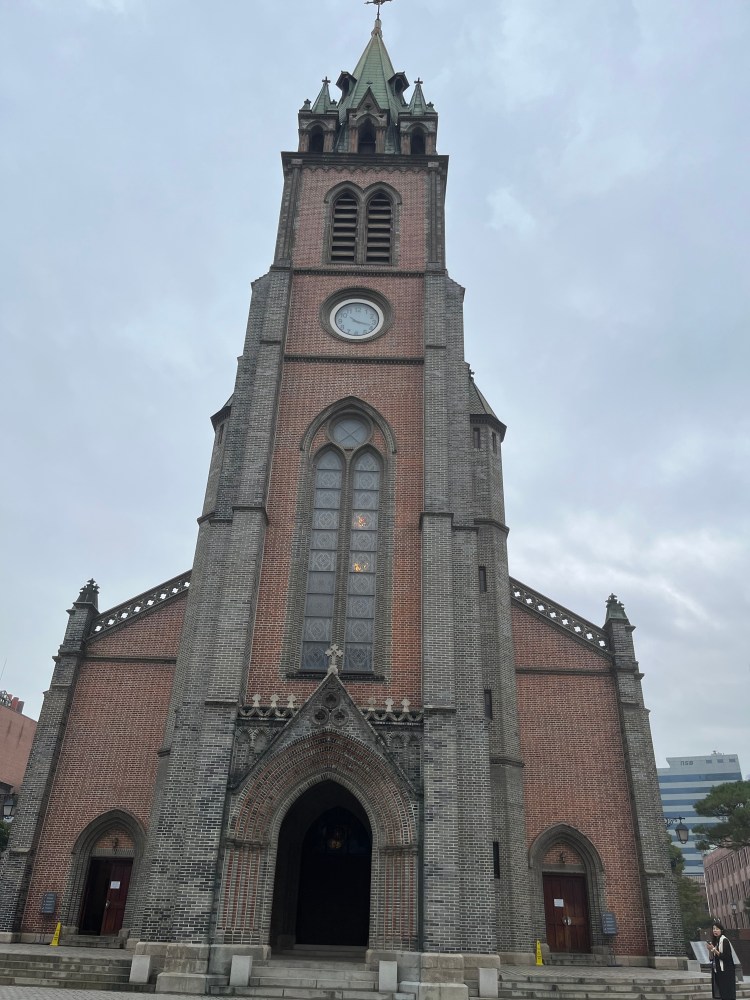
So we decided to go to the area anyway because we wanted to try out the subway system.  Unfortunately, it was raining.  We set out for the subway station and found a cathedral instead.  We wandered in, but there was a service in progress so we wandered out again.

Seoul Cathedral

The subway station was being rather elusive, but we found a little coffee house and the smell of pastries was too much to pass up.  We went in and were served by the slowest barista in the world! The aroma was coming from their croffles, so we just had to try one. It seems to be a croff between a croiffant and a waffle.

We still couldn’t find the subway station, but eventually found a large man.

He turned out to be guarding the entrance.

Large man guarding the subway entrance

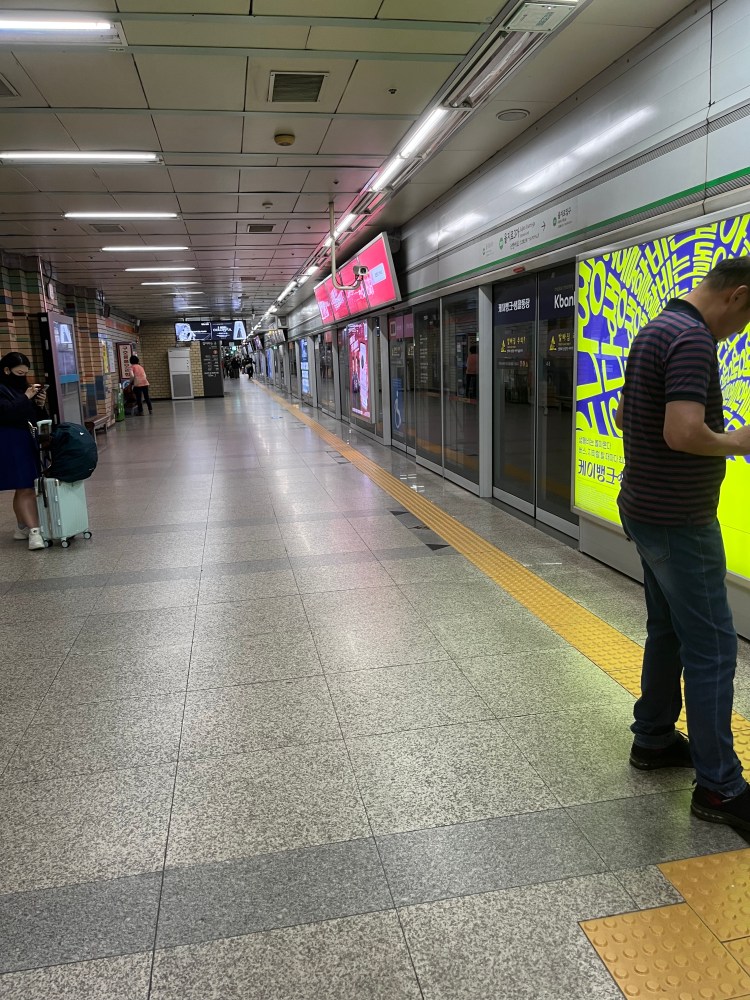
We broke out our T-money cards and tapped them in the appropriate place on the turnstile , said “open sesame” and we were in.  The platform was huge, as long as the Elizabeth line in London.  You know when the train is about to arrive, because a little fanfare plays on the PA system and someone says something unintelligible in three languages.

Looong platform

The train was quite crowded, and EVERYBODY was looking at their phone.  We only had to go one stop, from Euljiro to City Hall, so we got off when the train stopped.  And found ourselves in Euljiro!  It turns out that there are two stations, Euljiro 1 and Euljiro 3.  We’d managed to walk the wrong way in the morning and ended up at 3.  I’ve no idea why there isn’t a Euljiro 2.

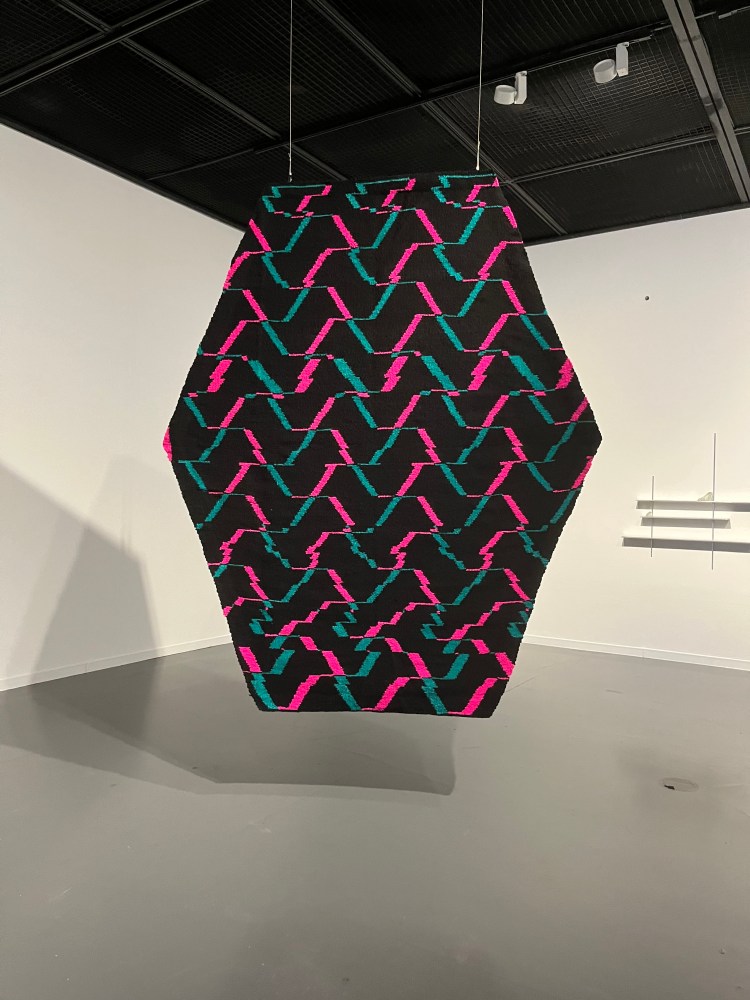
Anyway, we headed off into the rain looking for the Seoul museum of contemporary and modern art.  We did eventually find it, three floors of exhibition halls which prove that Seoul and Oxford have something in common; they both do pretentious art!

Modern “art” installation

It was still raining, so we headed back to the hotel, via another cook-it-yourself chicken dish and spent the rest of the day chilling.